
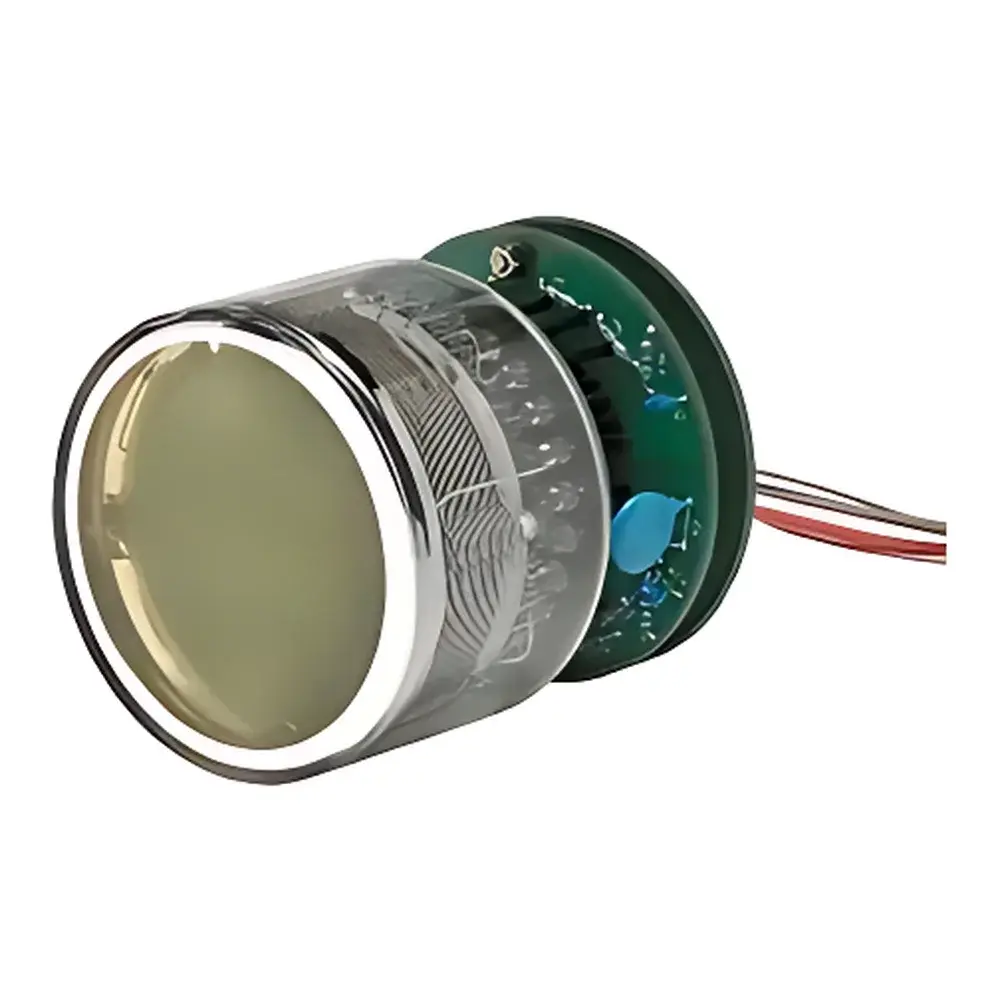
Hamamatsu Position-Sensitive Photomultiplier Tube (PMT) R2R3
| Brand | Hamamatsu |
|---|---|
| Origin | Japan |
| Manufacturer Type | Original Equipment Manufacturer (OEM) |
| Import Status | Imported |
| Model | R2R3 |
| Pricing | Upon Request |
Overview
The Hamamatsu Position-Sensitive Photomultiplier Tube (PMT) R2R3 is a vacuum photodetector engineered for high-spatial-resolution photon detection in demanding spectroscopic and analytical applications. Unlike conventional PMTs that integrate total photocurrent, the R2R3 implements resistive anode or multi-anode charge-division architecture to resolve the X–Y coordinates of individual photon events with sub-millimeter precision. Its operation relies on secondary electron multiplication through a dynode chain under high vacuum, coupled with position-encoded anode segmentation or resistive-layer readout—enabling real-time centroid calculation of scintillation light distributions. Designed for integration into UV–visible spectrometers, time-resolved fluorescence systems, and radiation imaging platforms, the R2R3 delivers exceptional single-photon sensitivity (< 1 photoelectron per incident photon at peak quantum efficiency), low dark count rates (< 100 cps at −20 °C), and nanosecond-level temporal response. It operates within a stable high-voltage range (typically −800 V to −1500 V) and maintains linearity over five decades of incident light intensity.
Key Features
- Position-sensitive detection with continuous X–Y coordinate resolution across the active photocathode area
- High quantum efficiency (> 25% at 420 nm) using bialkali (Sb-Rb-Cs) photocathode material
- Large effective photocathode diameter (76 mm for R2486-02; 132 mm for R3292-02 variants—R2R3 denotes platform family designation)
- Ultra-low dark current and thermally stabilized gain drift (< 0.05% / °C)
- Hermetically sealed borosilicate glass envelope with magnetic shielding option (available upon specification)
- Compatible with standard 14-pin or 16-pin base configurations supporting regulated high-voltage distribution
- Robust mechanical design compliant with IEC 61000-4 electromagnetic immunity standards
Sample Compatibility & Compliance
The R2R3 series supports direct coupling to scintillators (e.g., NaI(Tl), LYSO, BGO), phosphor screens, and fiber-optic tapers without optical degradation. Its spectral response (160–650 nm) aligns with common luminescent materials used in analytical chemistry and nuclear instrumentation. All units are manufactured in Hamamatsu’s ISO 9001-certified facilities in Japan and conform to JIS C 5401 (Photomultiplier Tubes – Standard Specifications). When integrated into GMP-regulated analytical workflows—such as USP UV–Vis spectrophotometer qualification or ASTM E275 for spectrophotometric system verification—the R2R3 satisfies traceable calibration requirements via NIST-traceable reference detectors. Its housing meets IP52 ingress protection for controlled laboratory environments and is compatible with Class 1000 cleanroom handling protocols.
Software & Data Management
Hamamatsu provides the optional PMT Measurement Software Suite (v4.x), which enables real-time centroid mapping, pulse-height analysis, and spatial histogram generation. The software supports USB 2.0 and Ethernet interfaces, outputs data in HDF5 and CSV formats, and integrates with LabVIEW™, MATLAB®, and Python (via PyHamamatsu API). Audit trails, user access control, and electronic signature support comply with FDA 21 CFR Part 11 requirements when deployed in regulated QC/QA laboratories. Raw event data streams include timestamped X/Y coordinates, amplitude, and pulse width—facilitating advanced post-processing such as coincidence filtering, trajectory reconstruction, and Monte Carlo-based signal deconvolution.
Applications
- Multi-channel spectroscopy in ICP-OES and LIBS systems requiring spatially resolved plasma emission mapping
- Time-of-flight mass spectrometry (TOF-MS) detector arrays for ion-induced secondary electron imaging
- Positron emission tomography (PET) prototype development and small-animal imaging benchtop systems
- Fluorescence correlation spectroscopy (FCS) and single-molecule Förster resonance energy transfer (smFRET)
- Environmental monitoring: airborne particulate matter characterization via laser-induced incandescence (LII)
- Plasma diagnostics in semiconductor process chambers using optical emission tomography (OET)
- Neutrino detection R&D infrastructure (e.g., water Cherenkov detector calibration subsystems)
FAQ
What is the difference between “position-sensitive” and “multi-anode” PMTs?
Position-sensitive PMTs use resistive anodes or charge-division networks to interpolate photon impact locations continuously, whereas multi-anode PMTs feature discrete pixelated anodes with fixed spatial binning.
Can the R2R3 be operated in photon-counting mode?
Yes—its low noise floor and high gain (> 1 × 10⁶) enable reliable single-photon counting with appropriate discriminators and TCSPC electronics.
Is magnetic shielding included as standard?
Magnetic shielding is optional; standard R2R3 units require external mu-metal enclosures in fields exceeding 0.1 mT.
Does Hamamatsu provide calibration certificates with NIST traceability?
Yes—certificates of calibration (including QE vs. wavelength, gain uniformity maps, and position linearity error profiles) are available upon request and meet ISO/IEC 17025 requirements.
What high-voltage power supply is recommended for stable operation?
Hamamatsu recommends the C9306 series or equivalent regulated supplies with ripple < 0.01% and programmable ramp control to prevent dynode damage during startup.
Related Products





