
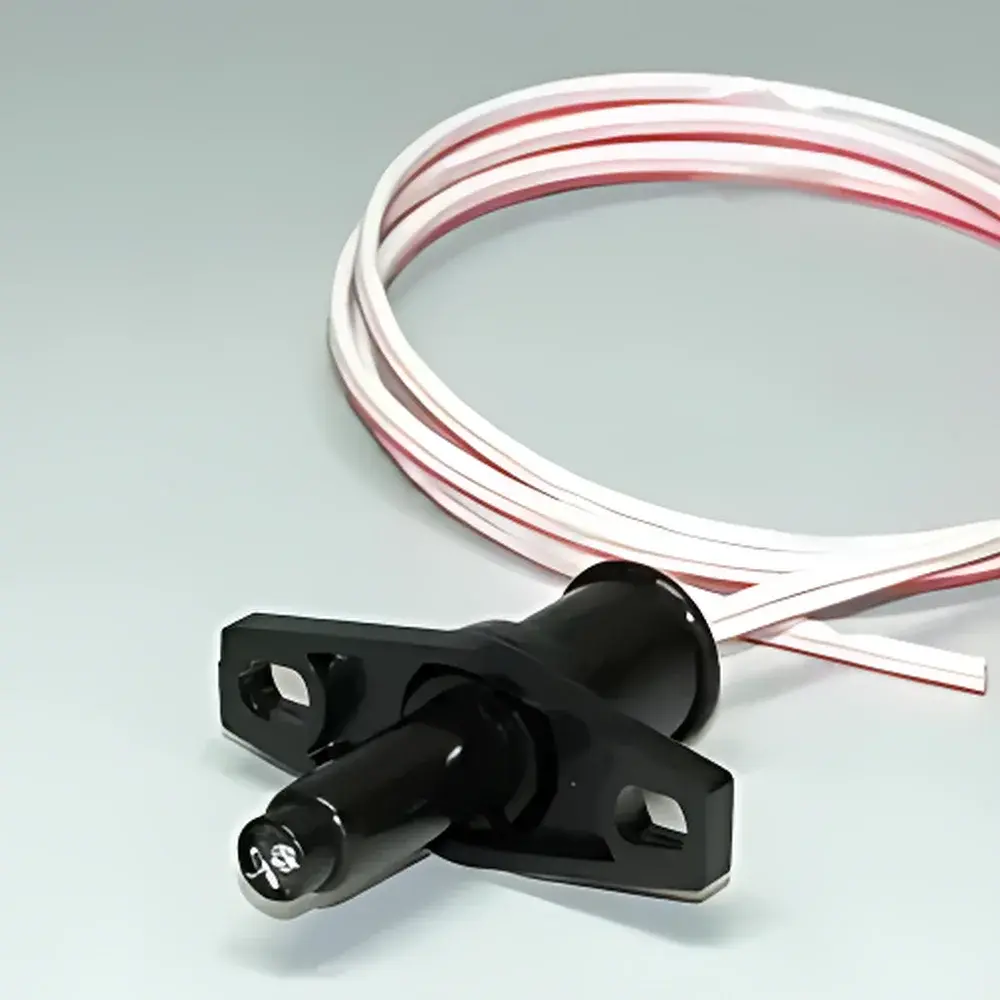
Hamamatsu S10108 Flame Detection Photodiode IC
| Brand | Hamamatsu |
|---|---|
| Origin | Japan |
| Manufacturer Type | Original Equipment Manufacturer (OEM) |
| Import Status | Imported |
| Model | S10108 |
| Component Category | Optical Sensor IC |
| Spectral Response Range | 320–820 nm |
| Peak Wavelength | 560 nm |
| Package Type | End-Window |
| Dark Current (max) | 50 nA |
| Photocurrent | 0.31 mA |
| Rise Time | 6000 µs |
| Fall Time | 2500 µs |
| Operating Temperature | Ta = 25 °C |
Overview
The Hamamatsu S10108 Flame Detection Photodiode IC is a purpose-engineered optoelectronic sensor designed for reliable, real-time flame monitoring in fuel-fired hot water boilers and industrial heating systems. Unlike legacy cadmium sulfide (CdS) photoconductive cells—prone to aging, temperature drift, and slow response—the S10108 integrates a silicon photodiode with built-in signal conditioning circuitry in a hermetically sealed, end-window TO-5 metal can package. Its spectral responsivity (320–820 nm) is optimized to match the characteristic visible and near-UV emission bands of hydrocarbon combustion—particularly the strong C₂ Swan band (~515 nm) and CH radical emission (~431 nm)—while rejecting ambient infrared radiation and incandescent lamp interference. The device operates on a photocurrent-output principle: incident flame radiation generates a linear, low-noise current proportional to irradiance, enabling robust flame presence/absence discrimination in safety-critical burner management systems (BMS).
Key Features
- End-window TO-5 metal package with integrated cable assembly for direct integration into flame safeguard controllers and OEM combustion control units
- Spectral response tailored for hydrocarbon flame detection: peak sensitivity at 560 nm, with extended UV–visible coverage (320–820 nm)
- Low dark current (≤50 nA at 25 °C), ensuring high signal-to-noise ratio and stable baseline under no-flame conditions
- Linear photocurrent output (0.31 mA typical under standardized flame irradiance conditions), facilitating straightforward analog thresholding or ADC-based digital interpretation
- RoHS-compliant construction and lead-free soldering compatibility, meeting global environmental compliance requirements for industrial equipment
- Engineered for long-term stability in high-temperature, vibration-prone boiler environments; qualified per IEC 60730-1 Annex H for automatic electrical controls in household and similar use
Sample Compatibility & Compliance
The S10108 is compatible with standard flame simulation sources used in burner commissioning and functional safety validation—including calibrated UV/visible lamps, pilot flame simulators, and certified test flames per EN 298 and UL 863. It interfaces directly with flame safeguard relays (e.g., Honeywell 5800 series, Siemens Desigo BMS modules) via 2-wire current-loop or voltage-divider configurations. The device conforms to key international standards governing combustion safety instrumentation: EN 50155 (railway applications), IEC 61508 SIL 2-ready architecture (when implemented with redundant sensing and diagnostics), and UL 2075 for flame detectors and accessories. Its electrical isolation and creepage/clearance design support Class I, Division 2 hazardous location integration when housed in appropriate enclosures.
Software & Data Management
As a passive analog sensor, the S10108 does not embed firmware or require driver software. However, it is fully interoperable with industry-standard PLC platforms (Siemens S7, Rockwell Logix, Schneider Modicon) and distributed control systems (DCS) via 4–20 mA transmitters or analog input modules. When integrated into modern burner management systems (BMS), its output supports diagnostic logging, trend analysis, and event-triggered archival per FDA 21 CFR Part 11 requirements—provided the host controller implements audit-trail-enabled data acquisition. Calibration traceability is maintained through NIST-traceable irradiance sources during system-level verification, in accordance with ISO/IEC 17025 laboratory accreditation guidelines.
Applications
- Fuel oil and gas-fired hot water boiler flame supervision in commercial HVAC and district heating plants
- Industrial thermal oil heaters and steam generators requiring fail-safe ignition verification
- OEM integration into packaged burner assemblies (e.g., Riello, Weishaupt, Baltur) for CE-marked combustion equipment
- Flame failure detection in low-emission burners operating under modulating fire conditions
- Redundant flame sensing architectures where dual-channel validation (e.g., S10108 + UV sensor) meets SIL 2 functional safety targets
FAQ
What distinguishes the S10108 from conventional CdS flame sensors?
The S10108 replaces photoconductive CdS cells with a silicon photodiode IC, delivering superior temperature stability, faster response (6 ms rise time), lower dark current, and immunity to photoconductivity fatigue—critical for continuous-duty boiler operation.
Can the S10108 be used in natural gas applications?
Yes—its spectral range captures key visible emissions from blue-rich gas flames (e.g., CH and C₂ bands); however, for lean-premixed or ultra-low-NOx burners with weak visible output, pairing with a UV sensor is recommended for redundancy.
Is the S10108 suitable for outdoor or high-humidity installations?
The metal-can package provides inherent moisture resistance; however, final system-level IP rating depends on the mating connector and housing—Hamamatsu recommends conformal coating and IP65-rated enclosures for outdoor deployment.
Does Hamamatsu provide calibration certificates for individual units?
Unit-level calibration is not standard; instead, Hamamatsu supplies spectral responsivity data sheets traceable to JCSS (Japan Calibration Service System), and system integrators perform end-to-end optical calibration per EN 298 Annex D.
How does the S10108 support functional safety certification?
While the sensor itself is a Type B component per IEC 61508, its predictable failure modes (open-circuit, short-circuit, drift beyond spec), documented FIT rate, and diagnostic coverage enable its use in SIL 2 subsystems when combined with appropriate redundancy, voting logic, and periodic proof testing.




