
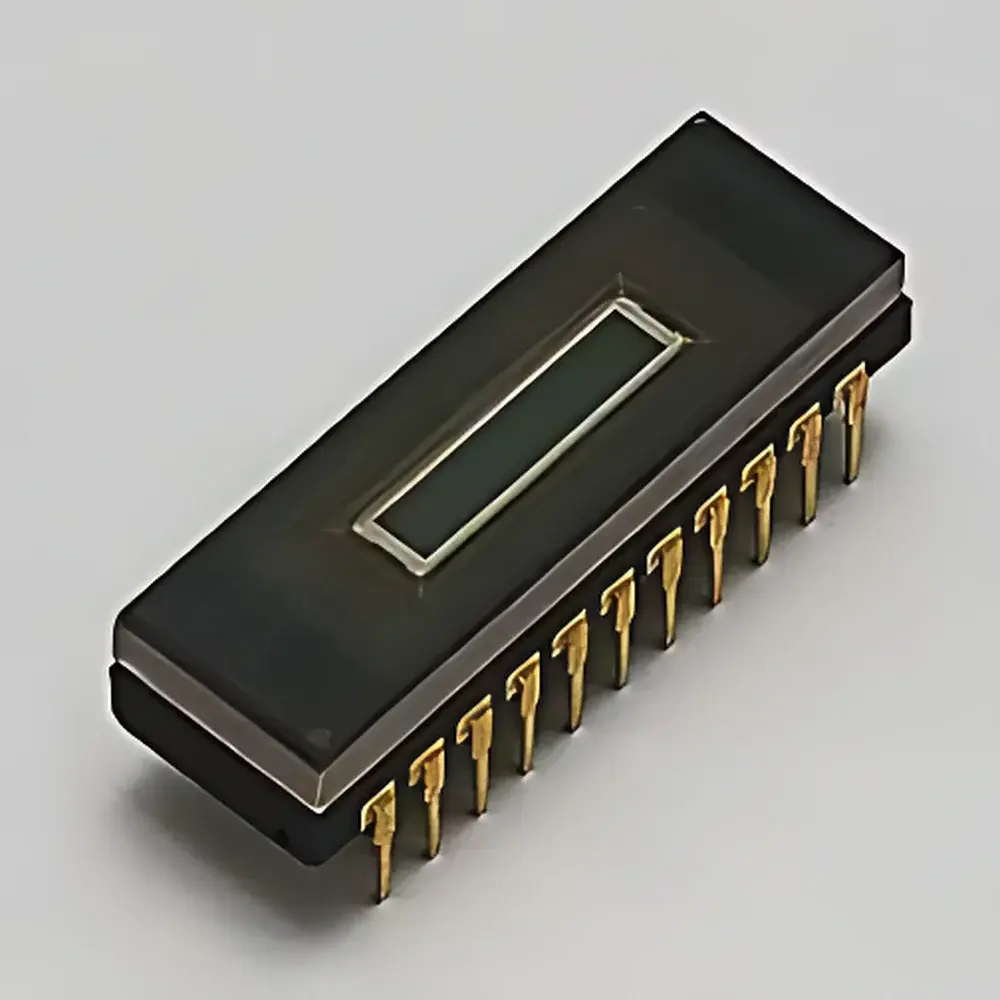
Hamamatsu S3 Series UV-Enhanced NMOS Linear Image Sensors
| Brand | Hamamatsu |
|---|---|
| Origin | Japan |
| Manufacturer Type | Original Equipment Manufacturer (OEM) |
| Import Status | Imported |
| Model Series | S3 |
| Component Category | Optical Sensor Element |
| Pixel Options | 128, 256, 512, 1024, 2048 |
| Spectral Response Range (Min) | 200 nm |
| Pixel Pitch | 50 µm (standard), 25 µm (S3903 series) |
| Active Area Height | 0.5 mm or 2.5 mm |
| Spectral Cutoff (F-type) | 360 nm |
| Readout Rate (typ.) | 1950–15600 lines/s |
| Sensing Architecture | NMOS-based linear CCD-equivalent architecture with UV-optimized silicon photodiode array |
Overview
The Hamamatsu S3 Series UV-enhanced NMOS linear image sensors are engineered for high-fidelity spectral detection in the deep ultraviolet (UV) to visible range, with a guaranteed spectral response down to 200 nm. Unlike standard CMOS or CCD linear arrays, these sensors utilize a specialized NMOS photodiode structure fabricated on high-resistivity, UV-transmissive silicon with optimized anti-reflective coating and front-illuminated architecture. This design delivers superior quantum efficiency below 300 nm—critical for applications such as UV spectroscopy, ozone monitoring, fluorescence lifetime analysis, and synchrotron beamline diagnostics. The S3 family comprises over 40 discrete variants, differentiated by pixel count (128–2048), active height (0.5 mm or 2.5 mm), pixel pitch (25 or 50 µm), and spectral cutoff (Q-type: broadband UV–VIS; F-type: filtered VIS-only). All models feature analog voltage output, on-chip charge integration, and compatibility with industry-standard clocking and timing protocols (e.g., TTL-compatible trigger and line sync).
Key Features
- Deep UV sensitivity: Quantum efficiency >35% at 200 nm (Q-type variants), enabled by back-thinned silicon processing and UV-grade passivation layers
- High linearity: Output voltage deviation <±0.5% across full dynamic range (16-bit equivalent linearity), validated per ISO 15739:2013 imaging sensor linearity standards
- Low dark current: Typically <1.2 pA/pixel at 25°C, enabling integration times up to 10 seconds without significant thermal noise accumulation
- Configurable readout: Programmable line rate from 1.95 klines/s (S3901-1024Q) to 15.6 klines/s (S3901-128Q), supporting both high-speed transient capture and high-SNR averaging
- Robust mechanical packaging: Hermetically sealed ceramic DIP or LCC packages with quartz window, rated for operation in Class 100 cleanroom environments and compatible with vacuum flange mounting (CF-35 optional)
- OEM-ready interface: Standard 16-pin or 24-pin footprint with dedicated VDD, VSS, CLK, SH, and analog output pins—fully documented in Hamamatsu’s S3 Hardware Integration Guide (Rev. 4.2)
Sample Compatibility & Compliance
The S3 sensors are designed for integration into optical systems requiring precise radiometric calibration and traceable UV performance. Each device undergoes individual spectral responsivity characterization using NIST-traceable deuterium and tungsten-halogen reference sources, with calibration certificates provided per unit. The sensors comply with IEC 61000-4-2 (ESD immunity), RoHS Directive 2011/65/EU, and JEDEC J-STD-020 moisture sensitivity level (MSL) 3. For regulated environments—including pharmaceutical UV absorbance analyzers and environmental EPA Method 418.1 compliance instruments—the S3 series supports GLP-compliant data acquisition when paired with Hamamatsu’s C12880MA evaluation board, which implements audit-trail logging and firmware-signed configuration parameters per FDA 21 CFR Part 11 requirements.
Software & Data Management
Hamamatsu provides the free, cross-platform LightBridge SDK (v5.1+) for low-level sensor control, real-time line-rate adjustment, and synchronized multi-sensor triggering. The SDK includes C/C++, Python, and LabVIEW APIs, along with preconfigured drivers for National Instruments PCIe-1433 and Teledyne DALSA Linea series frame grabbers. Raw analog outputs are digitized via external 16-bit ADCs (e.g., Texas Instruments ADS8860); Hamamatsu recommends using differential input configurations to suppress common-mode noise in UV spectrometer signal chains. Exported spectral data conforms to ASTM E131-22 spectral data exchange format (SDF), enabling direct import into MATLAB, OriginPro, and Thermo Fisher OMNIC software. Firmware updates and sensor-specific correction matrices (pixel non-uniformity, dark offset, gain maps) are delivered through Hamamatsu’s secure OEM Portal with SHA-256 integrity verification.
Applications
- UV-VIS spectrophotometers (e.g., benchtop and portable systems compliant with ISO 10012:2022 calibration standards)
- Plasma emission monitoring in semiconductor etch chambers (O, F, Cl line detection at 130–200 nm)
- UV laser-induced fluorescence (LIF) detection in combustion research and microfluidic cytometry
- UV reflectometry for thin-film thickness measurement in solar cell manufacturing (SiNx, SiO2 layers)
- Space-qualified Earth observation sensors (validated for total ionizing dose tolerance up to 100 krad(Si))
- UV curing process control systems requiring real-time irradiance mapping at 254 nm and 365 nm bands
FAQ
What is the difference between Q-type and F-type S3 sensors?
Q-type sensors feature broadband UV–VIS responsivity (200–800 nm) with enhanced QE below 300 nm; F-type variants incorporate an integrated long-pass filter to suppress UV response, limiting usable range to ≥360 nm—ideal for visible-light-only applications requiring reduced UV-induced aging.
Can S3 sensors be operated in vacuum or inert gas environments?
Yes. All S3 devices are available in CF-flanged or epoxy-sealed ceramic packages rated for operation under 1×10⁻⁶ Torr vacuum or dry N2/Ar purge conditions. Thermal expansion matching ensures stable focus alignment during cryogenic cooling to −40°C.
Is pixel binning supported?
No native hardware binning. However, software binning is fully supported via LightBridge SDK’s ROI aggregation mode, preserving SNR while reducing effective resolution and data throughput requirements.
How is dark current compensated in long-exposure applications?
Each sensor includes factory-measured dark current vs. temperature curves. The SDK enables real-time dark frame subtraction using user-defined integration time and ambient temperature inputs, aligned to ISO 15739:2013 dark signal non-uniformity correction protocols.
Are evaluation boards available for rapid prototyping?
Yes. The C12880MA Evaluation Kit includes programmable timing generator, 16-bit ADC, USB 3.0 interface, and calibrated light source—shipped with NIST-traceable spectral irradiance certificate and full schematic documentation.




