
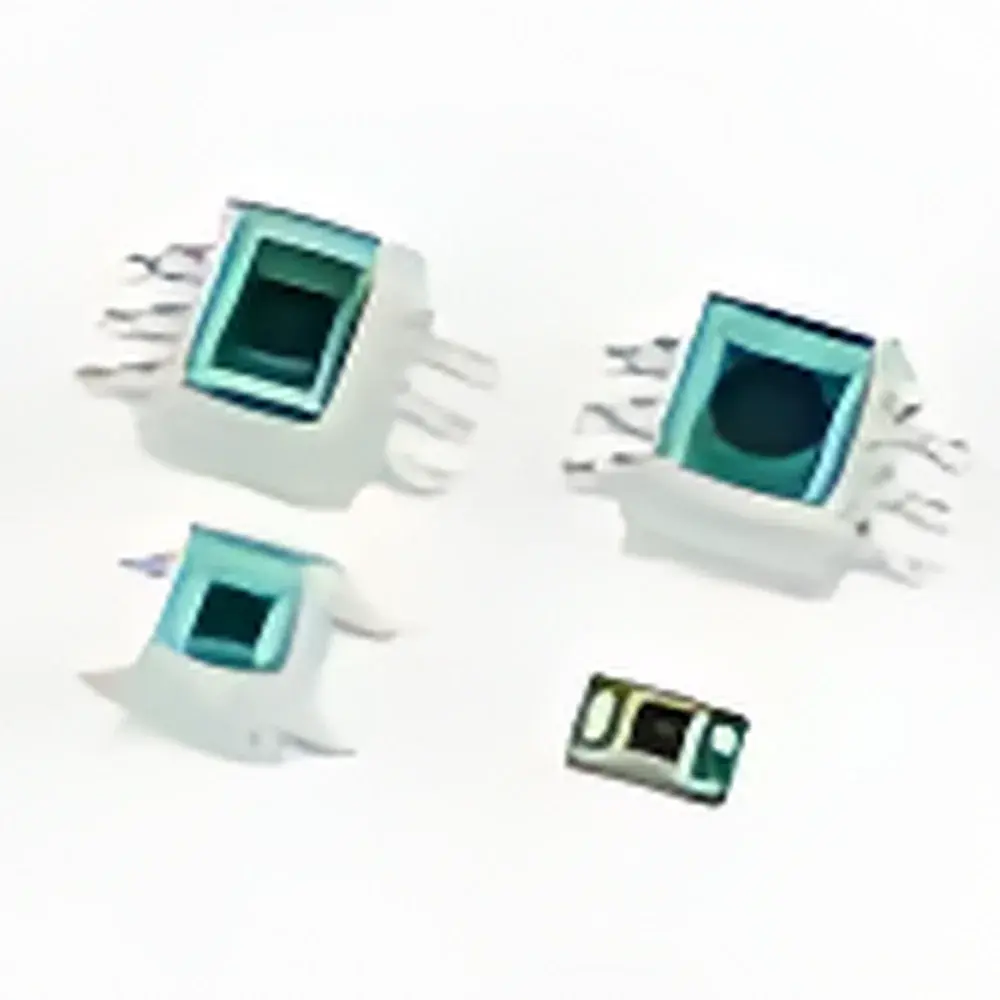
Hamamatsu S910 RGB Color Sensor
| Brand | Hamamatsu |
|---|---|
| Origin | Japan |
| Manufacturer Type | Original Equipment Manufacturer (OEM) |
| Import Status | Imported |
| Model | S910 |
| Component Category | Optical Component |
| Package Type | Plastic Molded Housing |
| Photodiode Configuration | Triple-channel (R, G, B) Silicon Photodiodes |
| Spectral Response (Typ.) | Blue Channel: 400–540 nm |
| Green Channel | 480–600 nm |
| Red Channel | 590–720 nm |
| Active Area | 1.0 × 1.0 mm² |
| Interface | Analog Output (Voltage or Current Proportional to Illuminance per Channel) |
| Operating Temperature | −10 °C to +60 °C |
| Storage Temperature | −40 °C to +85 °C |
Overview
The Hamamatsu S910 RGB Color Sensor is a precision silicon-based optical component engineered for quantitative tristimulus color measurement in laboratory, industrial, and embedded optical systems. Based on the CIE 1931 color matching functions’ spectral weighting approximation, the device integrates three monolithically aligned photodiodes—each optimized with distinct spectral responsivity profiles—to simultaneously capture radiant flux within the blue (400–540 nm), green (480–600 nm), and red (590–720 nm) bands of the visible spectrum. Unlike broad-spectrum photometers, the S910 employs spectrally selective filtering directly integrated into the plastic package, minimizing crosstalk and enabling stable chromaticity coordinate derivation (e.g., CIE x, y or u’, v’) when paired with calibrated signal conditioning circuitry. Its compact 1.0 × 1.0 mm² active area and low dark current (<10 pA at 25 °C) support high signal-to-noise ratio operation under low-irradiance conditions typical in optical bench setups, spectral calibration workflows, and reflectance/transmittance characterization systems.
Key Features
- Triple-channel silicon photodiode array with factory-matched responsivity curves for reproducible RGB separation
- Integrated interference-type bandpass filters deposited directly on die surface to suppress out-of-band response and reduce inter-channel leakage
- Plastic molded TO-can package offering mechanical robustness, thermal stability, and compatibility with standard SMT reflow processes
- Linear analog output per channel (voltage or current mode configurable via external bias network), facilitating direct integration with data acquisition systems compliant with IEEE 1057 or IEC 61000-4-3
- Specified operating temperature range of −10 °C to +60 °C ensures performance consistency across environmental test chambers and optical metrology enclosures
- No internal ADC or digital interface—designed for traceable analog signal chain implementation per ISO/IEC 17025 calibration requirements
Sample Compatibility & Compliance
The S910 is intended for use with collimated or diffused light sources meeting CIE Standard Illuminant A, D65, or custom spectral power distributions. It is routinely deployed in optical laboratories for measuring color coordinates of reflective standards (e.g., NIST-traceable ceramic tiles), transmissive filters, LED emission spectra, and liquid dye solutions. The sensor complies with RoHS Directive 2011/65/EU and REACH Regulation (EC) No. 1907/2006. While not certified as a medical device or safety-critical component, its design adheres to IEC 61000-6-2 (immunity) and IEC 61000-6-3 (emission) for industrial environments. Calibration documentation—including spectral responsivity tables referenced to NIST SRM 2020—can be supplied upon request to support GLP-compliant validation protocols.
Software & Data Management
As an analog front-end component, the S910 does not include embedded firmware or native USB/USB-C connectivity. Integration requires external signal conditioning (e.g., transimpedance amplification, offset trimming, temperature compensation) followed by digitization using a minimum 16-bit SAR ADC sampling at ≥1 kS/s per channel. Compatible software ecosystems include MATLAB® with Data Acquisition Toolbox, LabVIEW™ with NI-DAQmx drivers, and Python-based pipelines using PyVISA and NumPy for chromaticity transformation (e.g., XYZ → sRGB via 3×3 matrix multiplication with gamma correction). All raw voltage-time series data may be archived in HDF5 format to satisfy FDA 21 CFR Part 11 audit trail requirements when used in regulated QC/QA environments.
Applications
- Colorimetric validation of display panels (LCD, OLED, microLED) in R&D optical test benches
- In-line spectral monitoring of pigment dispersion homogeneity in pharmaceutical coating processes
- Reference-grade calibration of consumer-grade colorimeters using secondary standard transfer methodology
- Multi-angle goniophotometric analysis of retroreflective materials per ASTM E808 and EN 1436
- Development of closed-loop feedback systems for tunable white LED drivers requiring real-time CCT (Correlated Color Temperature) stabilization
- Teaching modules in undergraduate optics labs covering photometry, color science fundamentals, and sensor system noise analysis
FAQ
Is the S910 suitable for absolute radiometric measurements?
No—it is designed for relative colorimetry. Absolute irradiance quantification requires traceable calibration against a primary standard (e.g., NIST-calibrated photodiode) and knowledge of optical geometry.
Can the S910 be used underwater or in high-humidity environments?
Not without hermetic sealing; the plastic package is rated IP42 only. For immersion applications, consider Hamamatsu’s glass-hermetic S11059 series with optional quartz window.
Does Hamamatsu provide spectral responsivity data for individual units?
Yes—unit-specific spectral response curves (±1.5% tolerance) are available in CSV format upon request for metrological traceability.
What is the maximum permissible incident irradiance before saturation?
Saturation occurs at approximately 100 µW/cm² per channel under typical 5 V bias; exact threshold depends on load resistance and amplifier gain configuration.
Is there a recommended evaluation board for rapid prototyping?
Hamamatsu offers the C12880MA evaluation module, which includes matched TIA stages, temperature sensor, and Arduino-compatible header pins for immediate analog signal characterization.






