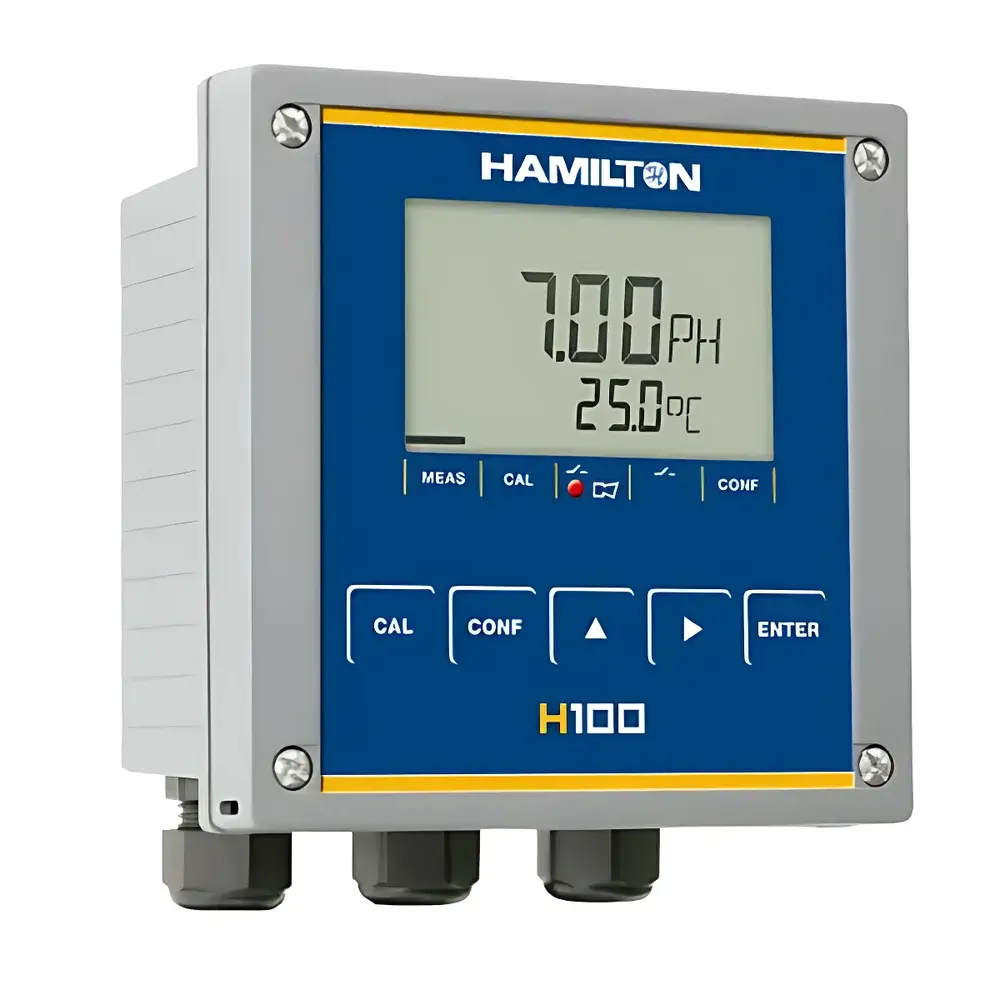
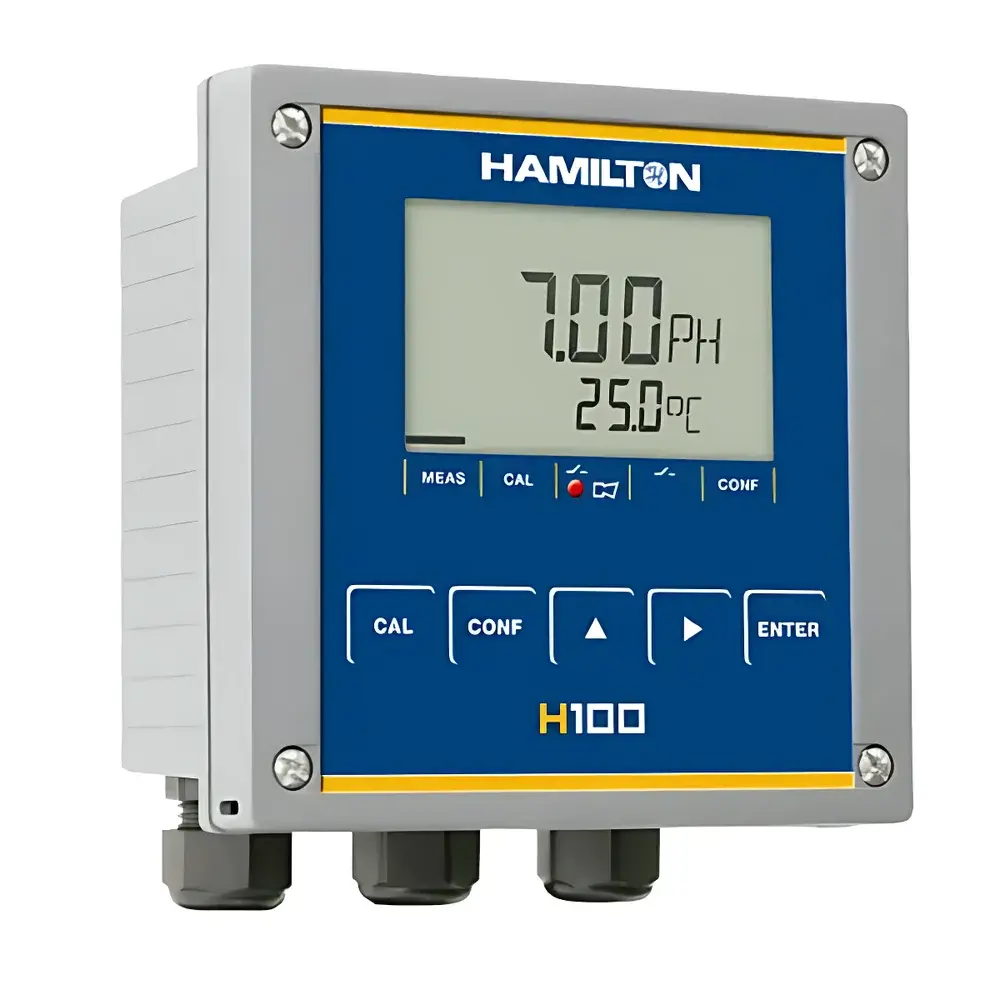
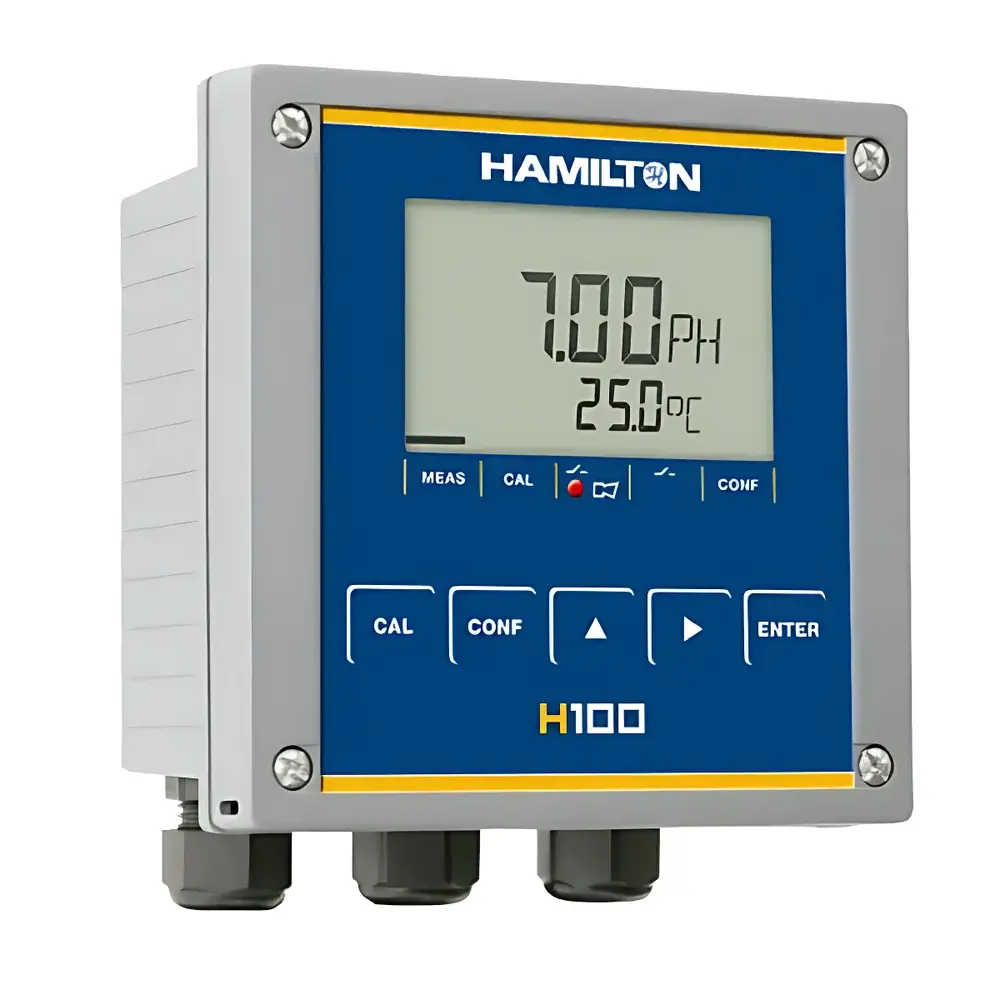
Hamilton H100 pH Transmitter
| Brand | Hamilton |
|---|---|
| Origin | Switzerland |
| Model | H100 pH |
| Measurement Range | pH −2.00 to 16.00 |
| ORP | −1500 to +1500 mV |
| Temperature Input | Pt100 / Pt1000 / NTC 30 kΩ |
| Temperature Range | −20 to +150 °C |
| Temperature Resolution | 0.1 °C |
| Measurement Error | <1 mV |
| Analog Outputs | Dual 4–20 mA (floating, max 10 V) |
| Relay Output | Configurable (alarm/flush), 3 A / <250 VAC or 30 VDC |
| Housing Material | PBT |
| Enclosure Rating | IP65 / NEMA 4X |
| Power Supply | 24–230 V AC/DC |
| Display | 7-segment LCD with icons |
| Operating Humidity | 0–80% RH at ≤55 °C |
| FM Certification | Class I, Div. 2, Groups A/B/C/D & IIC, T4, Ta = 55 °C, Type 2 |
Overview
The Hamilton H100 pH Transmitter is an industrial-grade, two-wire or four-wire process transmitter engineered for high-reliability continuous monitoring of pH, oxidation-reduction potential (ORP), and temperature in demanding liquid-phase applications. Based on Hamilton’s legacy of electrochemical sensor expertise, the H100 integrates precision analog signal conditioning with robust digital processing to deliver stable, low-drift measurements under fluctuating process conditions. Its core architecture supports direct connection to Hamilton’s family of pH and ORP sensors—including refillable, gel-filled, and differential reference electrodes—enabling accurate compensation for junction potential, liquid junction asymmetry, and thermal drift. Designed for integration into distributed control systems (DCS), programmable logic controllers (PLC), and SCADA networks, the H100 operates across a wide voltage range (24–230 V AC/DC), eliminating dependency on external power conditioners in multi-voltage plant environments.
Key Features
- True dual 4–20 mA analog outputs: independently configurable for pH, mV (ORP), or temperature signals—each floating and galvanically isolated to prevent ground-loop interference in multi-sensor installations.
- Intelligent diagnostics: real-time sensor health monitoring with visual status indicators (e.g., “dry electrode”, “junction clog”, “calibration overdue”) displayed via intuitive 7-segment LCD with context-sensitive icons.
- Configurable relay output: supports fail-safe alarm triggering or automated sensor cleaning cycles (e.g., air/water flush control), rated for 3 A resistive load at ≤250 VAC or 30 VDC.
- Comprehensive temperature compensation: accepts Pt100, Pt1000, or NTC 30 kΩ inputs with 0.1 °C resolution; automatic linearization per IEC 60751 (Pt) or DIN 43760 (NTC).
- FM-certified hazardous area compliance: approved for Class I, Division 2, Groups A/B/C/D and IIC, T4 ambient rating (Ta = 55 °C), Type 2 enclosure—suitable for pharmaceutical clean utilities, bioreactor skids, and wastewater influent channels.
- IP65/NEMA 4X-rated polycarbonate-free housing: constructed from flame-retardant PBT (polybutylene terephthalate) with UV-stabilized front bezel, ensuring long-term mechanical integrity in humid, chemically aggressive, or washdown-prone environments.
Sample Compatibility & Compliance
The H100 pH transmitter is compatible with aqueous and mildly conductive non-aqueous solutions typical in regulated industrial processes—including pharmaceutical buffer preparation, fermentation broth monitoring, potable water disinfection control, and municipal wastewater neutralization. It complies with key regulatory expectations for data integrity and operational reliability: its analog outputs meet IEC 61326-1 (EMC for industrial environments); its electrical safety conforms to IEC 61010-1; and its configuration logging supports audit-ready documentation required under FDA 21 CFR Part 11 when deployed with Hamilton’s optional calibration management software. While the transmitter itself does not perform digital data archiving, its analog outputs are fully compatible with validated DCS historian systems operating under GMP/GLP frameworks.
Software & Data Management
The H100 operates as a standalone analog transmitter without embedded firmware-based data logging. Configuration—including measurement units, alarm thresholds, relay behavior, and temperature sensor type—is performed locally via front-panel navigation or remotely using Hamilton’s free HMI-Link utility (Windows-based, USB or RS-485 interface). All parameter changes are stored in non-volatile memory with timestamped event logging (e.g., “Output range changed”, “Calibration initiated”). Though no cloud connectivity or OPC UA support is built-in, the dual 4–20 mA outputs ensure seamless integration with third-party SCADA platforms that enforce secure, time-synchronized acquisition—critical for batch record reconstruction in pharmaceutical manufacturing per Annex 11 and ISO 13485 requirements.
Applications
- Pharmaceutical water-for-injection (WFI) and pure steam condensate monitoring, where pH stability directly correlates with endotoxin control and system sanitization efficacy.
- Bioprocess pH control loops in single-use bioreactors and stainless-steel fermenters, interfacing with PID controllers for acid/base dosing precision.
- Municipal and industrial wastewater treatment—tracking neutralization efficiency in lime softening, heavy metal precipitation, and biological nutrient removal stages.
- Food & beverage CIP (clean-in-place) cycle verification, detecting residual alkalinity or acidity post-rinse to confirm sanitation completeness.
- Chemical manufacturing process streams involving caustic soda, sulfuric acid, or organic solvents with moderate conductivity (>50 µS/cm).
FAQ
Does the H100 pH transmitter support digital communication protocols such as HART or Modbus?
No—the H100 is an analog-only transmitter. It provides two isolated 4–20 mA outputs but lacks native HART, Modbus RTU, or Foundation Fieldbus capability. For digital integration, Hamilton recommends pairing it with a protocol converter or selecting the H200 series transmitters.
Can the H100 be used with non-Hamilton pH sensors?
Yes, provided the sensor meets standard industrial specifications: high-impedance glass electrode output (<1 GΩ), compatible reference junction design, and matching temperature element type (Pt100/Pt1000/NTC). However, full diagnostic functionality (e.g., “junction clog” detection) requires Hamilton-specific sensor firmware handshake.
Is the H100 suitable for sterilization-in-place (SIP) or autoclave environments?
No—the H100 is rated for ambient installation only (max 55 °C ambient). It must be mounted outside SIP/autoclave chambers; for in-line sterilizable applications, Hamilton offers the Arc+ series with integrated high-temperature transmitter modules.
How often does the H100 require calibration verification?
Per ASTM D1293 and USP , routine verification frequency depends on process criticality: typically every 24 hours for GMP water systems, weekly for wastewater, and per-shift for aggressive chemical dosing loops. The H100’s visual diagnostics reduce unscheduled downtime by flagging drift before specification limits are exceeded.
Related Products