
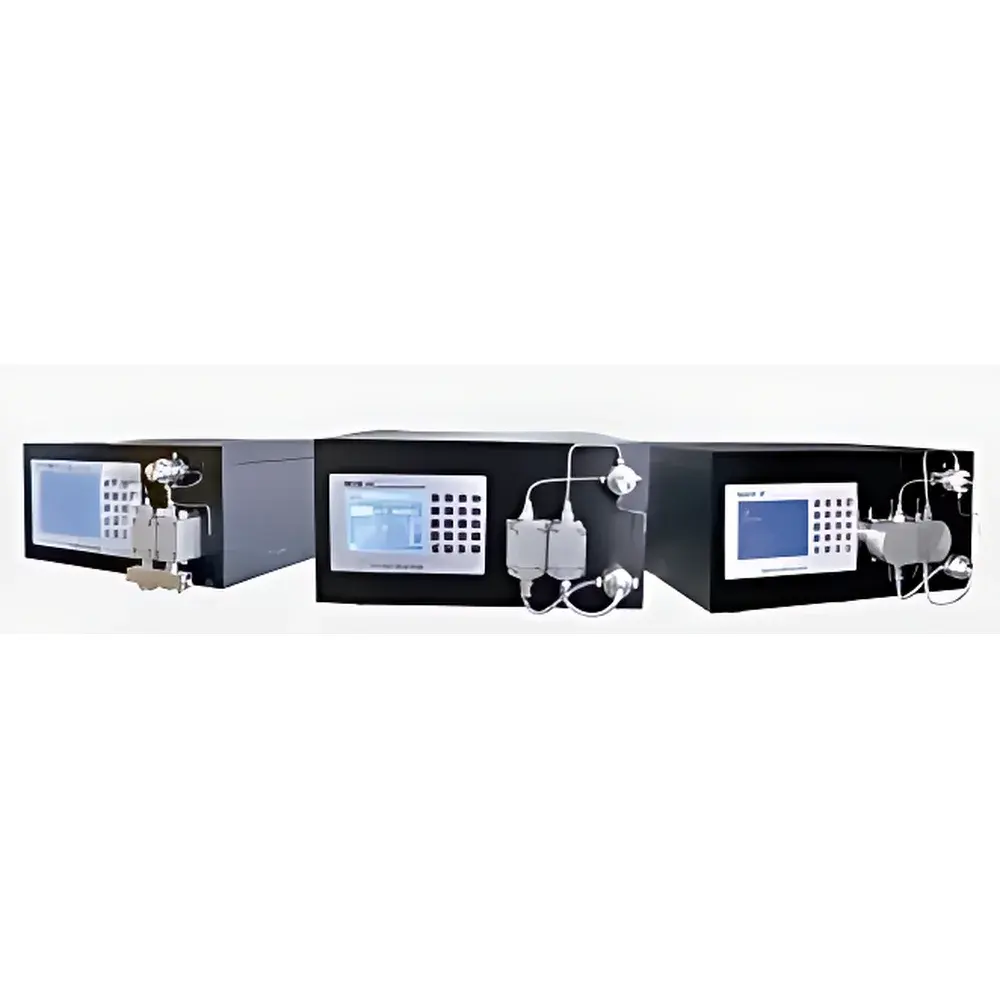
Hanbon NP7005-10C Semi-Preparative and Preparative HPLC Pump
| Brand | Hanbon |
|---|---|
| Origin | Jiangsu, China |
| Manufacturer Type | Direct Manufacturer |
| Regional Classification | Domestic (China) |
| Model | NP7005-10C |
| Application Level | Industrial-Scale Preparative |
| Instrument Type | Medium-to-Low Pressure Preparative Liquid Chromatography System |
| Flow Accuracy | ±0.5% over full range (0.01–100 mL/min) |
| Flow Pulsation | <0.1% RMS (measured at 1 mL/min, 10 MPa) |
| Maximum Operating Pressure | 10 MPa |
| Display | 4.7-inch TFT LCD (320 × 240 pixels) |
| User Programs | 10 stored gradient methods |
| Communication Interface | Open ASCII-based RS-232/RS-485 protocol compliant with ASTM E1381 and IEEE 11073 standards |
| Column Cleaning Mode | Optional automated back-flush for piston and seal assembly |
| Seal Lifetime Extension | Enabled via programmable solvent rinse during idle and gradient hold phases |
Overview
The Hanbon NP7005-10C Semi-Preparative and Preparative HPLC Pump is a precision fluid delivery module engineered for medium-to-low pressure preparative liquid chromatography applications in industrial purification, natural product isolation, pharmaceutical intermediate refinement, and catalyst recovery workflows. It operates on positive displacement principle using dual high-precision ceramic-coated pistons driven by a brushless DC motor and micro-stepping encoder feedback loop. Unlike analytical-scale pumps, the NP7005-10C is dimensioned for sustained operation at flow rates up to 100 mL/min with pressure stability maintained up to 10 MPa—enabling compatibility with 10–50 mm ID preparative columns packed with 5–25 µm spherical silica or polymer-based stationary phases. Its design prioritizes long-term volumetric fidelity under variable backpressure conditions typical of gradient elution across salt-containing mobile phases (e.g., ammonium acetate, sodium phosphate), where baseline noise and pulse-induced retention time drift are critical failure modes in fraction collection.
Key Features
- Floating piston architecture with self-aligning ceramic plunger sleeves minimizes eccentric wear and extends high-pressure seal service life beyond 6,000 operating hours under continuous 8 MPa load.
- Electronic damping control system actively compensates for mechanical inertia and compressibility effects in solvent delivery, reducing flow pulsation to <0.1% RMS—critical for UV absorbance stability during peak integration and mass-directed fractionation.
- Programmable column back-flush function automatically initiates solvent rinsing of piston rear surfaces and seal gland interfaces during method pauses or gradient plateaus, mitigating crystallization-induced abrasion from volatile buffer systems.
- Multi-point flow calibration routine (10 discrete points spanning 0.01–100 mL/min) corrects for non-linear volumetric displacement across pressure gradients, ensuring traceable accuracy per ISO 9001 calibration documentation requirements.
- Open ASCII communication protocol supports bidirectional command exchange with third-party CDS platforms (e.g., Chromeleon, Empower, LabSolutions) and custom PLC-integrated purification systems, compliant with ASTM E1381 data integrity guidelines.
- 4.7-inch TFT LCD interface features tabular method editing mode—allowing simultaneous visualization of flow rate, pressure, gradient slope, and elapsed time—optimized for operator efficiency in unattended overnight runs.
Sample Compatibility & Compliance
The NP7005-10C accommodates aqueous-organic mobile phases containing up to 1.5 M ionic strength buffers (e.g., triethylammonium acetate, ammonium bicarbonate), as well as aggressive solvents including dichloromethane, THF, and ethyl acetate when used with chemically resistant PEEK and sapphire wetted materials. All fluidic path components meet USP Class VI biocompatibility standards. The pump complies with IEC 61010-1 for laboratory equipment safety and incorporates hardware-level audit trail logging for pressure/flow event timestamps—supporting GLP/GMP environments requiring FDA 21 CFR Part 11–compliant electronic records when paired with validated host software.
Software & Data Management
Control firmware supports local method storage (10 user-defined gradient programs with up to 32 segment linear or multi-step profiles), real-time pressure/flow trending with configurable alarm thresholds (e.g., >120% max pressure, flow deviation >±1.5%), and CSV export of operational logs via USB host port. Remote monitoring is enabled through Modbus RTU over RS-485, allowing integration into centralized facility SCADA systems. Calibration certificates include NIST-traceable flow verification data with uncertainty budgets calculated per ISO/IEC 17025:2017 Annex A.3.
Applications
- Isolation of gram-to-kilogram quantities of active pharmaceutical ingredients (APIs) from reaction mixtures using reversed-phase or chiral preparative columns.
- Purification of monoclonal antibody fragments and oligonucleotides under low-shear conditions compatible with size-exclusion and ion-exchange media.
- Recovery of metal-organic frameworks (MOFs) and porous coordination polymers following solvothermal synthesis.
- Separation of natural product libraries from plant extracts or microbial fermentation broths with minimal thermal degradation.
- Method development bridging analytical HPLC to scalable semi-prep workflows via linear velocity and loading capacity correlation tools.
FAQ
What pressure range is supported for continuous operation?
Continuous operation is rated up to 10 MPa (1450 psi) at all flow rates; short-term excursions to 12 MPa are permitted for column equilibration only.
Does the pump support binary or quaternary gradient mixing?
The NP7005-10C is a single-pump module; gradient formation requires external low-dead-volume mixing tees or integration with Hanbon’s NP7000M series solvent selector valve.
Can it be validated for GMP manufacturing use?
Yes—when deployed with IQ/OQ protocols and paired with Part 11–enabled CDS software, it meets ALCOA+ data integrity criteria for Phase III clinical material purification.
Is remote firmware update capability available?
Firmware updates require local USB connection and signed binary files; no over-the-air (OTA) functionality is implemented for security compliance with IEC 62443-3-3.
What maintenance intervals are recommended for seal replacement?
Under typical buffer-free organic/aqueous operation, seal replacement is scheduled every 4,000–6,000 hours; high-salt usage reduces interval to 2,500 hours unless back-flush mode is activated per run.






