
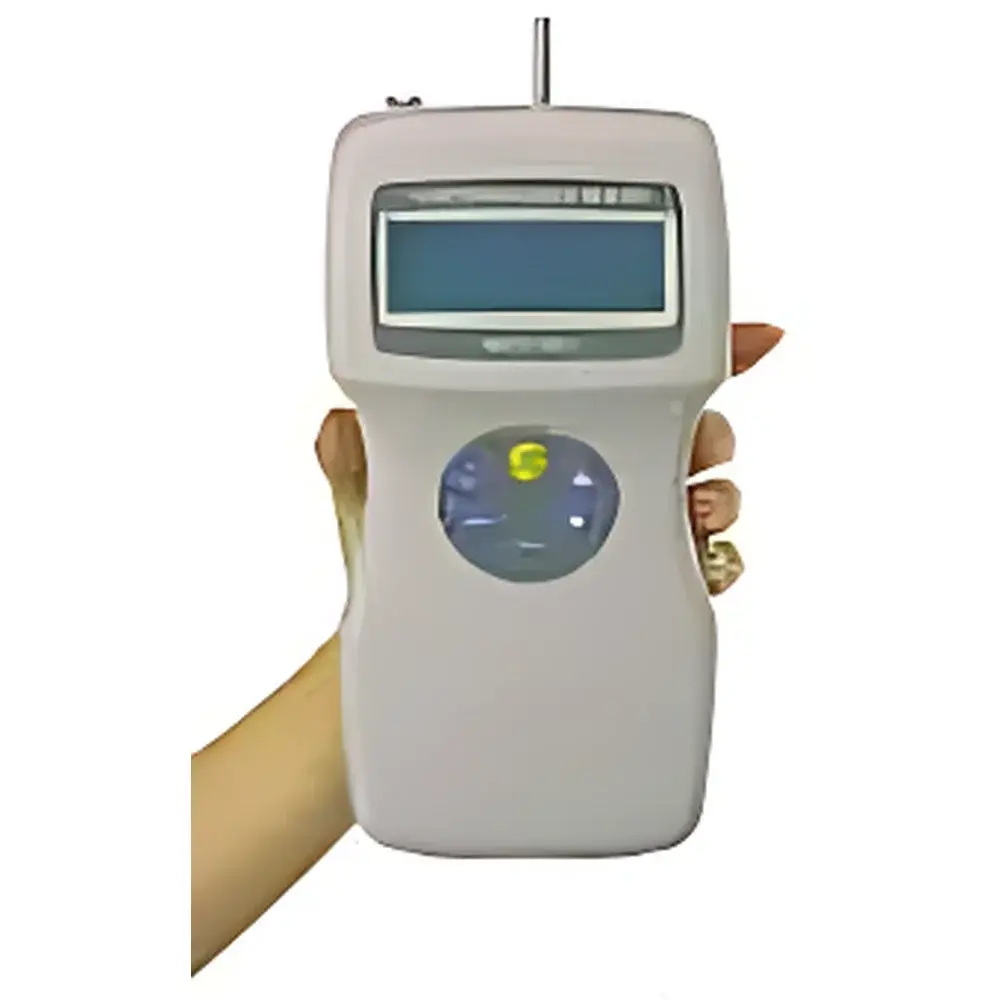
Handheld Laser Particle Counter Model 3886
| Origin | Japan |
|---|---|
| Manufacturer Type | Authorized Distributor |
| Origin Category | Imported |
| Model | 3886 |
| Safety Rating | Non-Explosion-Proof |
| Weight | ~980 g |
| Display | 4-line × 20-character LCD |
| Dimensions | 115 mm × 70 mm × 211 mm |
| Data Storage Capacity | 500 samples (4 records per test in Calculation Mode) |
| Communication Interface | RS-232 or RS-485 (selectable via menu) |
| Power Supply | 4× AA Ni-MH rechargeable batteries (4.8 V, 1.6 Ah) |
| Sampling Flow Rate | 0.1 cfm (2.83 L/min) |
| Counting Channels | 0.3 µm, 0.5 µm, 1.0 µm, 3.0 µm, 5.0 µm |
| Minimum Detectable Particle Size | 0.3 µm |
| Count Range | 1–70,000,000 particles/ft³ |
| Sampling Duration | 1 s – 99 min 59 s (adjustable in 1-s increments) |
| Sampling Frequency | 1–99 cycles or continuous |
| Operating Temperature | 10–35 °C |
| Test Modes | Single, Repeat, Continuous, Calculation, Remote Control |
| Simultaneous Environmental Monitoring | Particle count + temperature + relative humidity + air velocity (with optional probes) |
| Error Indicators | Out-of-range count, laser power degradation, flow deviation > ±1%, low battery |
Overview
The Handheld Laser Particle Counter Model 3886 is a portable, ISO 21501-4-compliant optical particle counter engineered for real-time airborne particulate monitoring in cleanrooms, pharmaceutical manufacturing suites, hospital isolation rooms, HVAC commissioning, and laboratory environments. It operates on the principle of single-particle light scattering: a collimated 650 nm laser beam interrogates aerosol-laden air drawn at a precisely regulated 2.83 L/min (0.1 cfm) volumetric flow rate through a calibrated sensing zone. Scattered photons are detected by a high-sensitivity photodiode array, with pulse height analysis enabling discrimination across five discrete size channels—0.3, 0.5, 1.0, 3.0, and 5.0 µm—each traceable to NIST-traceable reference standards. Unlike generic dust monitors, this instrument delivers quantitative, size-resolved particle concentration data in units of particles per cubic foot (or convertible to particles/m³), satisfying requirements for ISO Class 5–8 cleanroom certification per ISO 14644-1 and EU GMP Annex 1.
Key Features
- Five-channel simultaneous counting (0.3 µm to 5.0 µm) with 0.3 µm lower detection limit—meeting critical thresholds for sterile process monitoring
- Integrated mass-flow sensor continuously verifies sampling flow accuracy within ±1% tolerance, ensuring compliance with ISO 21501-4 flow stability criteria
- Real-time concurrent measurement of ambient temperature, relative humidity, and air velocity when paired with optional calibrated probes (NIST-traceable thermistor, capacitive RH sensor, and hot-wire anemometer)
- Robust embedded memory stores up to 500 complete test records—including time-stamped channel counts, environmental parameters, and operator-defined metadata—with flexible recall and export protocols
- Compact ergonomic design (115 × 70 × 211 mm; ~980 g) optimized for extended handheld operation and access to confined or elevated sampling locations
- Dual communication architecture: configurable RS-232/RS-485 serial interface supports both local PC-based remote control and multi-unit daisy-chained networked deployment via RJ-11 and industrial RS-485
Sample Compatibility & Compliance
The Model 3886 is validated for use with ambient air, compressed air (when fitted with appropriate inline filtration and pressure regulation), and HEPA-filtered laminar airflow environments. It is not rated for explosive atmospheres (ATEX/IECEx) or corrosive gas streams. All optical and electronic components meet IEC 61000-4 immunity standards for electrostatic discharge (±8 kV contact), radiated RF fields (10 V/m), and fast transients (±2 kV). Calibration certificates include uncertainty budgets compliant with ISO/IEC 17025 and are issued with traceability to national metrology institutes. The device satisfies data integrity requirements under FDA 21 CFR Part 11 when used with validated software platforms that enforce electronic signatures, audit trails, and role-based access control.
Software & Data Management
Data export is supported via ASCII text files (.txt) or comma-separated values (.csv) over serial link, compatible with industry-standard analysis tools including Microsoft Excel, MATLAB, and LIMS platforms. Optional PC software provides automated report generation aligned with ISO 14644-2 surveillance templates, trend analysis with statistical process control (SPC) charts, and deviation flagging against user-defined alert thresholds. Audit trail functionality logs all configuration changes, calibration events, and data exports with timestamps and operator IDs—fully supporting GLP and GMP documentation workflows. Firmware updates are delivered via secure signed packages and require password-authenticated installation to prevent unauthorized modification.
Applications
- Cleanroom classification and routine monitoring per ISO 14644-1 and EU GMP Annex 1
- Filter integrity testing (e.g., pre- and post-HEPA challenge with polyalphaolefin (PAO) or sodium chloride aerosols)
- HVAC system validation, balancing, and leak detection in critical facilities
- Pharmaceutical aseptic processing environment qualification (ISO Class 5 hood mapping, background monitoring)
- Medical device packaging clean area verification and bioburden risk assessment
- Research-grade aerosol characterization in university labs and material science facilities
FAQ
Is the Model 3886 suitable for use in explosive or hazardous locations?
No. It carries a non-explosion-proof safety rating and must not be operated in classified hazardous areas per NEC Article 500 or IEC 60079.
Can the internal battery be charged using the AC adapter?
No. The AC adapter powers the unit during operation but does not provide charging functionality. A dedicated Ni-MH battery charger is supplied separately.
What is the uncertainty associated with the 0.3 µm channel measurement?
Per ISO 21501-4, the counting efficiency at 0.3 µm is ≥50% with an overall size resolution (D50/D10 ratio) ≤1.40, and typical expanded uncertainty (k=2) for concentration is ±12% for concentrations above 100 particles/ft³.
Does the instrument support automatic data upload to a central server?
Yes—when integrated with third-party middleware or custom SCADA systems via its RS-485 Modbus RTU protocol, it enables scheduled or event-triggered data transmission without manual intervention.
Are calibration certificates provided with each unit?
Yes. Each shipped unit includes a factory calibration certificate with traceability to JCSS (Japan Calibration Service System) and documented uncertainty values for all five channels and flow rate.







