
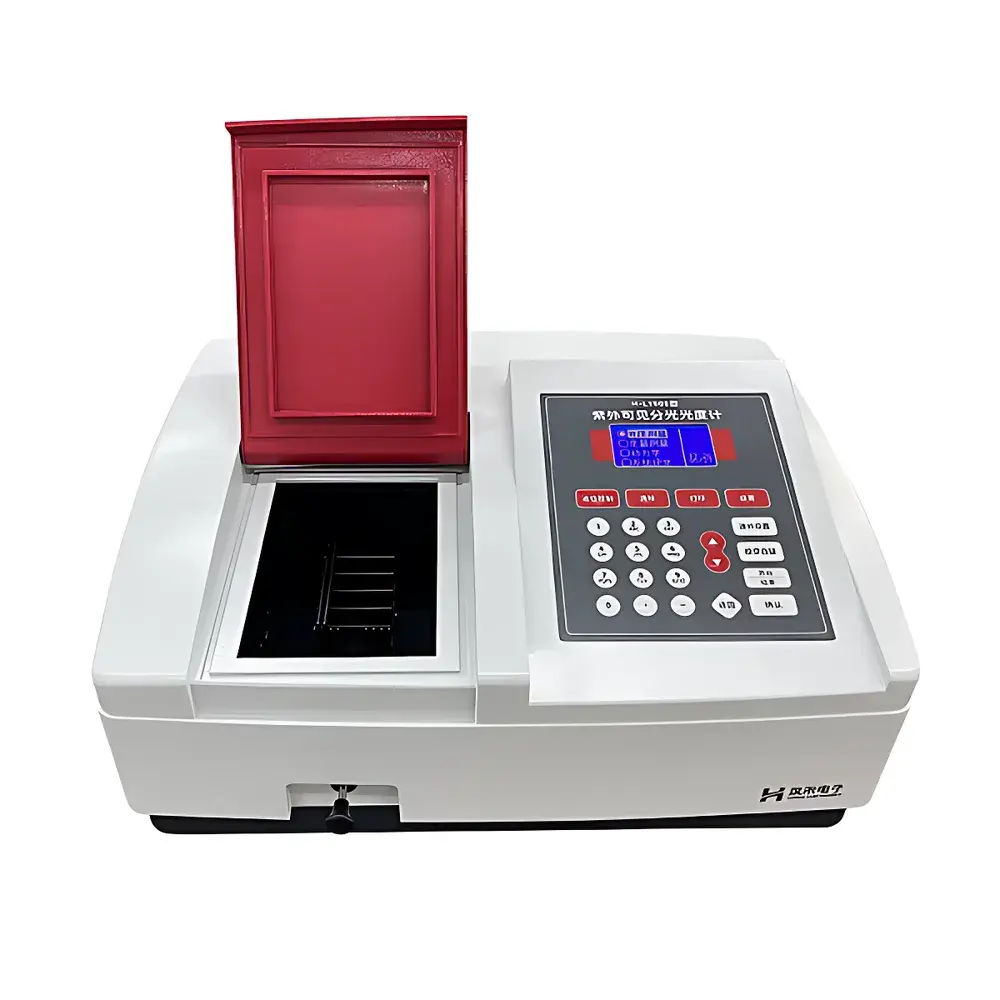
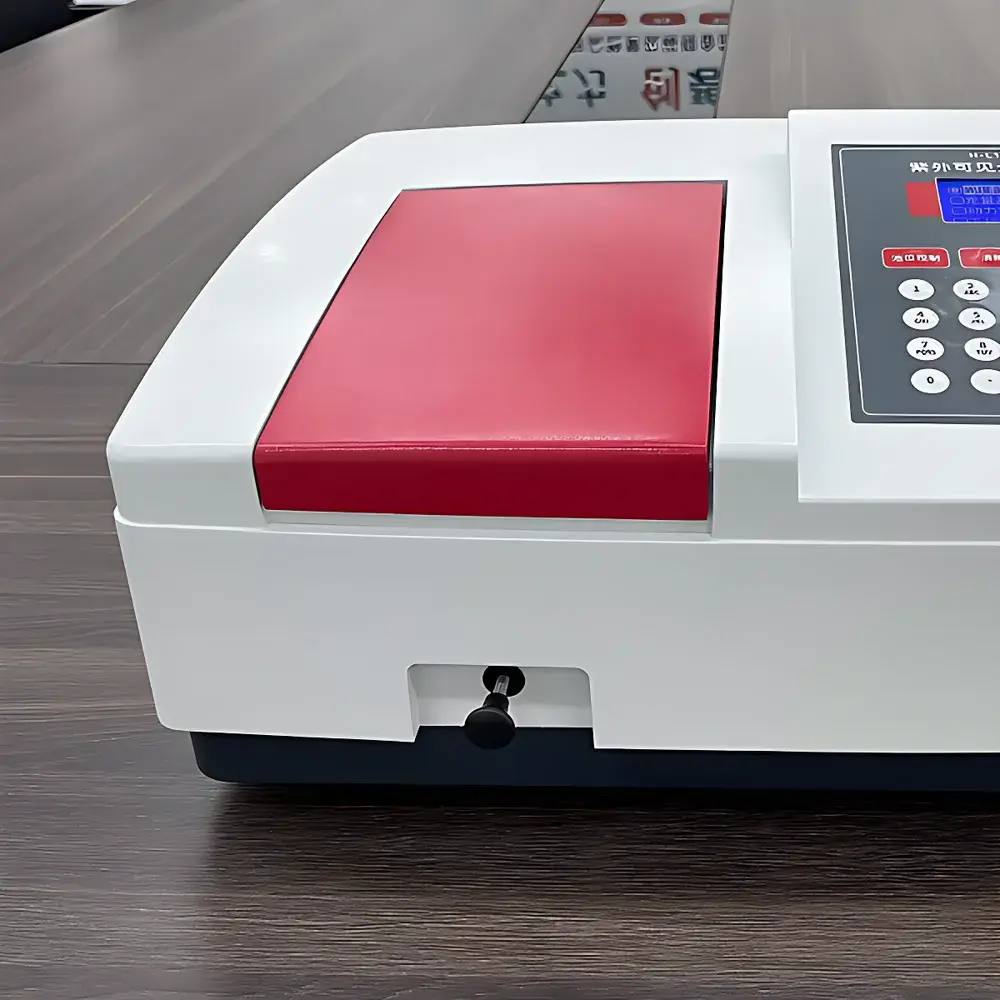
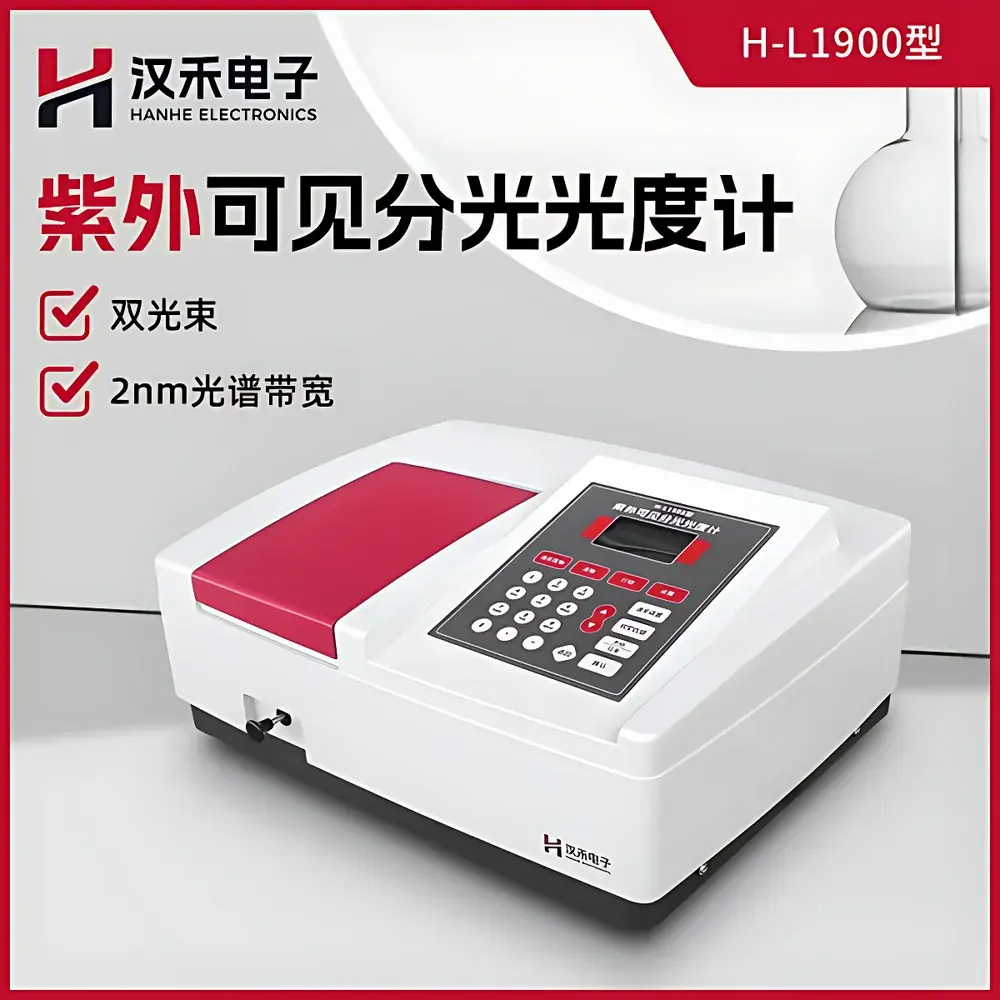
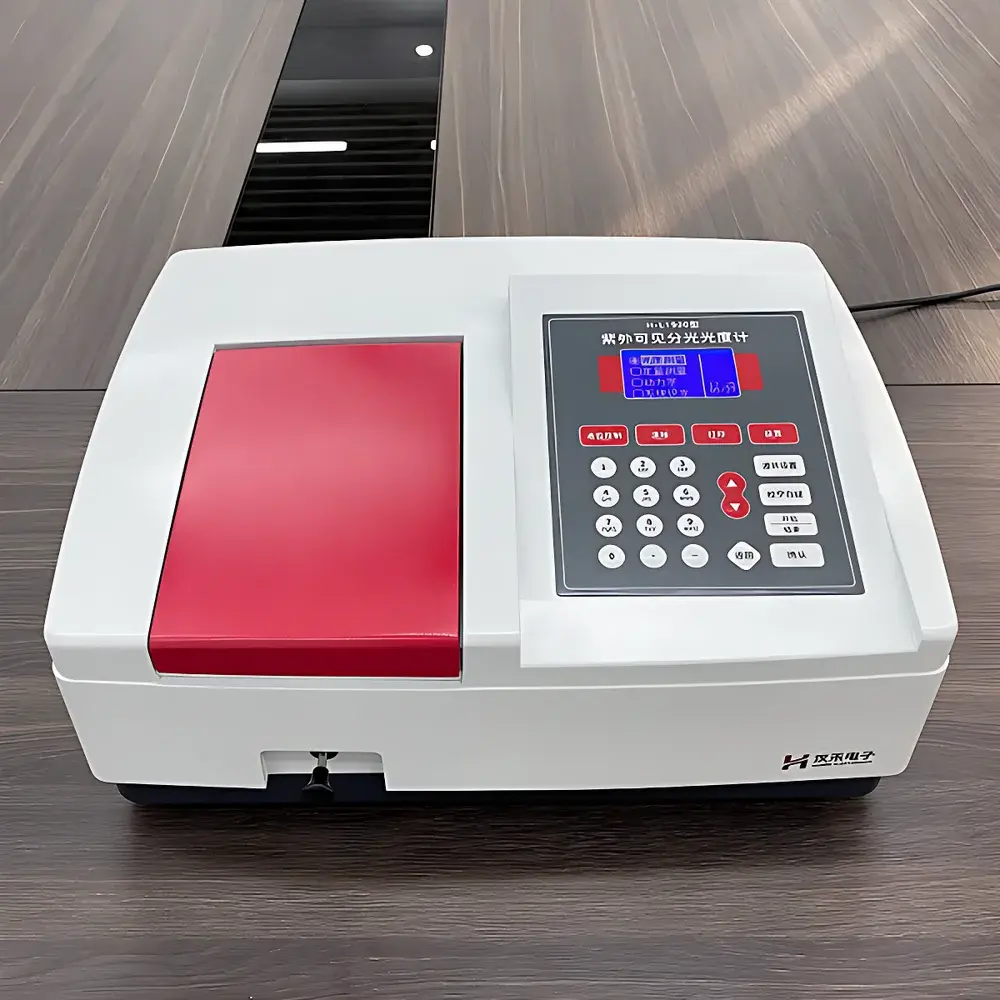
HanHe H-L1900 UV-Vis Spectrophotometer
| Brand | HanHe |
|---|---|
| Origin | Shandong, China |
| Model | H-L1900 |
| Spectral Range | 190–1100 nm |
| Spectral Bandwidth | 2 nm |
| Wavelength Accuracy | ±0.8 nm |
| Wavelength Repeatability | ≤0.2 nm |
| Photometric Accuracy | ±0.3%T (0–100%T), ±0.002 Abs (0–0.5 Abs), ±0.004 Abs (0.5–1.0 Abs) |
| Baseline Drift | ±0.002 A/h |
| Baseline Flatness | ±0.002 A |
| Stray Light | ≤0.1%T |
| Photometric Repeatability | ≤0.15%T (0–100%T), ≤0.001 Abs (0–0.5 Abs), ≤0.002 Abs (0.5–1.0 Abs) |
| Detector | Imported Silicon Photodiode |
| Light Sources | Long-life Deuterium Lamp & Tungsten Halogen Lamp |
| Display | 128×64 Dot-Matrix LCD |
| Data Interface | USB Port |
| Dimensions | 460 × 380 × 180 mm |
| Weight | 18 kg |
Overview
The HanHe H-L1900 UV-Vis Spectrophotometer is a dual-beam, ratio-monitoring spectrophotometer engineered for precision quantitative and qualitative analysis across the ultraviolet, visible, and near-infrared spectral regions (190–1100 nm). Its optical architecture employs a high-efficiency 1200 lines/mm imported diffraction grating and a rigid 8-mm optical base with suspended optical assembly—designed to minimize mechanical drift and maximize long-term photometric stability. The instrument utilizes classical Czerny-Turner optical path geometry, optimized for high end-point energy throughput and spectral resolution. All optical surfaces—including mirrors and gratings—are coated with SiO₂ protective films, and the entire optical compartment is hermetically sealed to mitigate environmental degradation from ambient humidity, dust, or reactive gases. This construction ensures consistent performance in routine QC laboratories, academic teaching environments, and regulated R&D settings where reproducibility and baseline integrity are critical.
Key Features
- Dual-beam ratio-monitoring system with real-time reference beam correction, eliminating source intensity fluctuations and improving measurement robustness.
- Suspended optical design mounted on a solid 8-mm aluminum base, delivering superior mechanical stability and thermal inertia.
- Modular internal layout enables rapid identification, isolation, and servicing of functional units without full disassembly.
- High-precision sine-bar drive mechanism for wavelength scanning—ensuring linearity, repeatability, and low hysteresis over extended operation.
- Optimized analog front-end and low-noise digital signal processing chain, reducing dark current drift and enhancing signal-to-noise ratio (SNR).
- Active thermal management via balanced air-circulation ducting maintains uniform internal temperature distribution, minimizing thermo-optic drift.
- Large sample compartment accommodating cuvettes from 5 mm to 100 mm pathlength; compatible with standard accessories including variable-pathlength cells, Peltier holders, and fiber-optic probes.
- Plug-and-play lamp module design: flanged D2 lamp and socket-mounted tungsten lamp allow replacement without optical realignment or recalibration.
- Full-sealed optical chamber with SiO₂-coated optics reduces sensitivity to atmospheric contaminants and extends component service life.
- Intuitive 128×64 dot-matrix LCD display supports multi-parameter readout per screen, including wavelength, absorbance, transmittance, concentration, and kinetic time stamps.
Sample Compatibility & Compliance
The H-L1900 accommodates standard quartz and glass cuvettes (10 mm included), as well as specialized sample formats such as micro-volume cells, flow-through cells, and solid-sample reflectance accessories. Its spectral range and photometric accuracy meet core requirements outlined in ISO 6425, ASTM E275, and USP <731> for UV-Vis instrumentation used in pharmaceutical assay, excipient qualification, and raw material identity testing. While not pre-certified for 21 CFR Part 11 compliance out-of-the-box, the instrument’s software architecture supports audit-trail-enabling configurations—including user-access logs, electronic signatures, and immutable data export—when deployed with validated third-party LIMS or ELN integrations. Routine operation adheres to GLP principles through built-in self-diagnostic routines, automatic dark-current correction, and wavelength calibration verification protocols.
Software & Data Management
The included PC-based control software provides native support for photometric measurement, quantitative analysis (single- and multi-point calibration), kinetics, spectrum scanning (high/medium/low speed), multi-wavelength quantitation, and nucleic acid/protein analysis (A260/A280, ε calculation). Up to 200 measurement sets—including full spectral scans and calibration curves—can be stored internally with non-volatile memory retention during power loss. Data export is supported via USB interface in CSV, TXT, and native binary formats. The software includes curve-fitting tools (linear, polynomial, quadratic), baseline correction algorithms (rolling ball, asymmetric least squares), and overlay visualization for comparative spectral analysis. Optional GMP-compliant add-ons enable electronic record generation compliant with FDA 21 CFR Part 11 when paired with timestamped user authentication and change-tracking modules.
Applications
- Pharmaceutical quality control: assay of active pharmaceutical ingredients (APIs), dissolution testing, and excipient purity screening per USP monographs.
- Environmental analysis: quantification of nitrate, phosphate, COD, and heavy metal complexes (e.g., Cr(VI) diphenylcarbazide method).
- Food & beverage: determination of antioxidants (e.g., ascorbic acid), colorants (E-numbers), and adulterant detection via spectral fingerprinting.
- Academic research: enzyme kinetics (NADH/NADPH monitoring at 340 nm), ligand-binding studies, and nanoparticle size estimation via surface plasmon resonance.
- Materials science: thin-film thickness and bandgap analysis using Tauc plot methodology on transparent substrates.
- Clinical biochemistry: protein concentration (Bradford, Lowry, BCA), DNA/RNA purity assessment, and hemoglobin quantification.
FAQ
What is the minimum detectable absorbance change for the H-L1900?
The instrument achieves a photometric noise level of ±0.001 A under standard conditions (1 sec integration, 2 nm bandwidth), enabling reliable detection of sub-millimolar analyte concentrations in optimized assays.
Does the H-L1900 support automatic wavelength calibration?
Yes—the system includes an internal holmium oxide filter-based wavelength validation routine, and users may perform manual or automated wavelength calibration using certified reference standards.
Can the instrument operate under regulated GxP environments?
While the base configuration meets fundamental analytical performance criteria, full GxP readiness requires documented IQ/OQ/PQ protocols, software validation packages, and integration with compliant data management systems.
Is the software compatible with Windows 10/11 and macOS?
The native application is Windows-compatible (Windows 7–11, 64-bit); macOS operation is supported via virtualization or dedicated cross-platform drivers available upon request.
What maintenance intervals are recommended for lamp replacement?
Deuterium lamps typically last ≥1,000 hours; tungsten lamps ≥5,000 hours. The system monitors cumulative lamp usage and alerts users prior to end-of-life thresholds.






