
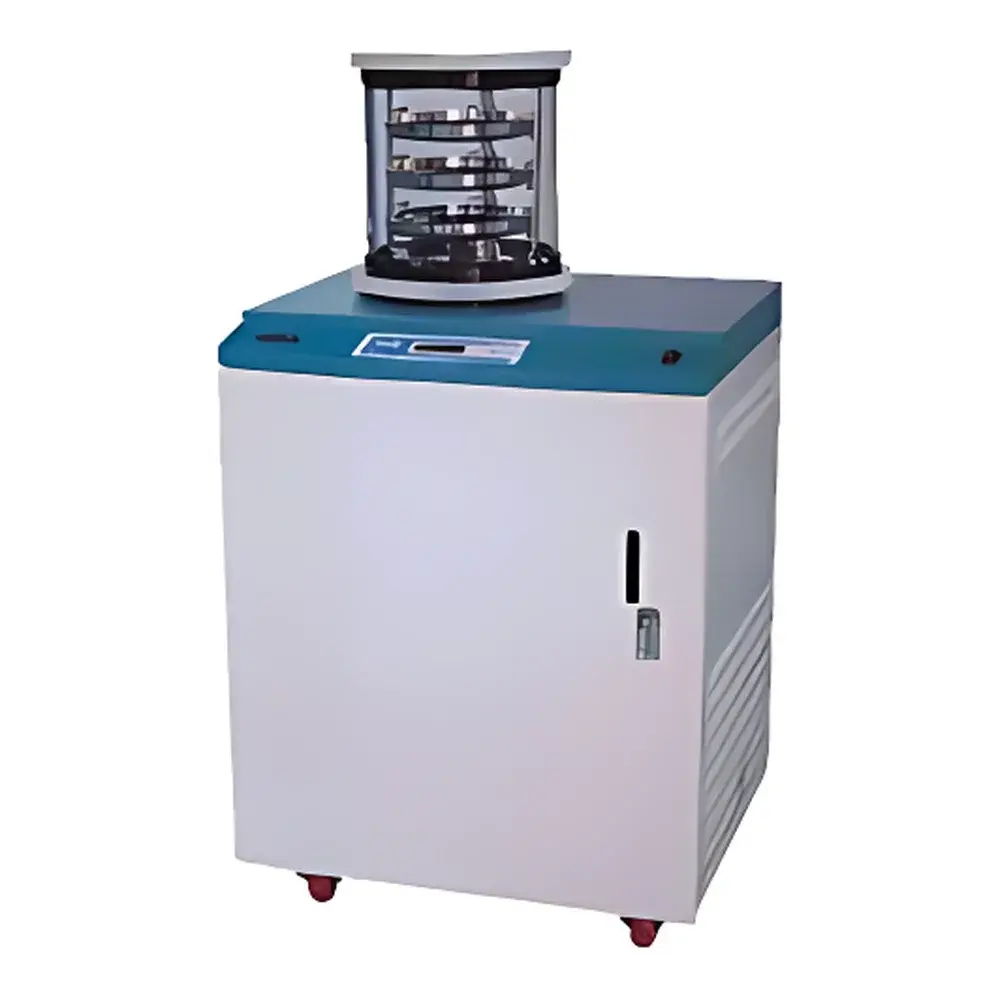
Hanil CleanVac 8 Laboratory Freeze Dryer
| Brand | Hanil |
|---|---|
| Origin | South Korea |
| Model | CleanVac 8 |
| Maximum Sample Capacity | 8 L |
| Chamber Dimensions | 310 mm (D) × 250 mm (H) |
| Compressor | Dual 1/2 HP |
| Power Supply | 220 V, 60 Hz, Single Phase, 1.5 kW |
| Vacuum Measurement | Pirani Gauge (Range: 0.005–760 torr |
| Resolution | 0.5 per decade) |
| Temperature Sensing | Pt100 Sensors (–85 °C to +40 °C |
| Resolution | 1 °C) |
| Overall Dimensions | 740 W × 600 D × 965 H mm |
Overview
The Hanil CleanVac 8 is a benchtop laboratory freeze dryer engineered for reproducible lyophilization of biological, pharmaceutical, and analytical samples under controlled low-temperature vacuum conditions. It operates on the fundamental principle of sublimation—removing water from frozen samples by reducing ambient pressure below the triple point of ice while maintaining cryogenic temperatures in both the condenser (down to –85 °C) and drying chamber. Designed for routine R&D, quality control, and small-batch processing, the CleanVac 8 integrates dual-stage refrigeration, real-time vacuum monitoring via a calibrated Pirani gauge, and microprocessor-based process logic to ensure consistent cycle execution and endpoint detection without manual intervention.
Key Features
- Dual 1/2 HP hermetic compressors deliver rapid cooldown of the condenser to –85 °C and sustain stable deep-vacuum performance throughout extended cycles.
- Transparent cylindrical drying chamber (Ø310 × 250 mm height), constructed from optical-grade acrylic, enables visual monitoring of sample status and ice formation without compromising vacuum integrity.
- Front-access removable panel provides unobstructed service access to the vacuum pump and refrigeration components—minimizing downtime during preventive maintenance or filter replacement.
- Integrated Pt100 temperature sensors continuously monitor shelf (or tray) temperature and condenser temperature with ±1 °C resolution, supporting precise thermal profiling and validation-ready data logging.
- Microprocessor-controlled system displays real-time vacuum pressure (torr), chamber temperature, condenser temperature, and elapsed time on a backlit LCD interface—no external software required for basic operation.
- Intelligent endpoint detection algorithm automatically pauses the vacuum pump hourly, measures pressure rise over 60 seconds, and compares it against user-defined thresholds (e.g., <5 mtorr/min); if stability criteria are met, the system prompts “Cycle Complete” on-screen and halts the process.
- Heated shelf option (available with Petri dish support rack) introduces controlled conductive heating during secondary drying, accelerating desorption kinetics while preserving thermolabile structure—fully compatible with USP & ICH Q5C stability protocols.
Sample Compatibility & Compliance
The CleanVac 8 accommodates standard labware including glass vials (up to 20 mL), serum bottles, scintillation vials, and Petri dishes mounted on an optional heated support rack. Its vacuum range (0.005–760 torr) and condenser capacity (8 L max aqueous load) align with ASTM F2375-04 (Standard Practice for Lyophilization Process Development) and ISO 22055-1:2021 (Biotechnology — Lyophilization — Part 1: General Requirements). The system supports GLP-compliant documentation when paired with external data loggers; its analog sensor outputs (0–5 V or 4–20 mA) and RS-232 interface enable integration into validated environments requiring FDA 21 CFR Part 11 audit trails (when used with compliant third-party software).
Software & Data Management
While the CleanVac 8 operates autonomously via its embedded controller, it offers serial communication (RS-232) for bidirectional parameter transfer and real-time telemetry export. Users may connect to PC-based SCADA or LIMS platforms for centralized cycle archiving, trend analysis, and electronic signature workflows. All displayed parameters—including vacuum decay rate, cumulative pump runtime, and temperature deviation alerts—are timestamped and exportable as CSV files. No proprietary software license is required for basic data capture; however, advanced analytics (e.g., residual moisture estimation via pressure rise test correlation) require post-processing using validated Python or MATLAB scripts aligned with PDA Technical Report No. 45.
Applications
- Stabilization of monoclonal antibodies, vaccines, and enzyme formulations prior to long-term storage or shipping.
- Preparation of reference standards and calibration materials for HPLC, GC-MS, and elemental analysis.
- Drying of microbial cultures, tissue homogenates, and nucleic acid extracts without denaturation or oxidation.
- Processing of forensic evidence samples (e.g., blood swabs, saliva cards) where morphological integrity and DNA recovery are critical.
- Academic research in material science involving porous scaffold fabrication, aerogel synthesis, and nanocellulose preservation.
FAQ
What is the maximum ice condensing capacity of the CleanVac 8?
The condenser is rated for up to 8 liters of total aqueous load per cycle, assuming optimal pre-freezing at ≤–40 °C and chamber pressure maintained below 100 mtorr during primary drying.
Does the system comply with GMP requirements for pharmaceutical use?
The CleanVac 8 meets mechanical and functional prerequisites for GMP-aligned operations (e.g., traceable temperature/vacuum sensing, repeatable endpoint logic); full compliance requires IQ/OQ/PQ validation using site-specific protocols and integration with Part 11–compliant data management systems.
Can the heated shelf be retrofitted to existing units?
Yes—the heated support rack and associated PID-controlled power module are field-installable with factory-supplied mounting hardware and firmware update (v2.3+).
Is remote monitoring supported out of the box?
Basic remote status readout (vacuum, temps, cycle stage) is enabled via RS-232; Ethernet or Wi-Fi connectivity requires an external protocol converter and custom middleware deployment.
What maintenance intervals are recommended for the vacuum pump?
Oil change every 500 operating hours; inlet filter replacement every 200 hours; annual calibration of Pirani gauge against NIST-traceable reference standard.



