
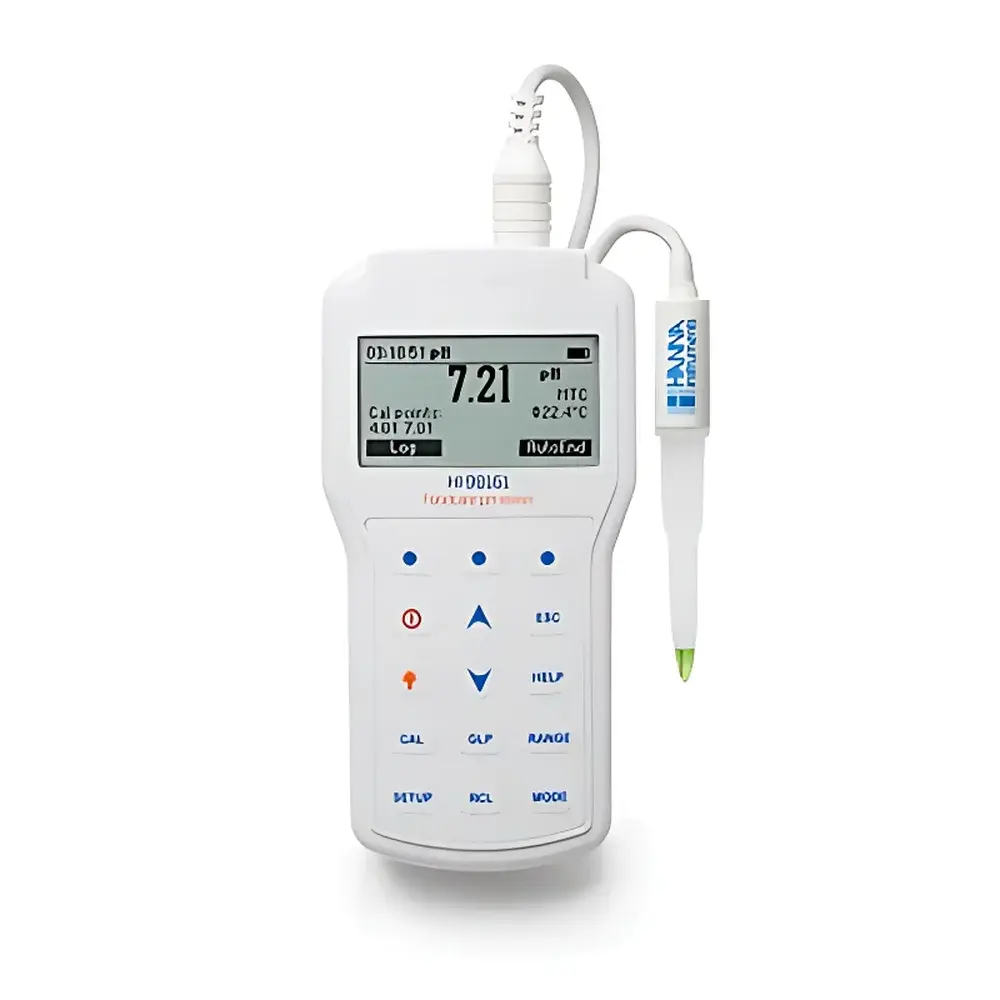
Hanna HI98161 Portable pH/mV/°C Meter for Food Industry
| Brand | Hanna Instruments |
|---|---|
| Origin | Italy |
| Model | HI98161 Portable pH/mV/°C Meter (Food Industry Optimized) |
| pH Range | -2.000 to 20.000 |
| mV Range | ±2000.0 |
| Temperature Range | -20.0 to 120.0 °C |
| Calibration | Up to 5-point auto-recognizing + 5-point custom calibration |
| Built-in Standards | 7 buffer points (1.68, 4.01, 6.86, 7.01, 9.18, 10.01, 12.45 pH) |
| Resolution | 0.001 pH / 0.1 mV / 0.1 °C |
| Accuracy | ±0.002 pH / ±0.2 mV / ±0.4 °C |
| Electrode | FC2023 PVDF-body pH electrode with integrated amplifier and NTC temperature sensor |
| Connectivity | USB interface (HI92000-15 software compatible) |
| Data Storage | 200 records (100 pH + 100 mV) |
| IP Rating | IP67 |
| Power | 4×AAA batteries (BEPS low-battery warning) |
| Auto-off | Configurable (5/10/30/60 min or disabled) |
Overview
The Hanna HI98161 is a high-precision, portable benchtop-grade pH/mV/°C meter engineered specifically for quality control and process monitoring in food production, dairy processing, beverage manufacturing, and regulatory-compliant sanitation verification. It operates on the fundamental electrochemical principle of potentiometric measurement: a pH-sensitive glass membrane generates a potential difference relative to a stable reference electrode, which—when compensated for temperature and calibrated against traceable standard buffers—yields a quantitative pH value in accordance with NIST-traceable methodology. The integrated mV mode supports redox (ORP) analysis critical for monitoring sanitizing agent efficacy (e.g., chlorine, peracetic acid), while the embedded NTC thermistor enables real-time automatic temperature compensation (ATC) across the full operational range (–20.0 to 120.0 °C). Designed for rugged daily use in humid, splash-prone environments, the HI98161 meets IP67 ingress protection standards and complies with ISO 8655-4 (volumetric apparatus calibration) and ASTM D1293 (standard test method for pH of water), forming a foundational tool for HACCP-aligned environmental monitoring and finished-product testing.
Key Features
- Triple-resolution pH display (0.1 / 0.01 / 0.001 pH) with ±0.002 pH accuracy at 25 °C—validated per ISO/IEC 17025-accredited calibration protocols
- Up to five-point automatic buffer recognition plus five-point user-defined calibration, supporting all seven NIST-traceable standard points (1.68, 4.01, 6.86, 7.01, 9.18, 10.01, 12.45 pH)
- Sensor Check™ diagnostic system continuously monitors electrode impedance, slope (%), and offset—providing immediate feedback on electrode health prior to measurement
- GLP-compliant data logging: timestamped calibration history, date/time-stamped measurements, and electrode ID tracking for full audit trail integrity
- FC2023 conical-tip pH electrode with integrated solid-state amplifier and 10¹² Ω input impedance—optimized for viscous, particulate-laden, or low-ionic-strength food matrices (e.g., fruit purees, yogurt, brines)
- Auto-endpoint hold function freezes stable readings on the graphical LCD—eliminating parallax error during manual transcription in fast-paced production lines
- Configurable auto-power-off (5/10/30/60 minutes or disabled) and BEPS battery-error prevention system with visual alert at <5% remaining capacity
Sample Compatibility & Compliance
The HI98161 is validated for direct immersion measurement in liquid foods, rinse water, cleaning-in-place (CIP) solutions, fermentation broths, and surface swab extracts. Its PVDF-bodied FC2023 electrode resists chemical degradation from organic acids (citric, lactic, acetic), ethanol, and mild sanitizers—ensuring long-term stability in acidic and alkaline food processing environments. The instrument adheres to FDA 21 CFR Part 11 requirements when used with HI92000-15 software for electronic signature-enabled data export. All calibration and measurement procedures align with AOAC Official Method 973.41 (pH of Foods) and ISO 2173 (fruit and vegetable products—determination of pH), supporting compliance with SQF Code Edition 9, BRCGS Food Safety Issue 9, and IFS Food v7 internal audit criteria.
Software & Data Management
Data transfer occurs via standard USB-B interface to Windows-based systems running HI92000-15 data management software—a validated application supporting 21 CFR Part 11 compliance through user authentication, audit trail generation, and electronic signature capability. Each stored record includes measurement type (pH/mV), value, timestamp, temperature, electrode ID, and calibration status. Export formats include CSV, PDF, and Excel-compatible XLSX—enabling integration into LIMS platforms and automated QA reporting workflows. Internal memory retains 200 entries (100 pH + 100 mV), with automatic overwrite protection for the most recent 10 calibrations.
Applications
- Monitoring pH stability during cheese curd aging and whey separation
- Verifying sanitizer concentration via ORP in post-CIP final rinse validation
- Measuring acidity in fermented beverages (kombucha, kefir, sour beer)
- Controlling pH drift in enzymatic hydrolysis reactions (e.g., soy protein isolate production)
- Validating thermal process lethality calculations requiring precise product core temperature correlation
- Supporting shelf-life studies by tracking pH-driven spoilage kinetics in chilled ready-to-eat meals
FAQ
Is the HI98161 compliant with GLP and GMP documentation requirements?
Yes—the instrument logs calibration dates, buffers used, slope/offset values, and operator IDs; when paired with HI92000-15 software, it generates fully auditable, time-stamped reports meeting GLP/GMP and ISO/IEC 17025 record retention mandates.
Can the FC2023 electrode be used for semi-solid samples like mashed potatoes or custard?
The conical tip and robust PVDF body allow gentle penetration into semi-solids; however, proper stirring and thermal equilibration are required prior to endpoint stabilization—refer to AOAC 973.41 for matrix-specific protocol guidance.
Does the meter support temperature compensation for non-aqueous solutions?
Automatic temperature compensation (ATC) is optimized for aqueous systems; for ethanol-rich or high-sugar matrices, manual temperature correction using published activity coefficients is recommended.
What is the expected service life of the FC2023 electrode under continuous food plant use?
With daily cleaning per Hanna’s FC2023 maintenance protocol (rinse with deionized water, store in HI70300 storage solution), typical operational lifespan exceeds 12 months in controlled food QC labs—slope degradation >15% triggers Sensor Check™ alert.
Is USB data export compatible with macOS or Linux systems?
HI92000-15 is Windows-only; however, exported CSV files are natively readable on macOS and Linux platforms using standard spreadsheet applications.







