
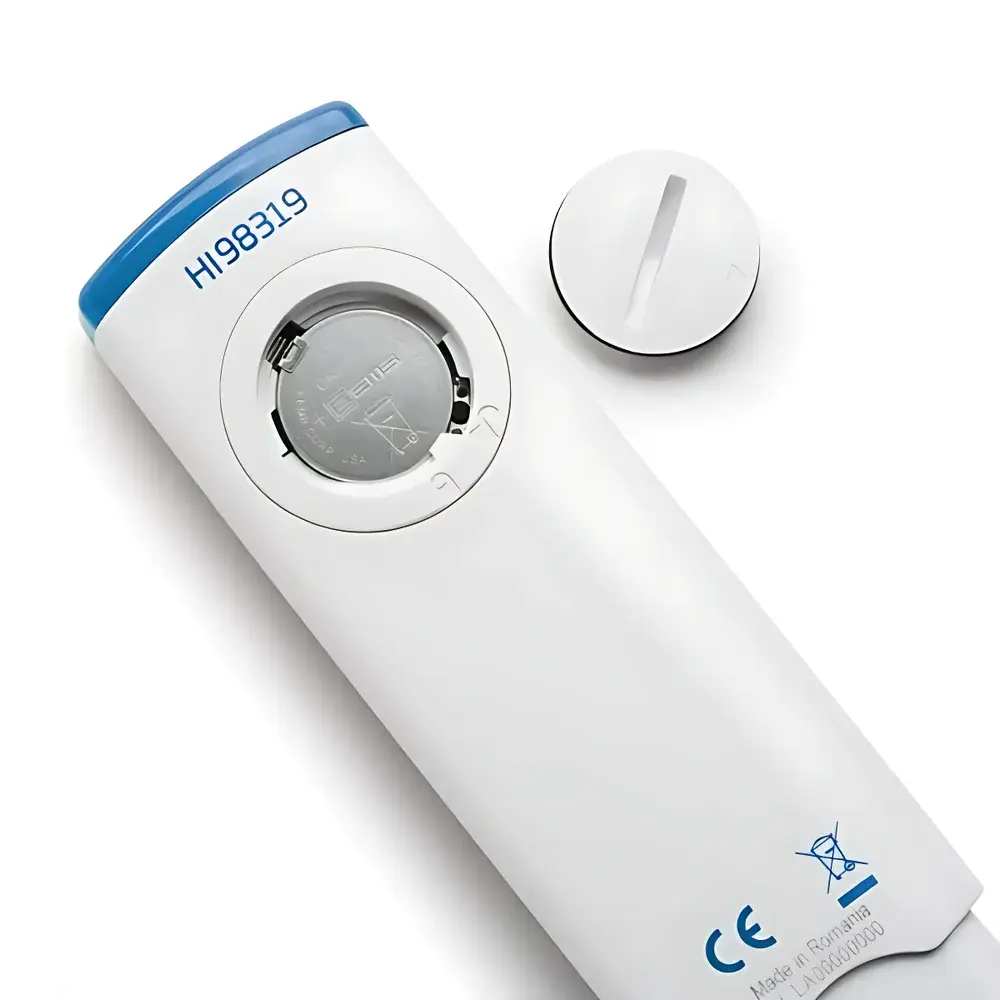
Hanna HI98319 Portable Salinity Meter for Marine Aquariums
| Brand | Hanna Instruments |
|---|---|
| Origin | Italy |
| Model | HI98319 |
| Instrument Type | Portable |
| Parameter Type | Single-Parameter (Salinity) |
| Measurement Range | 0.0 to 70.0 ppt (g/L), 0.0 to 70.0 PSU, 1.000 to 1.041 S.G., 0.0 to 50.0 °C |
| Resolution | 0.1 ppt, 0.1 PSU, 0.001 S.G., 0.1 °C/°F |
| Accuracy | ±1 ppt (0.0–40.0 ppt), ±2 ppt (>40.0 ppt) |
| Calibration | Auto-recognizing single-point at 35.00 ppt (HI70024P recommended) |
| Temperature Compensation | Automatic (0.0 to 50.0 °C) |
| Power | CR2032 lithium coin cell |
| Dimensions | 160 × 40 × 17 mm |
| Weight | 68 g |
Overview
The Hanna HI98319 is a dedicated portable salinity meter engineered for precision monitoring of marine aquarium systems. It employs conductometric measurement principles—based on the International Oceanographic Standard (IOS)—to determine salinity via electrical conductivity, then automatically converts readings into three standardized units: practical salinity units (PSU), parts per thousand (ppt), and specific gravity (S.G.). This conversion adheres to established methodologies outlined in Standard Methods for the Examination of Water and Wastewater (Method 2510B for PSU and Method 2510 for S.G. density correlation). Unlike general-purpose conductivity meters, the HI98319 integrates a temperature-compensated, exposed NTC thermistor sensor that enables real-time automatic temperature compensation (ATC) across 0.0 to 50.0 °C—critical for maintaining measurement integrity in dynamic aquatic environments where thermal fluctuations directly affect ion mobility and conductivity response. Its compact, IP67-rated housing ensures operational reliability in humid, splash-prone settings typical of reef tanks and aquaculture maintenance workflows.
Key Features
- Triple-unit display: Simultaneous or selectable readout of salinity in ppt (g/L), PSU, and S.G.—all traceable to internationally accepted oceanographic and water quality standards.
- Auto-recognizing single-point calibration at 35.00 ppt using Hanna’s certified HI70024P standard solution (20 mL × 25 pouches), eliminating manual entry errors and ensuring metrological consistency.
- Stability-indicated measurement protocol: Animated hourglass icon appears during acquisition; disappears only upon signal stabilization—providing unambiguous visual confirmation before data recording.
- Configurable auto-power-off: User-selectable intervals (8 minutes, 60 minutes, or disabled) optimize battery longevity without compromising workflow continuity.
- Integrated battery status indicator: Displays real-time remaining capacity (%) at startup and flashes when CR2032 voltage drops below operational threshold—preventing unexpected shutdown mid-measurement.
- Ergonomic, low-profile design (6.3 × 1.6 × 0.7 in / 160 × 40 × 17 mm; 68 g): Optimized for one-handed operation and secure grip during wet-hand handling.
Sample Compatibility & Compliance
The HI98319 is validated exclusively for aqueous saline solutions within the specified range (0.0–70.0 ppt), with primary application in marine aquarium management, coral propagation labs, and small-scale aquaculture facilities. It is not intended for high-TDS industrial brines, organic solvent mixtures, or viscous suspensions. All salinity calculations conform to ISO 80000-9:2019 (quantities and units — physical chemistry and molecular physics) and align with ASTM D1125-22 (Standard Test Methods for Electrical Conductivity and Resistivity of Water), supporting traceable documentation in GLP-aligned maintenance logs. While not FDA 21 CFR Part 11 compliant (as it lacks electronic signature or audit trail functionality), its calibration verification sequence—including timestamped stability detection and auto-stored calibration values—supports basic QA/QC recordkeeping requirements under ISO/IEC 17025:2017 Clause 7.7 (Ensuring validity of results).
Software & Data Management
The HI98319 operates as a standalone instrument with no embedded firmware update capability or PC connectivity. Data output is limited to real-time LCD display and manual transcription. However, its deterministic calibration routine—where the meter autonomously verifies standard recognition, monitors drift convergence, and locks calibration coefficients upon stabilization—provides inherent repeatability and reduces operator-dependent variability. The device stores no historical measurements or calibration logs internally; users are advised to maintain external records using standardized logbooks referencing batch numbers of HI70024P standards and ambient temperature at time of use—practices consistent with ISO 15197:2013 guidance for point-of-care analyte verification.
Applications
- Marine aquarium husbandry: Routine verification of salinity prior to water changes, top-offs, or introduction of new specimens.
- Coral fragging and larval rearing: Monitoring osmotic stability in acclimation tanks and settlement chambers.
- Education and outreach labs: Demonstrating conductivity–salinity relationships in undergraduate marine science curricula.
- Small-volume recirculating aquaculture systems (RAS): Spot-checking effluent and intake points where rapid, field-deployable assessment is prioritized over continuous logging.
- Conservation facility support: Field validation of transport media salinity for endangered marine species relocation protocols.
FAQ
What calibration standard is required for the HI98319?
The meter is factory-configured for auto-recognition of 35.00 ppt. Hanna recommends HI70024P (certified 35.00 ± 0.05 ppt at 25 °C, supplied in 20 mL foil-sealed pouches).
Does the HI98319 measure conductivity directly?
No—it measures conductivity and applies proprietary algorithms to compute salinity in ppt, PSU, and S.G. based on IOS and Standard Methods equations; raw µS/cm values are not displayed.
Can the unit be used in freshwater or brackish applications?
Yes, within its full 0.0–70.0 ppt range—but accuracy specifications assume seawater matrix behavior; deviations may occur in low-ionic-strength freshwater due to non-linear conductivity–salinity correlation below 5 ppt.
Is temperature measurement independent of salinity sensing?
Yes—the exposed NTC sensor operates independently and updates temperature values every 0.5 seconds, enabling continuous ATC even during prolonged immersion.
How often should calibration be performed?
Daily for critical applications (e.g., coral spawning tanks); before each session for general maintenance. Frequency should increase if readings drift beyond ±1 ppt against verified reference samples.







