
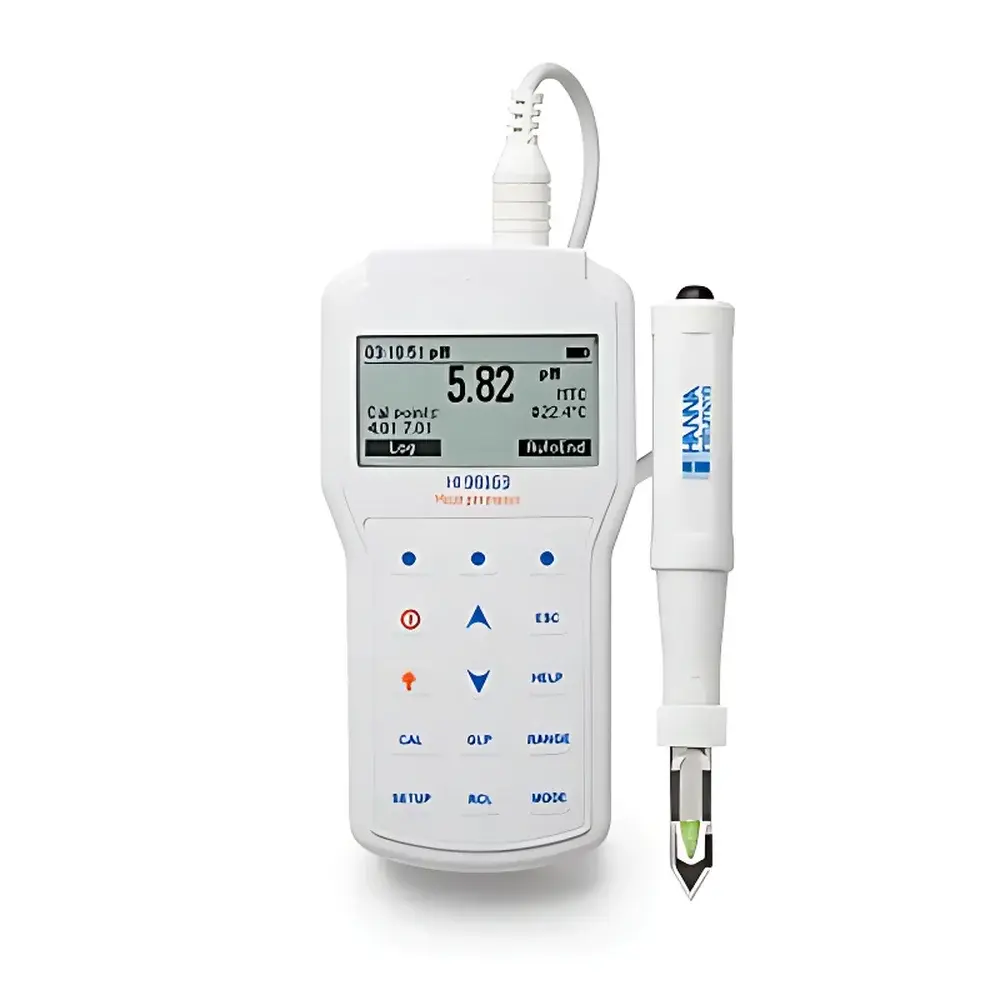
Hanna Instruments HI98163 Portable pH/mV/Temperature Meter for Meat Industry
| Brand | Hanna Instruments |
|---|---|
| Origin | Italy |
| Model | HI98163 |
| pH Range | −2.000 to 20.000 |
| mV Range | ±2000.0 |
| Temperature Range | −20.0 to 120.0 °C |
| Resolution | 0.001 pH / 0.1 mV / 0.1 °C |
| Accuracy | ±0.002 pH / ±0.2 mV / ±0.4 °C |
| Calibration | Up to 5-point auto-recognizing + 5-point custom calibration with 7 built-in buffer points (1.68, 4.01, 6.86, 7.01, 9.18, 10.01, 12.45 pH) |
| Electrode | FC2323 conical-tip PVDF-body pH electrode with integrated amplifier and NTC temperature sensor, stainless-steel blade tip, DIN waterproof connector, 1 m cable |
| Data Logging | 200 records (100 pH + 100 mV) |
| Interface | USB (HI92000-15 software compatible) |
| IP Rating | IP67 |
| Power | 4 × AAA batteries (1.5 V), BEPS low-battery warning |
| Auto-off | Configurable (5/10/30/60 min or disabled) |
| Dimensions | 185 × 93 × 35.2 mm |
| Weight | 400 g |
Overview
The Hanna Instruments HI98163 is a rugged, handheld pH/mV/temperature meter engineered specifically for quality control and process verification in meat processing facilities, slaughterhouses, and food safety laboratories. It operates on the fundamental principle of potentiometric measurement: a glass pH-sensitive membrane generates a voltage differential proportional to hydrogen ion activity in the sample, referenced against a stable internal Ag/AgCl reference system. The integrated NTC thermistor enables real-time automatic temperature compensation (ATC) across the full operational range (−20.0 to 120.0 °C), critical for accurate pH assessment in hot carcass rinses, brine solutions, cured products, and surface swab extracts where thermal drift significantly impacts measurement fidelity. Designed for compliance-driven environments, the HI98163 meets the physical durability and data integrity requirements aligned with HACCP prerequisite programs and supports traceability workflows essential for USDA-FSIS and EU Regulation (EC) No 853/2004 verification protocols.
Key Features
- Triple-parameter measurement capability: high-resolution pH (−2.000 to 20.000), redox potential (±2000.0 mV), and temperature (−20.0 to 120.0 °C) — all simultaneously displayed with user-selectable units (°C/°F).
- Advanced calibration architecture: supports up to five-point automatic buffer recognition plus five additional user-defined calibration points, leveraging seven factory-stored NIST-traceable standard buffers (pH 1.68, 4.01, 6.86, 7.01, 9.18, 10.01, 12.45) to ensure metrological rigor across extreme pH ranges encountered in acidic marinades or alkaline cleaning agents.
- Sensor Check™ diagnostic system: provides real-time visual feedback on electrode slope (%), offset (mV), and response time — enabling proactive maintenance and preventing nonconforming measurements before they enter QC records.
- Dedicated FC2323 conical-tip pH electrode: constructed with chemically resistant PVDF body and integrated solid-state amplifier; features a precision stainless-steel cutting tip optimized for direct insertion into muscle tissue, ground meat patties, and viscous emulsions without clogging or membrane damage.
- Auto-endpoint hold function: freezes stable readings on the graphical LCD upon signal stabilization (configurable threshold), eliminating parallax errors during manual data transcription in humid, fast-paced production zones.
- GLP-compliant data management: stores 200 timestamped entries (100 pH + 100 mV) with date/time stamp, calibration history, and electrode diagnostics — exportable via USB to HI92000-15 software for audit-ready reporting.
Sample Compatibility & Compliance
The HI98163 is validated for direct immersion and surface-contact measurement in heterogeneous meat matrices including raw beef/pork/chicken cuts, comminuted products (sausages, nuggets), brines, marinades, curing solutions, and post-evisceration rinse water. Its IP67-rated enclosure ensures reliable operation under washdown conditions (0–100% RH), while the FC2323 electrode’s conical geometry and stainless-steel blade enable reproducible penetration into fibrous tissue without requiring homogenization—reducing preparation time and preserving sample integrity. The instrument conforms to IEC 60529 (IP67), EN 61010-1 (electrical safety), and supports alignment with FDA 21 CFR Part 11 when used with validated HI92000-15 software configurations. Calibration traceability adheres to ISO/IEC 17025 principles through documented use of certified reference materials.
Software & Data Management
Data acquisition and reporting are managed via the optional HI92000-15 Windows-based software suite, which facilitates secure, password-protected data import, trend analysis, calibration certificate generation, and electronic signature support. Each logged measurement includes embedded metadata: operator ID (user-definable), location tag, electrode serial number, calibration status, ambient temperature, and battery level. Audit trails record all configuration changes, calibration events, and data exports — satisfying GLP/GMP documentation requirements for third-party audits and regulatory inspections. USB communication uses HID-class protocol; no driver installation is required on modern Windows systems.
Applications
- Verification of pH decline post-mortem in beef and pork carcasses to confirm glycolytic progression and tenderness development (target: pH ≤ 5.8 within 24 h).
- Monitoring acidification kinetics in fermented sausages and dry-cured hams using buffered starter cultures.
- Validation of antimicrobial intervention efficacy (e.g., lactic acid or acetic acid sprays) via pre- and post-treatment surface pH mapping.
- Quality assurance of brine formulations for injection curing — ensuring consistent water-holding capacity and salt diffusion rates.
- Sanitation verification: measuring residual alkalinity in CIP rinse water to confirm removal of caustic cleaners (pH > 11.5 indicates inadequate rinsing).
FAQ
Is the FC2323 electrode suitable for measuring pH in intact muscle tissue without homogenization?
Yes. Its conical tip and stainless-steel blade allow controlled, repeatable puncture into fresh or chilled meat, delivering representative interstitial fluid readings without maceration artifacts.
Does the HI98163 meet USDA-FSIS sanitation verification requirements?
While the instrument itself is not “certified” by USDA, its measurement accuracy, GLP logging, IP67 rating, and traceable calibration methodology align with FSIS Directive 7120.1 guidance for environmental monitoring and process control instrumentation.
Can calibration data be exported separately from measurement logs?
Yes. HI92000-15 software allows independent export of calibration reports (including slope, offset, buffer IDs, and timestamps) as PDF or CSV files for internal review or auditor submission.
What is the recommended recalibration frequency for routine meat plant use?
Per industry best practice (AMIF, 2022), recalibrate before each shift and after any electrode cleaning or temperature excursion exceeding 10 °C — with Sensor Check™ used for interim verification between calibrations.
How does BEPS improve measurement reliability in field conditions?
BEPS prevents erroneous low-voltage readings by disabling analog circuitry below 5% battery capacity, eliminating drift-induced inaccuracies during extended use in remote chill rooms or mobile inspection carts.




