
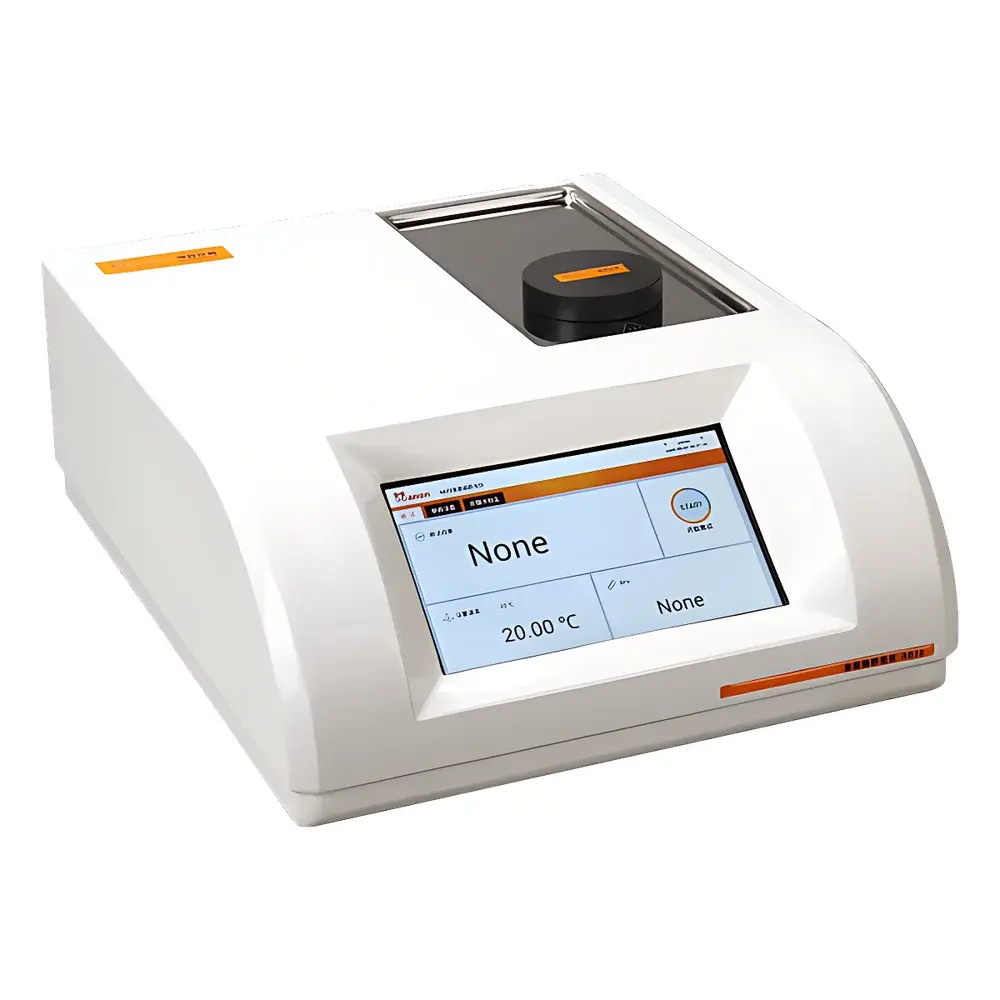
Hanon A630 Desktop Automated Refractometer
| Brand | Hanon |
|---|---|
| Origin | Shandong, China |
| Model | A630 |
| Instrument Type | Benchtop Refractometer |
| Temperature Control | Peltier-based |
| Digital Display | Yes |
| Refractive Index Range | 1.3000–1.7000 (nD) |
| Brix Accuracy | ±0.1% |
| nD Resolution | 0.0001 |
| Temperature Control Range | 10–50 °C |
| Temperature Stability | ±0.05 °C |
| Display | 7-inch capacitive touchscreen (Android OS) |
| Data Storage | 4 GB internal |
| Connectivity | 2× USB, RS232, Ethernet |
| Prism Material | Sapphire-grade optical glass |
| Light Source | >100,000 h LED |
| Compliance | FDA 21 CFR Part 11 (audit trail, user roles, electronic signature support) |
Overview
The Hanon A630 Desktop Automated Refractometer is a precision optical instrument engineered for accurate, repeatable measurement of refractive index (nD) and Brix concentration in liquid samples across diverse industrial and research environments. It operates on the principle of total internal reflection at the sample-prism interface, where a high-intensity LED light source illuminates the sapphire-grade measuring prism, and a high-resolution CCD sensor captures the critical angle of refraction. Signal processing algorithms convert this optical boundary into calibrated nD and Brix values with traceable accuracy. Designed for routine quality control and R&D applications, the A630 delivers stable, operator-independent results under tightly controlled thermal conditions—enabled by an integrated Peltier temperature regulation system. Its benchtop architecture, robust mechanical design, and intuitive Android-based interface make it suitable for ISO/IEC 17025-accredited laboratories, GMP-compliant manufacturing sites, and academic teaching labs requiring regulatory-ready documentation.
Key Features
- Integrated Peltier temperature control system maintaining sample temperature within ±0.05 °C across a 10–50 °C range, ensuring thermally stabilized measurements per ASTM D1218 and ISO 2859-1 protocols
- Sapphire-grade optical prism—exhibiting exceptional hardness (Mohs 9), chemical inertness, and resistance to abrasion and corrosion—enabling safe cleaning with solvents including acetone, ethanol, and dilute acids without surface degradation
- High-sensitivity CCD detector with 0.0001 nD resolution and selectable Brix resolution (0.1% or 0.01%), minimizing human reading error and supporting GLP-compliant data integrity
- 7-inch capacitive touchscreen running a real-time Android OS platform, featuring responsive GUI navigation, multi-language support (English/Chinese), and one-touch measurement workflow
- Dual-layer data security architecture: password policy enforcement (expiry, complexity rules), three-tier user role management (Administrator, Supervisor, Operator), and mandatory screen lock after configurable idle time
- 4 GB onboard flash memory with timestamped storage of raw measurements, operator ID, calibration history, ambient temperature, and Peltier setpoint—each entry cryptographically hashed to prevent tampering
Sample Compatibility & Compliance
The A630 accommodates transparent, translucent, dark-colored, and highly viscous liquids—including crude oil fractions, pharmaceutical syrups, polymer solutions, fruit concentrates, and essential oils—without requiring dilution or filtration. Its wide nD range (1.3000–1.7000) covers common organic solvents (e.g., ethanol: nD ≈ 1.361), glycerol (nD ≈ 1.474), and concentrated sucrose solutions (up to 100% Brix). All firmware and data handling modules comply with FDA 21 CFR Part 11 requirements: full audit trail logging (immutable records of all user actions, parameter changes, and calibration events), electronic signatures for result release, and role-based access control. The device supports IQ/OQ documentation packages and meets electromagnetic compatibility (EMC) standards per IEC 61326-1 and safety requirements per IEC 61010-1.
Software & Data Management
Data export is supported via USB mass storage mode, RS232 serial output (ASCII format), or Ethernet TCP/IP transmission to LIMS or ELN systems. The embedded software includes a customizable formula editor for implementing segmented calibration functions—enabling direct calculation of concentration from nD using user-defined polynomial or piecewise-linear relationships. Calibration verification at 20 °C, 25 °C, and 40 °C using distilled water ensures thermal drift compensation. All measurement sessions are automatically tagged with date/time, operator credentials, temperature setpoint, and environmental metadata—facilitating retrospective analysis and regulatory inspection readiness. Audit logs are stored separately from measurement data and cannot be edited or deleted, satisfying ALCOA+ principles (Attributable, Legible, Contemporaneous, Original, Accurate, Complete, Consistent, Enduring, Available).
Applications
- Food & Beverage: Brix quantification in fruit juices, soft drinks, honey, and dairy products per AOAC 932.12 and ICUMSA methods
- Pharmaceuticals: Excipient concentration verification, syrup density control, and solvent purity screening in API synthesis
- Petrochemicals: Hydrocarbon blend analysis, lubricant formulation QC, and biodiesel purity assessment (ASTM D613, D445)
- Chemicals & Coatings: Resin solids content, monomer conversion monitoring, and paint binder concentration
- Academic Research: Teaching optical property fundamentals, polymer solution thermodynamics, and colligative property studies
FAQ
Does the A630 support network connectivity for remote data retrieval?
Yes—it features native Ethernet interface for wired LAN integration; Wi-Fi is available only on the A670 variant.
Can the instrument be calibrated using standards other than distilled water?
Yes—users may define up to five custom calibration points using NIST-traceable reference fluids with certified nD values.
Is audit trail data exportable in CSV or PDF format?
Audit logs are exportable as encrypted binary files; decoded reports (CSV/PDF) require administrator-level credentials and digital signature validation.
What maintenance is required for the sapphire prism?
No periodic polishing or recoating is needed; routine cleaning with lint-free tissue and analytical-grade isopropanol is sufficient.
How does the A630 ensure measurement repeatability across different operators?
By eliminating manual scale reading through full automation, enforcing standardized temperature equilibration protocols, and binding each result to authenticated user identity and environmental metadata.



