
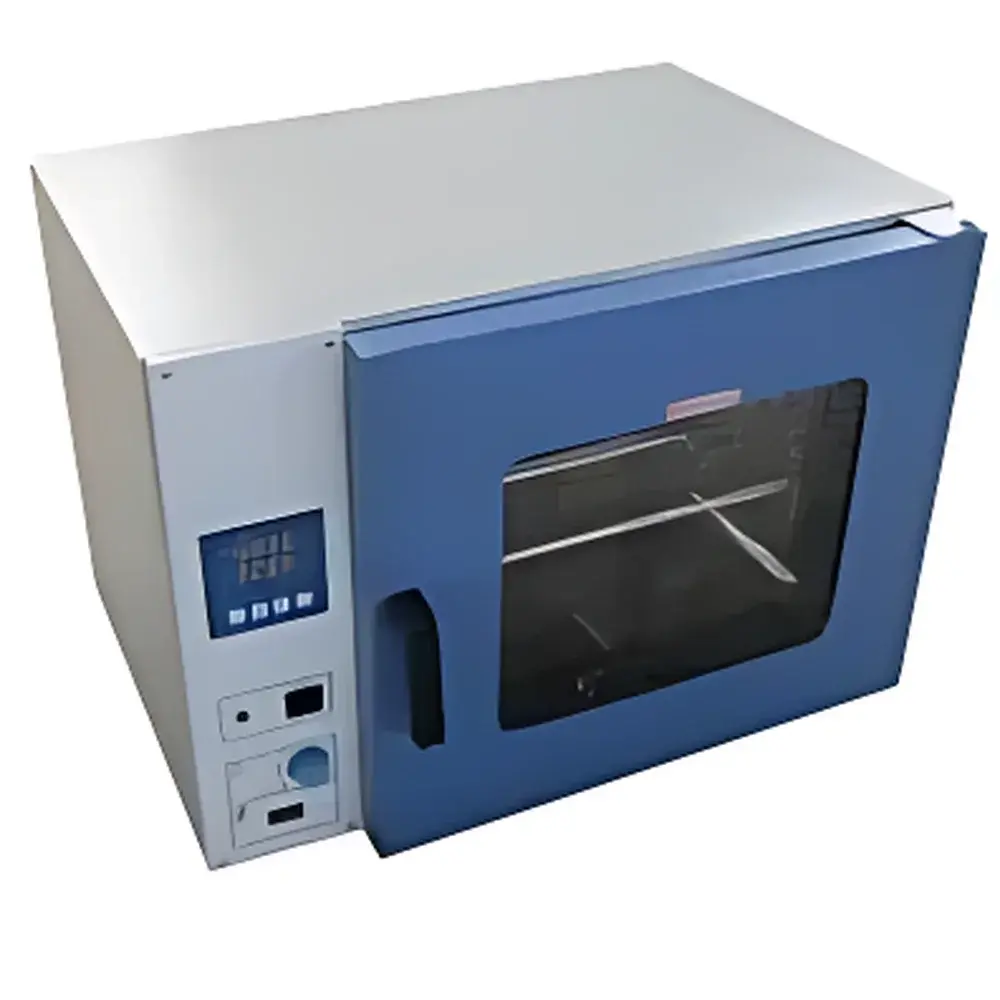
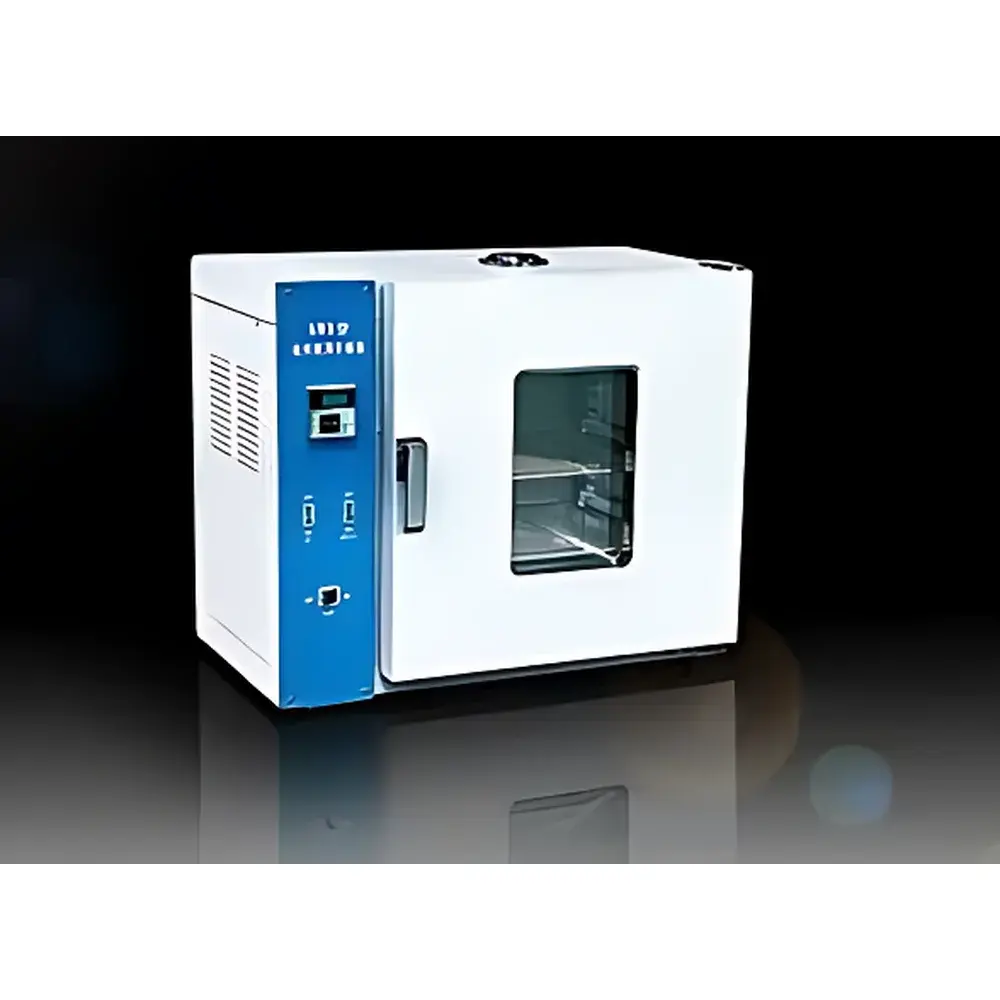
Hanuo 202-0ES Benchtop Forced-Air Drying Oven
| Brand | Hanuo |
|---|---|
| Origin | Shanghai, China |
| Model | 202-0ES |
| Instrument Type | General-Purpose Laboratory Drying Oven |
| Temperature Range | Ambient +10°C to 250°C |
| Temperature Uniformity | ±0.5°C |
| External Dimensions (W×D×H) | 640 mm × 520 mm × 560 mm |
| Internal Chamber Dimensions (W×D×H) | 350 mm × 350 mm × 350 mm |
| Chamber Material | Stainless Steel or Cold-Rolled Steel (Optional) |
| Heating Method | Forced-Air Circulation |
| Power Supply | 220 V, 50 Hz |
| Rated Power | 0.6 kW |
Overview
The Hanuo 202-0ES is a benchtop forced-air drying oven engineered for precision thermal processing in routine laboratory environments. It operates on the principle of convective heat transfer, utilizing an internal axial fan and optimized airflow ducting to ensure uniform temperature distribution across the working chamber—critical for reproducible drying, baking, sterilization, wax melting, and polymer curing applications. Designed to meet the operational demands of quality control laboratories, pharmaceutical R&D facilities, academic research groups, and industrial QA/QC departments, the 202-0ES delivers stable thermal performance within a compact footprint. Its temperature control architecture supports continuous operation at setpoints from ambient +10°C up to 250°C, with typical thermal stability maintained at ±0.5°C under steady-state conditions—a specification aligned with ISO 17025–recommended environmental monitoring tolerances for non-critical thermal validation tasks.
Key Features
- Benchtop form factor with ergonomic external dimensions (640 × 520 × 560 mm), enabling integration into space-constrained lab benches or fume hood alcoves.
- Forced-air circulation system featuring a rear-mounted centrifugal blower and perforated baffle plates to minimize thermal stratification and enhance cross-chamber uniformity.
- Double-walled construction with high-density mineral wool insulation (≥50 mm thickness) between inner and outer chambers, reducing surface temperature rise and improving energy efficiency.
- Tempered glass observation window integrated into the front door, allowing real-time visual monitoring of sample status without interrupting thermal equilibrium.
- Electrostatically coated steel exterior finish providing corrosion resistance and mechanical durability under standard laboratory handling conditions.
- Modular temperature controller interface compatible with optional digital PID controllers (e.g., 0.1°C resolution, programmable ramp/soak profiles), supporting both manual setpoint operation and time-based cycling.
Sample Compatibility & Compliance
The 202-0ES accommodates standard laboratory ware including porcelain crucibles, glass Petri dishes, aluminum weighing boats, stainless-steel trays, and polymer-coated substrates—provided materials are rated for continuous exposure up to 250°C. The chamber’s 350 × 350 × 350 mm usable volume supports simultaneous processing of multiple small-to-medium samples while maintaining adequate air exchange rates (≥12 air changes per minute at 100°C). While not certified for Class II biological safety or explosion-proof use, the unit complies with IEC 61010-1:2010 (Safety Requirements for Electrical Equipment for Measurement, Control, and Laboratory Use) and meets CE marking requirements for electromagnetic compatibility (EN 61326-1) and low-voltage directive (2014/35/EU). It is suitable for GLP-aligned workflows where documented thermal consistency is required, though formal IQ/OQ validation kits must be procured separately.
Software & Data Management
The base 202-0ES model operates via analog or basic digital panel controls and does not include embedded data logging or network connectivity. However, it supports third-party integration through analog voltage output (0–5 V or 4–20 mA) for external temperature recording systems compliant with FDA 21 CFR Part 11 when paired with validated data acquisition hardware and audit-trail-enabled software (e.g., LabVIEW DAQ modules or Eurotherm 2408 recorders). Optional upgrades include microprocessor-based controllers with USB or RS-485 interfaces, enabling CSV export of time-stamped temperature logs and configurable alarm thresholds—facilitating traceability in ISO/IEC 17025-accredited testing environments.
Applications
- Moisture content determination per ASTM D2297 and ISO 712 for polymers, adhesives, and coatings.
- Drying of filter papers, gravimetric precipitates, and soil samples prior to ashing or elemental analysis.
- Pre-conditioning of reference standards and calibration weights in metrology labs.
- Curing of epoxy resins and silicone encapsulants during electronics assembly process development.
- Depyrogenation of glassware and stainless-steel tools at ≥250°C for low-end cleanroom pre-use treatment (non-sterile applications).
- Accelerated aging studies of packaging materials under controlled thermal stress per ISTA 2A protocols.
FAQ
What is the maximum recommended continuous operating temperature?
The 202-0ES is rated for continuous operation up to 250°C; exceeding this limit may compromise sensor longevity and insulation integrity.
Can the chamber be configured with stainless steel interior as standard?
Yes—stainless steel lining is available as a factory-configurable option (designated by “B” suffix in model variants such as 202-0EBS); cold-rolled steel remains standard unless otherwise specified.
Is this oven suitable for sterilization of medical devices?
No—it lacks the temperature uniformity validation, documentation features, and regulatory certifications (e.g., EN 285, ISO 17665) required for sterilization-grade dry heat processes.
Does the unit include over-temperature protection?
Yes—a redundant mechanical safety thermostat cuts power if chamber temperature exceeds 270°C, independent of the primary controller.
What maintenance intervals are recommended for optimal performance?
Inspect and clean the air intake filter monthly; verify temperature uniformity annually using calibrated NIST-traceable thermocouples placed at nine standardized chamber locations per ASTM E2203.



