
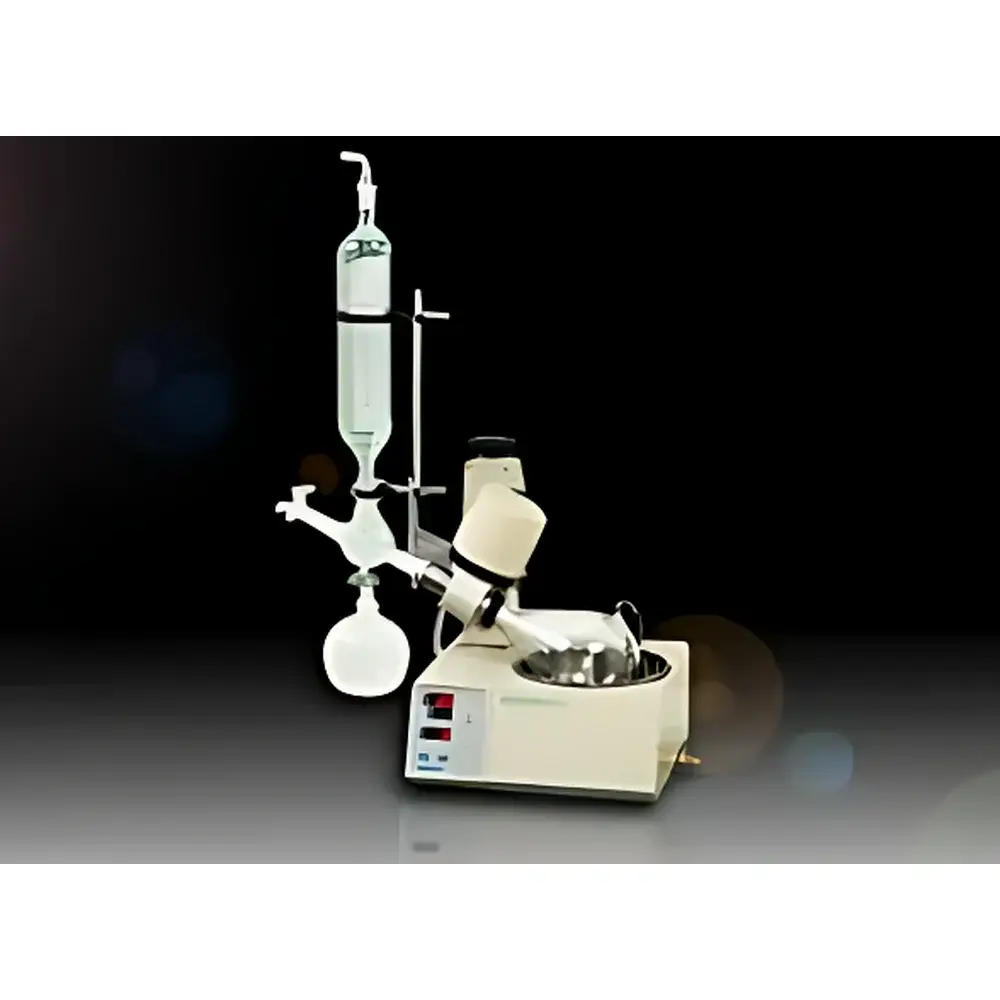
Hanuo RE-52A Rotary Evaporator
| Brand | Hanuo |
|---|---|
| Origin | Shanghai, China |
| Model | RE-52A |
| Rotational Speed | 0–120 rpm |
| Heating Bath Temperature Range | RT to 100 °C |
| Vacuum Capability | ≤ 0.098 MPa (≈ 74 Torr) |
| Evaporation Flask Capacity | 2 L |
| Collection Flask Capacity | 2 L |
| Cooling Surface Area | 0.11 m² |
| Heating Control Accuracy | ±1 °C over full range |
| Lift Mechanism | Manual screw-type vertical lift |
| Condenser Type | Vertical dual-spiral coil with integrated small-capacity cold trap |
| Total Power Consumption | 1060 W |
Overview
The Hanuo RE-52A Rotary Evaporator is a benchtop-to-floor-standing vacuum distillation system engineered for reproducible solvent removal, concentration, and recovery under controlled thermal and pressure conditions. It operates on the principle of thin-film evaporation: under reduced pressure (down to 0.098 MPa), a motor-driven 2 L evaporation flask rotates at adjustable speeds (0–120 rpm) within a thermostatically regulated water or oil bath (RT to 100 °C). This rotation generates a uniform, high-surface-area liquid film along the inner wall of the flask—maximizing heat transfer and mass transfer efficiency while minimizing localized overheating. Vaporized solvent passes through a vertically oriented dual-spiral condenser with 0.11 m² effective cooling surface area, where it undergoes rapid phase transition and is collected in a matched 2 L receiving flask. The system’s design prioritizes thermal stability, mechanical robustness, and operational safety—making it suitable for routine use in academic laboratories, QC/QA environments, and pilot-scale process development across pharmaceutical, fine chemical, food science, and environmental analysis applications.
Key Features
- Stable manual screw-type vertical lift mechanism enabling precise, backlash-free positioning of the evaporation flask relative to the heating bath—critical for consistent immersion depth and thermal coupling.
- Dual-spiral vertical condenser with integrated small-capacity cold trap enhances condensation efficiency for low-boiling solvents (e.g., diethyl ether, dichloromethane, acetone) and reduces vapor bypass during high-throughput operation.
- Heating bath with PID-controlled temperature regulation (RT to 100 °C) and ±1 °C accuracy across the full operating range ensures repeatable thermal input—essential for thermolabile compound handling and method transfer.
- Sealed rotary joint with PTFE/graphite composite seal minimizes vacuum leakage and accommodates continuous rotation under sub-atmospheric pressure without lubricant contamination.
- Robust aluminum alloy frame and borosilicate 3.3 glassware set (evaporation flask, condenser, collection flask, adapter) conform to ISO 3585 standards for chemical resistance and thermal shock tolerance.
- Integrated safety features include over-temperature cutoff, motor overload protection, and grounding continuity verification per IEC 61010-1 requirements for laboratory electrical equipment.
Sample Compatibility & Compliance
The RE-52A accommodates a broad spectrum of organic and aqueous solutions—including polar aprotic solvents (DMF, DMSO), chlorinated hydrocarbons, alcohols, and buffer systems—provided compatibility with borosilicate glass and PTFE sealing materials is verified. It supports standard GLP-compliant documentation workflows when paired with external vacuum controllers and calibrated temperature probes. While the unit itself does not include digital audit trail functionality, its analog control architecture allows integration into validated environments where manual logbook entries meet regulatory expectations (e.g., USP , ASTM E2500-13 for equipment qualification). All glass components comply with ISO 3585; electrical design adheres to IEC 61010-1 Edition 3 for safety in laboratory use.
Software & Data Management
The RE-52A is an analog-operated instrument with no embedded microprocessor or digital interface. Temperature setpoint and rotational speed are adjusted via front-panel dials with mechanical indicators. As such, it does not generate electronic records, require firmware updates, or support network connectivity. This architecture eliminates cybersecurity concerns and simplifies 21 CFR Part 11 compliance pathways in regulated settings—where handwritten logs, calibrated external thermometers, and vacuum gauge readings constitute the primary data capture method. Users may pair the system with third-party data loggers (e.g., Omega OM-DAQPRO-5300) for time-stamped monitoring of bath temperature and vacuum level, supporting IQ/OQ documentation per GAMP 5 guidelines.
Applications
- Concentration of natural product extracts (e.g., plant alkaloids, essential oils) without thermal degradation.
- Solvent recovery in API synthesis workflows—reducing waste disposal costs and improving EHS metrics.
- Removal of volatile reaction byproducts (e.g., THF, toluene) prior to crystallization or lyophilization.
- Preparative-scale dehydration of heat-sensitive biopolymers (e.g., polysaccharides, peptides) under mild vacuum and controlled bath temperature.
- Standardized evaporation protocols in teaching labs for undergraduate organic chemistry instruction (ASTM D86, ISO 3405 referenced methodologies).
- Environmental sample preparation: concentration of aqueous pesticide extracts prior to GC-MS analysis.
FAQ
What is the maximum recommended operating vacuum for the RE-52A?
The system is rated for sustained operation at ≤ 0.098 MPa (approximately 74 Torr); optimal performance is achieved using a two-stage vacuum pump capable of reaching ≤ 0.005 MPa base pressure.
Can the RE-52A be used with corrosive solvents such as concentrated HCl or HF?
No—standard borosilicate 3.3 glass and PTFE seals are incompatible with hydrofluoric acid and fuming hydrochloric acid. Use only with solvents listed in Corning’s chemical resistance guide for Pyrex-type glass.
Is the heating bath compatible with silicone oil as a heat transfer medium?
Yes—the bath vessel is rated for continuous operation up to 100 °C with water or silicone oil (up to 200 cSt viscosity); ensure oil level remains ≥2 cm above heater element.
Does the RE-52A include a vacuum controller or pressure sensor?
No—vacuum regulation requires an external controller or manual needle valve; optional analog vacuum gauges (e.g., Pirani-type) may be installed downstream of the condenser.
What maintenance intervals are recommended for long-term reliability?
Inspect PTFE/graphite rotary seal every 200 operating hours; replace if axial play exceeds 0.3 mm. Clean condenser coils quarterly with ethanol and lint-free wipes; verify bath heater calibration annually using a NIST-traceable thermometer.



