
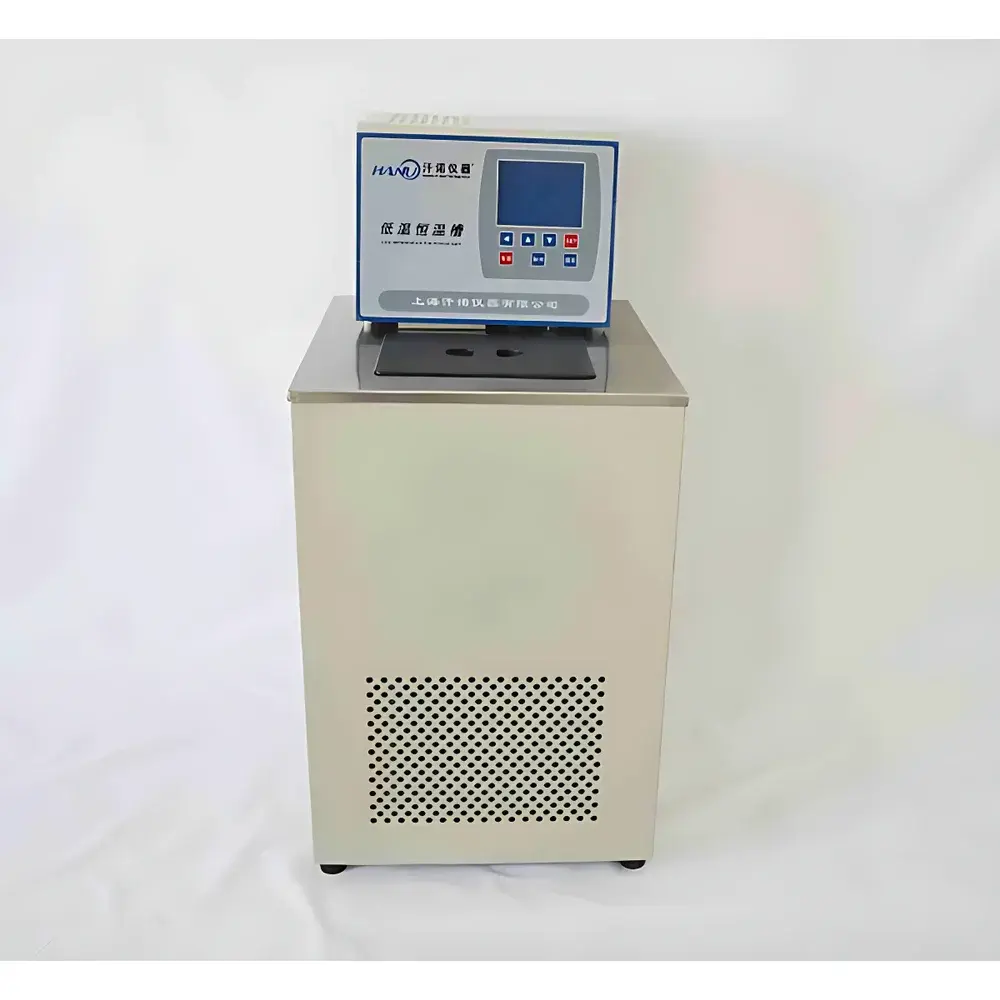
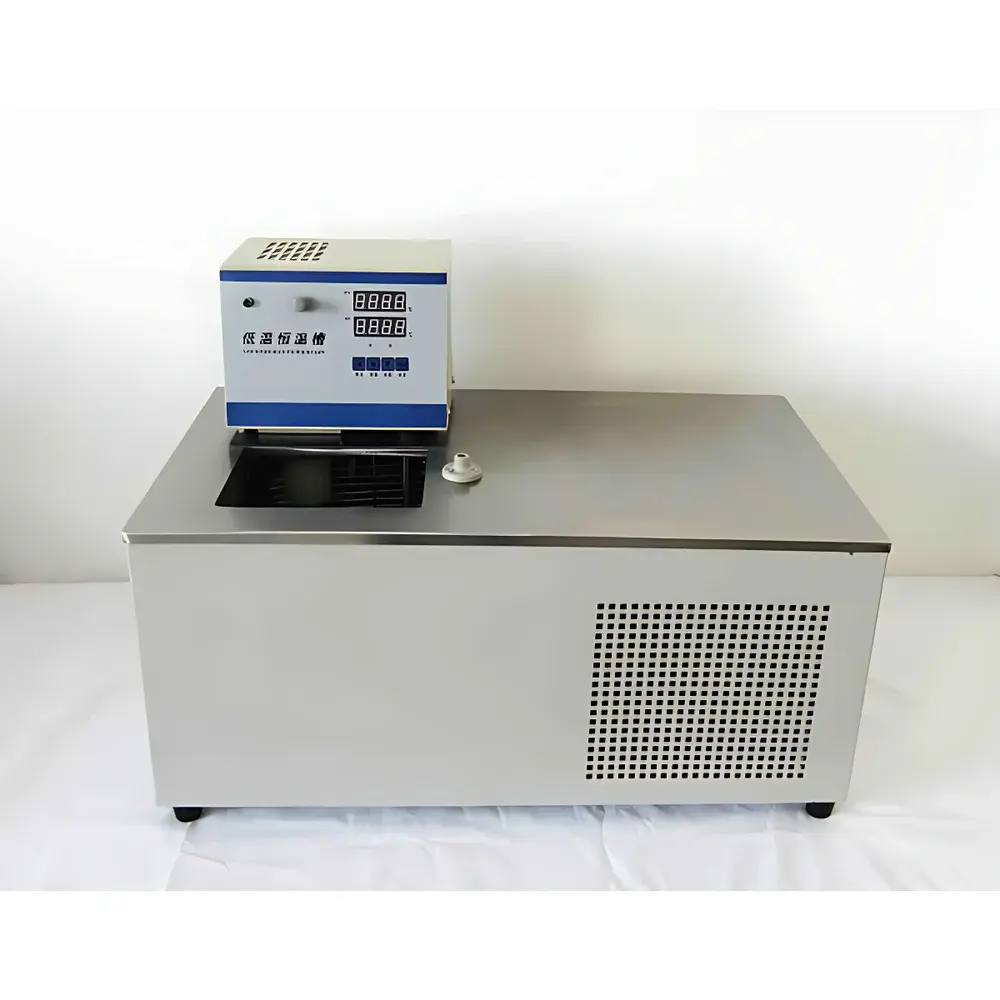
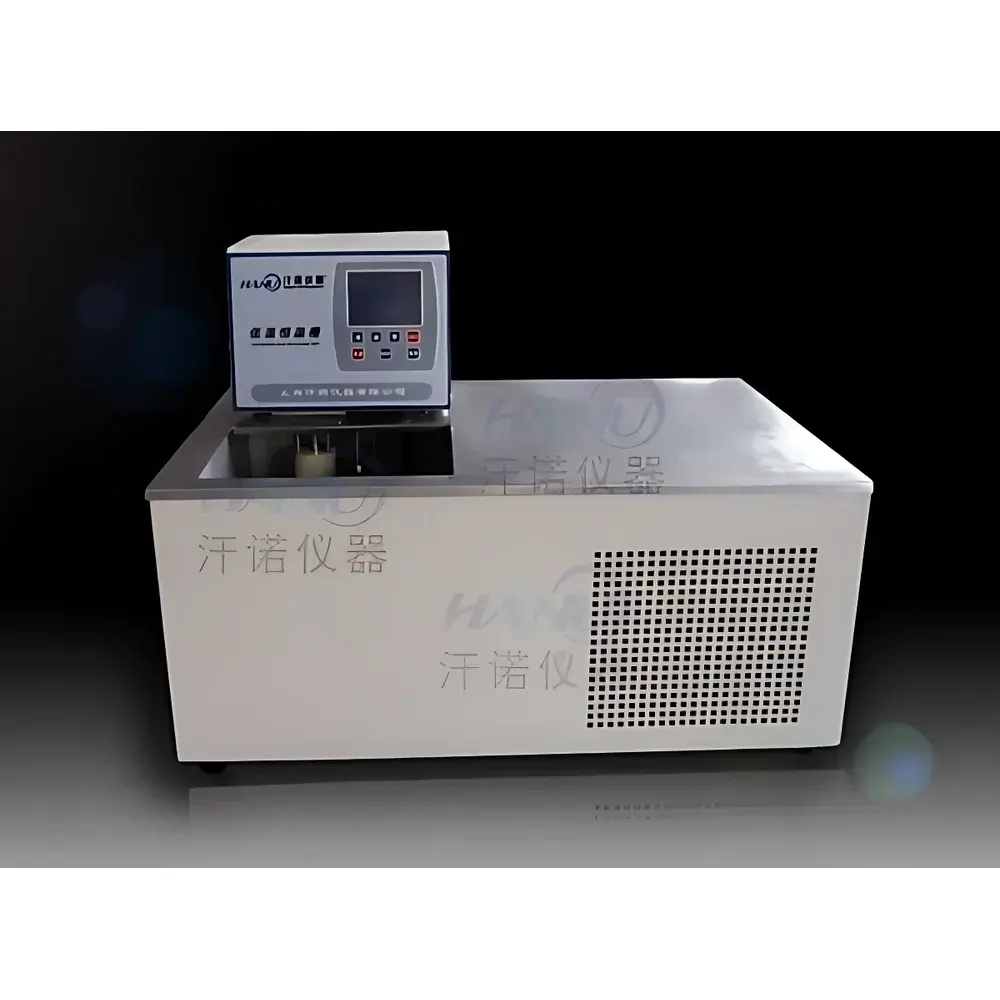
Hanuo DC-0520 Low-Temperature Constant-Temperature Circulating Bath
| Brand | Hanuo |
|---|---|
| Origin | Shanghai, China |
| Model | DC-0520 |
| Instrument Type | Constant-Temperature Bath |
| Circulation Mode | Internal & External |
| Temperature Control | Refrigeration & Heating |
| Bath Volume | 20 L |
| Temperature Range | −5 °C to 100 °C |
| Temperature Stability | ±0.05 °C |
Overview
The Hanuo DC-0520 Low-Temperature Constant-Temperature Circulating Bath is a precision-engineered thermal control system designed for laboratory and industrial applications requiring stable, programmable temperature environments across a broad operational range (−5 °C to 100 °C). It operates on a closed-loop refrigeration–heating principle, integrating a hermetically sealed compressor, high-efficiency heat exchanger, and PID-based digital temperature controller to deliver rapid thermal response and exceptional long-term stability (±0.05 °C). Unlike simple immersion baths, the DC-0520 functions as both an internal test chamber and an external temperature source—enabling precise conditioning of samples within its 20 L stainless-steel bath or remote circulation of thermally regulated fluid to external equipment such as spectrophotometer cells, reaction jackets, or material testing fixtures. Its dual-mode circulation pump supports consistent thermal homogeneity and enables integration into larger experimental setups compliant with ISO/IEC 17025 and GLP traceability requirements.
Key Features
- Advanced XMT-series digital PID controller with real-time temperature display, setpoint programming, and auto-tuning capability for minimized overshoot and steady-state deviation.
- Hermetically sealed refrigeration unit with overheat and overcurrent protection circuits, ensuring safe, uninterrupted operation during extended low-temperature protocols.
- Dual-path circulation system: internal recirculation maintains uniform bath temperature; external output port (with adjustable flow rate) delivers conditioned fluid at up to 4 L/min to auxiliary devices.
- Corrosion-resistant 304 stainless-steel bath tank (280 × 250 × 280 mm internal dimensions) with insulated lid and ergonomic handle design for operator safety and thermal efficiency.
- Compact footprint optimized for benchtop integration; compatible with standard laboratory fume hoods and modular workstations.
- Configurable orientation: vertical design (DC series) maximizes vertical space utilization; optional DCW-series horizontal variants available for under-bench installation.
Sample Compatibility & Compliance
The DC-0520 accommodates a wide range of sample formats—including glassware (e.g., jacketed reactors, cuvettes, viscometer sleeves), metal housings, and polymer-based test fixtures—without risk of thermal shock or condensation-induced corrosion. Its fluid compatibility extends to water, water–glycol mixtures (up to 30 % v/v), and other non-aggressive heat-transfer media recommended by ASTM D1176 and ISO 2531. All electrical components comply with IEC 61010-1:2010 for laboratory equipment safety. The system supports audit-ready documentation workflows aligned with FDA 21 CFR Part 11 when paired with validated data logging software (see Software & Data Management section). Calibration certificates traceable to NIM (National Institute of Metrology, China) are available upon request for ISO/IEC 17025-accredited laboratories.
Software & Data Management
While the DC-0520 operates autonomously via its front-panel interface, it features an RS232 communication port for connection to PC-based monitoring systems. Third-party software (e.g., LabVIEW, MATLAB, or custom Python scripts using PySerial) can acquire real-time temperature readings, log setpoint history, and trigger alarms based on user-defined thresholds. For regulated environments, Hanuo offers optional validation packages—including IQ/OQ documentation templates, sensor calibration records, and electronic audit trail configuration guidance—to support GMP/GLP compliance. Data export is supported in CSV format for integration into LIMS platforms and statistical process control (SPC) analysis tools.
Applications
- Thermal calibration of temperature-sensitive sensors (RTDs, thermistors, infrared detectors) per ASTM E220 and ISO 17025 Clause 5.10.
- Controlled-rate cooling/heating studies in polymer crystallization, protein denaturation, and phase-transition analysis.
- Stabilization of optical instruments (e.g., laser diodes, interferometers) requiring sub-0.1 °C thermal drift control.
- Supporting ASTM D7042, ISO 23529, and USP environmental conditioning for rheological, viscoelastic, and sterility testing.
- Process validation in pharmaceutical QC labs where thermal consistency directly impacts dissolution profile reproducibility.
- Material testing per ASTM D696 (coefficient of linear expansion) and ISO 11359 (dynamic mechanical analysis).
FAQ
What is the minimum operating temperature, and how quickly does the unit reach −5 °C from ambient?
The DC-0520 achieves −5 °C in approximately 45 minutes under standard load conditions (20 L deionized water, no external circulation). Cooling time varies with ambient temperature, fluid volume, and thermal load.
Can this bath be used with organic solvents such as ethanol or acetone?
No. Only water, aqueous glycol solutions (≤30 %), or manufacturer-approved heat-transfer fluids should be used. Organic solvents may degrade seals and compromise refrigerant integrity.
Is external temperature probe input supported for cascade control?
Not natively. The DC-0520 regulates based on internal bath sensor feedback. For sample-specific control, users must implement external PID controllers interfaced via analog output signals or RS232 command protocol.
Does the unit meet CE or UL safety certification standards?
The DC-0520 conforms to GB 4793.1–2007 (Chinese equivalent of IEC 61010-1) and carries CCC certification. CE marking is not applied; UL listing requires separate regional certification engagement.
How often should the refrigeration system be serviced?
Under normal operation, annual inspection of compressor oil level, refrigerant pressure, and condenser coil cleanliness is recommended. Full service intervals depend on cumulative runtime and ambient dust/humidity exposure.
Related Products



