
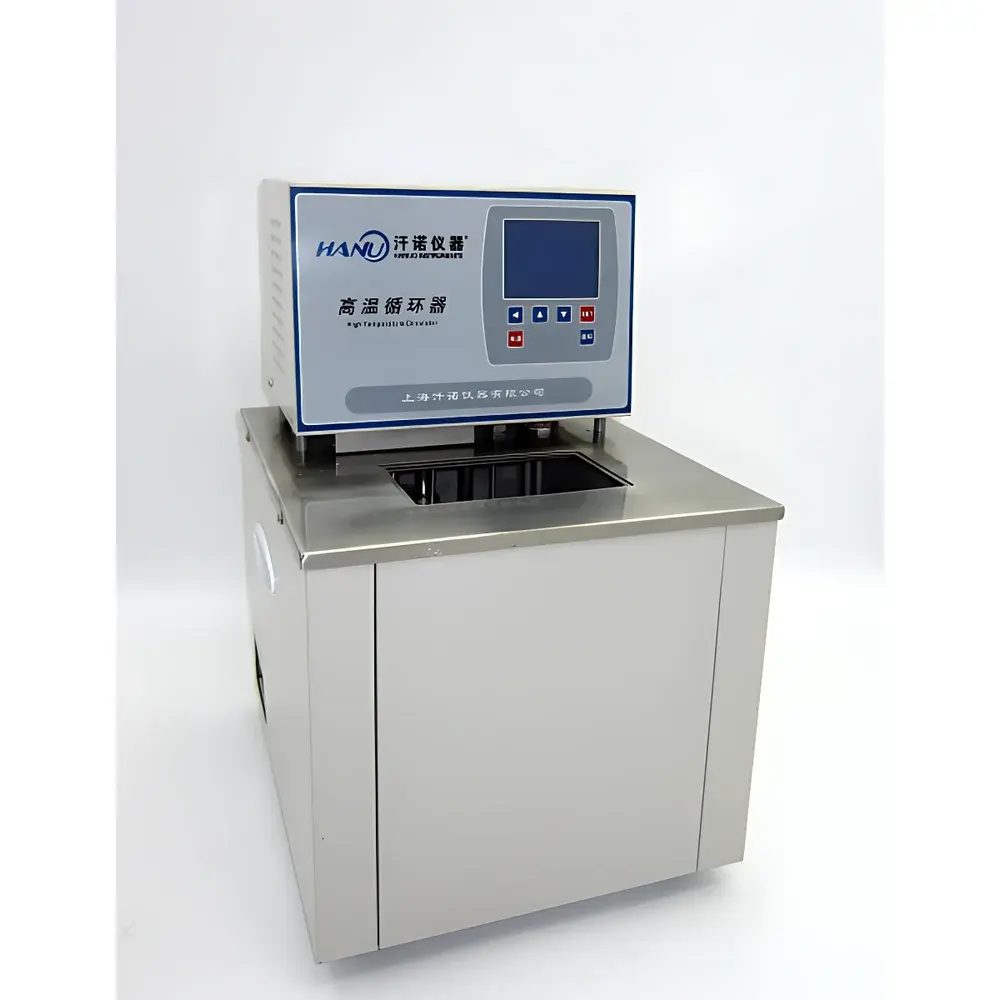
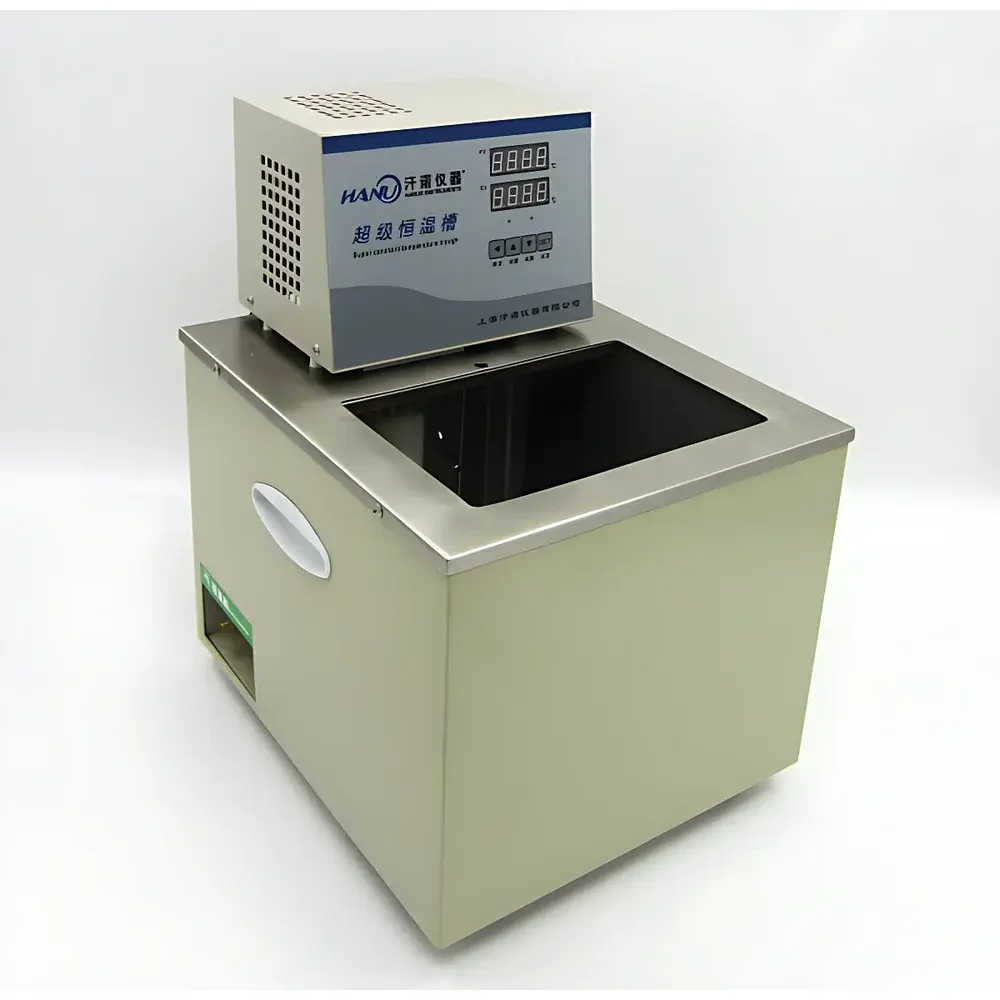
Hanuo GX-2005 High-Temperature Circulating Bath
| Brand | Hanuo |
|---|---|
| Origin | Shanghai, China |
| Model | GX-2005 |
| Instrument Type | Constant-Temperature Circulating Bath |
| Circulation Mode | External Circulation |
| Temperature Control | Heating-Only |
| Bath Volume | 5 L |
| Temperature Range | Ambient to 300 °C |
| Temperature Stability | ±0.2 °C |
| Pump Flow Rate | 10–15 L/min |
| Tank Dimensions (W×D×H) | 240 × 150 × 150 mm |
| Tank Depth | 150 mm |
| Dual LED Display | Setpoint & Actual Temperature |
| Power Supply | Standard Industrial AC Input |
Overview
The Hanuo GX-2005 High-Temperature Circulating Bath is a precision-engineered thermal management system designed for demanding laboratory and pilot-scale applications requiring stable, controllable heat delivery up to 300 °C. Operating on the principle of forced liquid circulation—using a robust external pump to circulate heated silicone oil or high-flash-point heat transfer fluid—the GX-2005 delivers uniform thermal energy to external process equipment such as jacketed reactors, distillation columns, calorimeters, and semiconductor wafer processing stations. Unlike basic immersion heaters or static oil baths, this unit integrates closed-loop temperature feedback with microprocessor-based PID control, enabling rapid heating ramp rates and high reproducibility across repeated thermal cycles. Its all-stainless-steel fluid path and corrosion-resistant tank construction ensure long-term reliability when operating with aggressive heat transfer media under sustained high-temperature conditions.
Key Features
- Microprocessor-controlled PID temperature regulation with dual LED display showing both setpoint and real-time bath temperature—enabling precise manual adjustment and immediate visual verification.
- Heating-only operation optimized for stability at elevated temperatures; no integrated cooling mechanism, but compatible with optional external chiller integration via auxiliary inlet/outlet ports.
- High-capacity external circulation pump delivering 10–15 L/min flow rate, supporting large-volume jacketed systems and minimizing thermal lag in multi-point distribution loops.
- Universal fluid compatibility: validated for use with water (up to 99 °C), ethylene glycol/water mixtures, and high-thermal-stability silicone oils (e.g., Dow Corning PMX-200 series) up to 300 °C.
- Compact benchtop footprint (240 × 150 × 150 mm internal tank dimensions) with 5 L usable volume—optimized for space-constrained labs while maintaining sufficient thermal mass for low-drift operation.
- Touch-sensitive membrane keypad interface with intuitive navigation, eliminating mechanical switches prone to oil ingress or thermal degradation.
Sample Compatibility & Compliance
The GX-2005 is routinely deployed in environments governed by ISO/IEC 17025-accredited testing laboratories and GLP-compliant R&D facilities. While the unit itself does not carry CE or UL certification out-of-the-box (as supplied by regional distributors), its electrical architecture conforms to IEC 61010-1 safety requirements for laboratory equipment, including over-temperature cut-off, ground-fault protection, and thermal fuse redundancy. When operated with certified heat transfer fluids meeting ASTM D4652 or ISO 6743-12 specifications, the system supports traceable thermal validation per ASTM E1137/E1137M (Standard Specification for Temperature Uniformity of Laboratory Ovens). It is commonly integrated into processes aligned with USP (Thermal Analysis) and ICH Q5C (Stability Testing of Biotechnological Products), particularly where elevated temperature hold steps are required during formulation development.
Software & Data Management
The GX-2005 operates as a standalone analog/digital hybrid controller without native USB or Ethernet connectivity. However, its 0–5 V or 4–20 mA analog output port (optional configuration) enables seamless integration into centralized SCADA or LabVIEW-based monitoring systems for time-stamped temperature logging, alarm triggering, and audit-trail generation. For full 21 CFR Part 11 compliance—including electronic signatures, user access levels, and immutable data records—external data acquisition hardware (e.g., National Instruments cDAQ modules with calibrated thermocouple inputs) must be employed in conjunction with validated third-party software platforms such as DeltaV or Siemens Desigo CC. Routine calibration verification follows NIST-traceable procedures using Class A PT100 reference probes per ISO/IEC 17025 clause 6.5.
Applications
- Temperature control of single- or double-jacketed glass reactors during exothermic catalytic hydrogenation or Grignard synthesis.
- Providing stable thermal input to rotary evaporators during high-boiling-point solvent removal (e.g., DMF, NMP, or DMSO).
- Calibration source for infrared pyrometers and contact thermometers in metrology labs.
- Thermal preconditioning of polymer samples prior to dynamic mechanical analysis (DMA) or thermogravimetric analysis (TGA).
- Process support in semiconductor cleanroom environments for controlled bake-out of photomask holders and wafer chucks.
FAQ
Is the GX-2005 suitable for use with water above 100 °C?
No. Water must not be used above its atmospheric boiling point (100 °C); for temperatures beyond this range, only certified silicone oils or synthetic heat transfer fluids with appropriate flash points and thermal oxidative stability should be employed.
Can the unit maintain ±0.2 °C stability across the full 300 °C range?
Yes—under steady-state conditions with proper fluid selection and minimal ambient draft, the specified stability of ±0.2 °C applies across the entire operational range, verified per internal factory calibration using reference-grade PRTs.
Does the external circulation port support standard 1/2″ NPT fittings?
Yes—the inlet and outlet ports are equipped with 1/2″ BSP female threads, compatible with common Swagelok or Parker compression fittings via standard adapters.
What maintenance intervals are recommended for continuous 24/7 operation?
Oil level and clarity should be inspected weekly; heat transfer fluid replacement is advised every 6–12 months depending on peak operating temperature and duty cycle, per manufacturer’s technical bulletin TB-GX-2023-04.



