
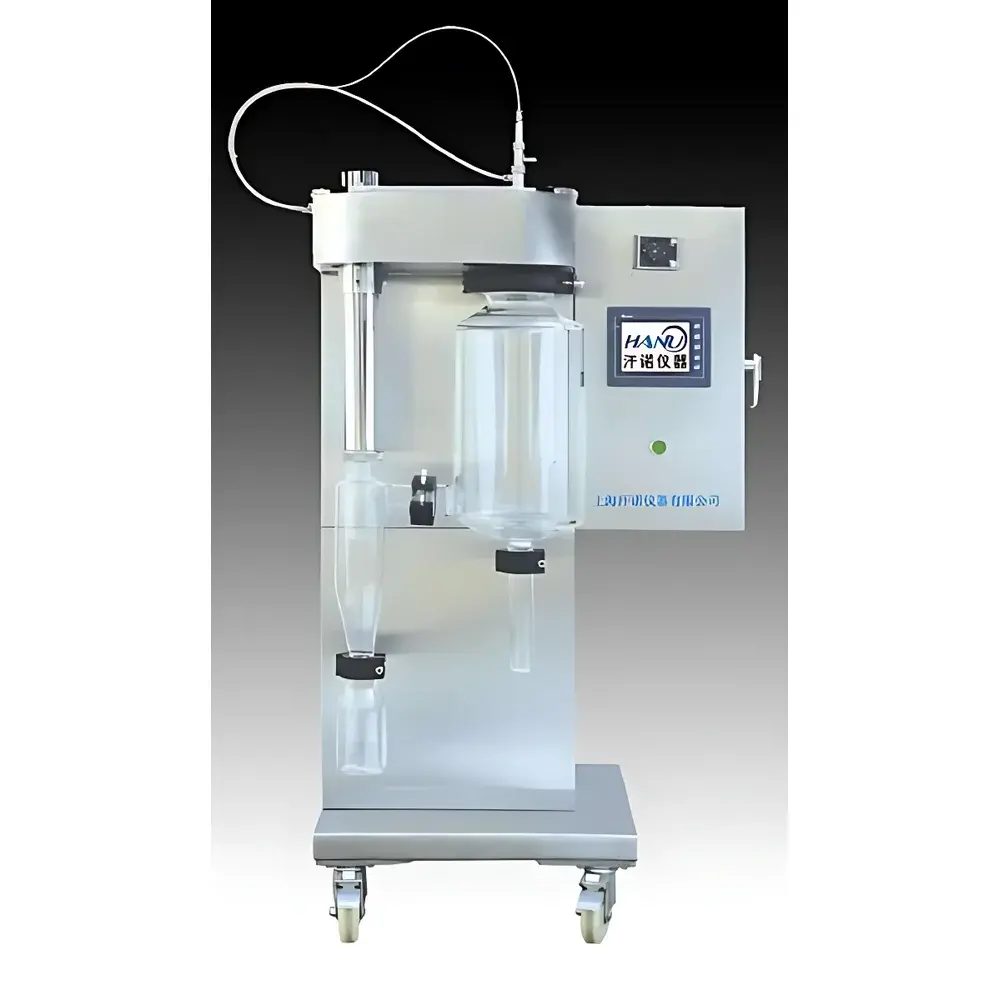
Hanuo HN-1500P Laboratory Spray Dryer
| Brand | Hanuo |
|---|---|
| Origin | Shanghai, China |
| Model | HN-1500P |
| Sample Type | Aqueous solutions only |
| Max. Feed Rate | 2500 mL/h |
| Inlet Temp. Range | 30–300 °C |
| Outlet Temp. Range | 30–140 °C |
| Evaporation Capacity | 1500–2500 mL/h |
| Drying Time | 1.0–1.5 s |
| Temperature Control Accuracy | ±1 °C |
| Power Supply | 3 kW / 220 V |
| Dimensions (H×L×W) | 1300 × 650 × 500 mm |
| Construction | Full 316 stainless steel frame + borosilicate glass drying chamber & collection system |
| Nozzle Type | Two-fluid pneumatic atomizer |
| Cleaning | Automatic needle cleaner (adjustable frequency) |
| Display | Color LCD touchscreen showing inlet/outlet temp., pump speed, airflow, needle actuation frequency |
| Minimum Sample Volume | 30 mL |
Overview
The Hanuo HN-1500P Laboratory Spray Dryer is a compact, benchtop-scale spray drying system engineered for precise, reproducible powder production from aqueous solutions and suspensions. It operates on the principle of flash evaporation via two-fluid pneumatic atomization: liquid feed is pneumatically dispersed into fine droplets within a heated air stream, enabling rapid solvent removal in 1.0–1.5 seconds. This ultra-short residence time minimizes thermal degradation—making the HN-1500P especially suitable for thermolabile compounds including proteins, enzymes, probiotics, vaccine adjuvants, natural extracts, and pharmaceutical actives. Unlike conventional oven or freeze-drying methods, spray drying delivers continuous, scalable particle formation with inherent control over morphology, density, and residual moisture—critical parameters in formulation development, excipient screening, and preclinical dosage form optimization.
Key Features
- Two-fluid pneumatic nozzle assembly with precision-machined 316 stainless steel atomizer—ensures consistent droplet size distribution and high atomization efficiency across variable feed viscosities.
- Full 316 stainless steel structural frame and fluid-contact components—provides long-term corrosion resistance in humid, saline, or mildly acidic environments typical in biopharmaceutical and food R&D labs.
- Borosilicate glass drying chamber and cyclonic collection vessel—optically transparent, chemically inert, and capable of withstanding thermal shocks up to 300 °C; enables real-time process observation without compromising containment integrity.
- Integrated PID-based temperature control system—maintains inlet air temperature within ±1 °C of setpoint across the full 30–300 °C range; outlet temperature independently regulated between 30–140 °C for precise thermal profiling.
- Programmable peristaltic feed pump—adjustable flow rate from 30 to 2500 mL/h, supporting minimal sample consumption (as low as 30 mL) for high-value biologics or early-stage compound libraries.
- Automatic needle-cleaning mechanism—actuates at user-defined intervals to prevent nozzle clogging during prolonged operation with particulate-laden feeds (e.g., colloidal suspensions or cell lysates); cleaning frequency and duration are fully configurable via touchscreen interface.
- Safety-oriented shutdown protocol—pressing “Stop” halts heating elements and feed pump immediately while allowing the blower to continue running until outlet temperature drops below 50 °C, preventing thermal buildup and safeguarding internal insulation and gasket integrity.
Sample Compatibility & Compliance
The HN-1500P is validated for use with aqueous-based feeds only—including buffer solutions, protein formulations, polymer dispersions, herbal extracts, and microbial broths. It is not rated for organic solvents, flammable liquids, or high-viscosity non-aqueous media. The system conforms to general laboratory safety standards for Class II electrical equipment (IEC 61010-1). While not certified to ISO 22000 or GMP Annex 1 out-of-the-box, its stainless steel construction, cleanable glassware, and traceable parameter logging (via optional data export) support alignment with GLP documentation requirements and internal quality systems. Users implementing this instrument in regulated environments should perform IQ/OQ validation per their SOPs and reference applicable sections of USP <1211>, FDA Guidance for Industry: Process Validation, and ISO 9001:2015 Clause 7.5.3.
Software & Data Management
The HN-1500P features an embedded color LCD touchscreen interface that displays real-time operational parameters: inlet and outlet air temperatures, peristaltic pump RPM, airflow rate (calibrated volumetric), and needle actuation status. All settings—including temperature setpoints, pump speed, and cleaning interval—are stored in non-volatile memory and can be recalled as user-defined protocols. Data logging is performed internally at 1-second intervals; historical runs may be exported via USB port in CSV format for external analysis in MATLAB, Python, or statistical process control (SPC) software. Though no cloud connectivity or remote monitoring is built-in, the device supports integration into lab-wide LIMS or ELN platforms via manual file transfer and metadata tagging. Audit trails are limited to timestamped parameter changes visible on screen—full 21 CFR Part 11 compliance requires supplemental third-party electronic record systems.
Applications
- Rapid formulation screening of amorphous solid dispersions for enhanced oral bioavailability.
- Stabilization of monoclonal antibodies and mRNA-LNP complexes into inhalable or lyophilization-compatible powders.
- Production of standardized botanical extract powders with controlled polyphenol retention.
- Microencapsulation of probiotics and vitamins using wall materials such as maltodextrin, gum arabic, or whey protein isolate.
- Development of ceramic precursors, catalyst supports, and battery electrode materials via sol-gel precursor drying.
- Teaching modules in chemical engineering labs covering mass/heat transfer, particle technology, and process intensification principles.
FAQ
Can the HN-1500P handle organic solvents such as ethanol or acetone?
No. The system is designed exclusively for aqueous feeds. Organic solvents pose explosion hazards under hot air conditions and may degrade seals or gaskets not rated for hydrocarbon exposure.
Is the glass drying chamber autoclavable?
The borosilicate glass components are heat-resistant but not designed for repeated autoclaving cycles. Manual cleaning with warm detergent, followed by rinsing with deionized water and drying under laminar flow, is recommended.
What is the typical particle size distribution obtained with this unit?
Under standard operating conditions (inlet 180 °C, outlet 90 °C, 10% w/v maltodextrin solution), median particle diameter (D50) typically falls between 5–15 µm, with span <2.0. Size distribution is highly dependent on feed concentration, atomization pressure, and drying kinetics.
Does the unit include a nitrogen purge option for oxygen-sensitive materials?
Not as standard. A custom inert gas manifold (with flow meter and pressure regulator) can be retrofitted to replace ambient air intake—contact technical support for compatibility verification and installation guidance.
How often does the peristaltic pump tubing require replacement?
With continuous operation at 100 rpm and aqueous buffers, tubing life averages 300–500 hours. Replacement intervals shorten significantly with abrasive or high-salt feeds; visual inspection for cracking or flattening is advised weekly.



