
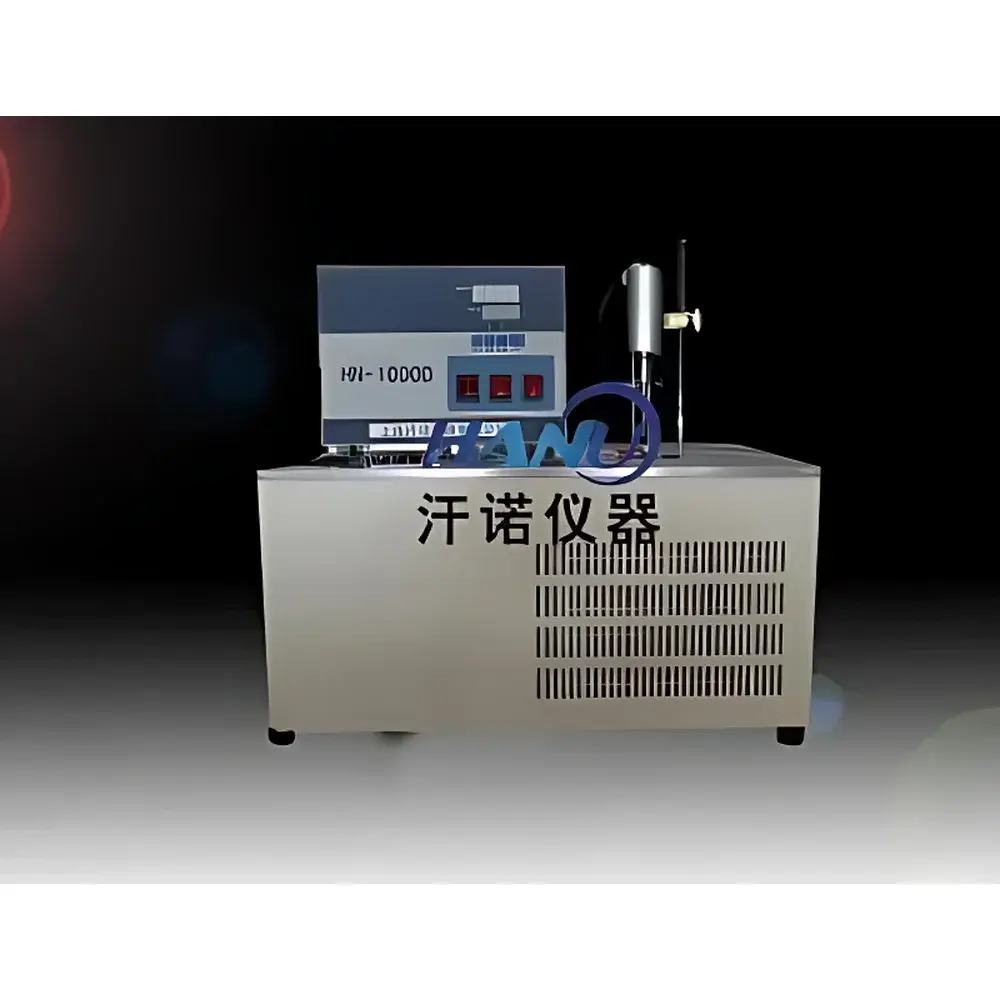
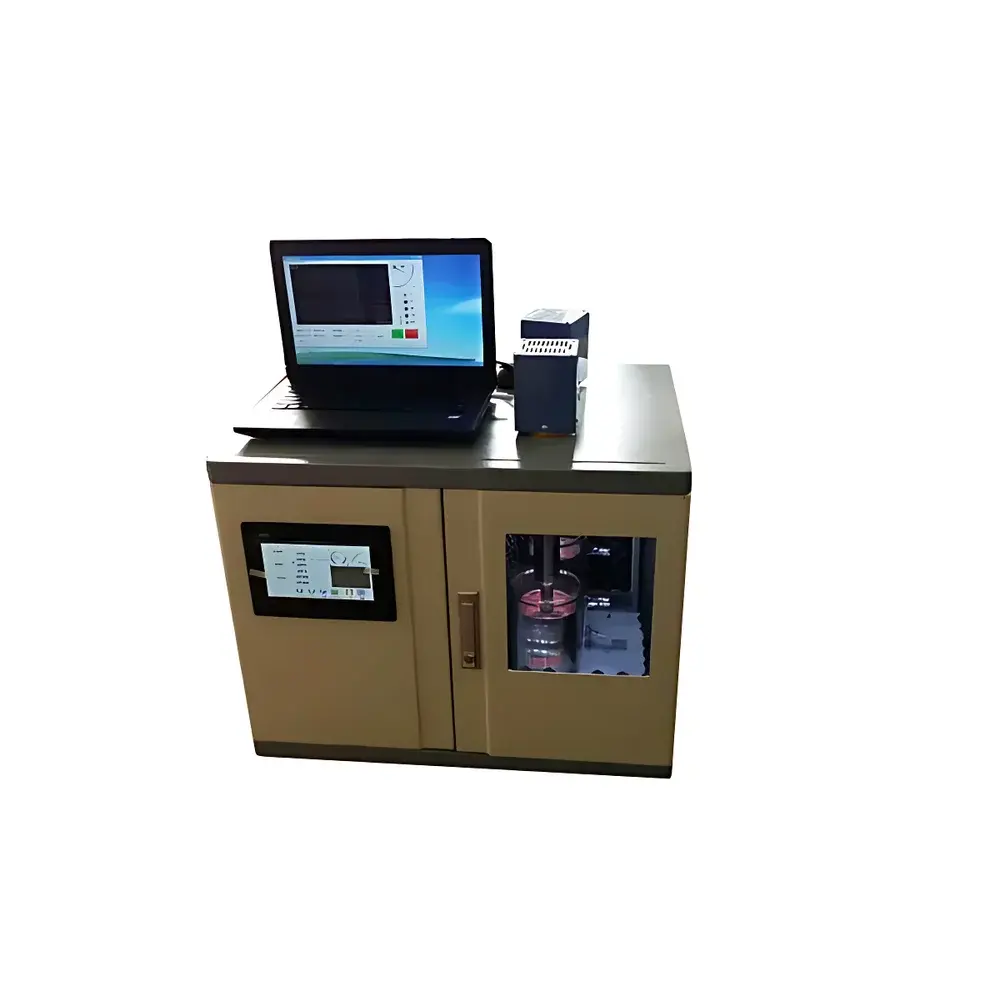
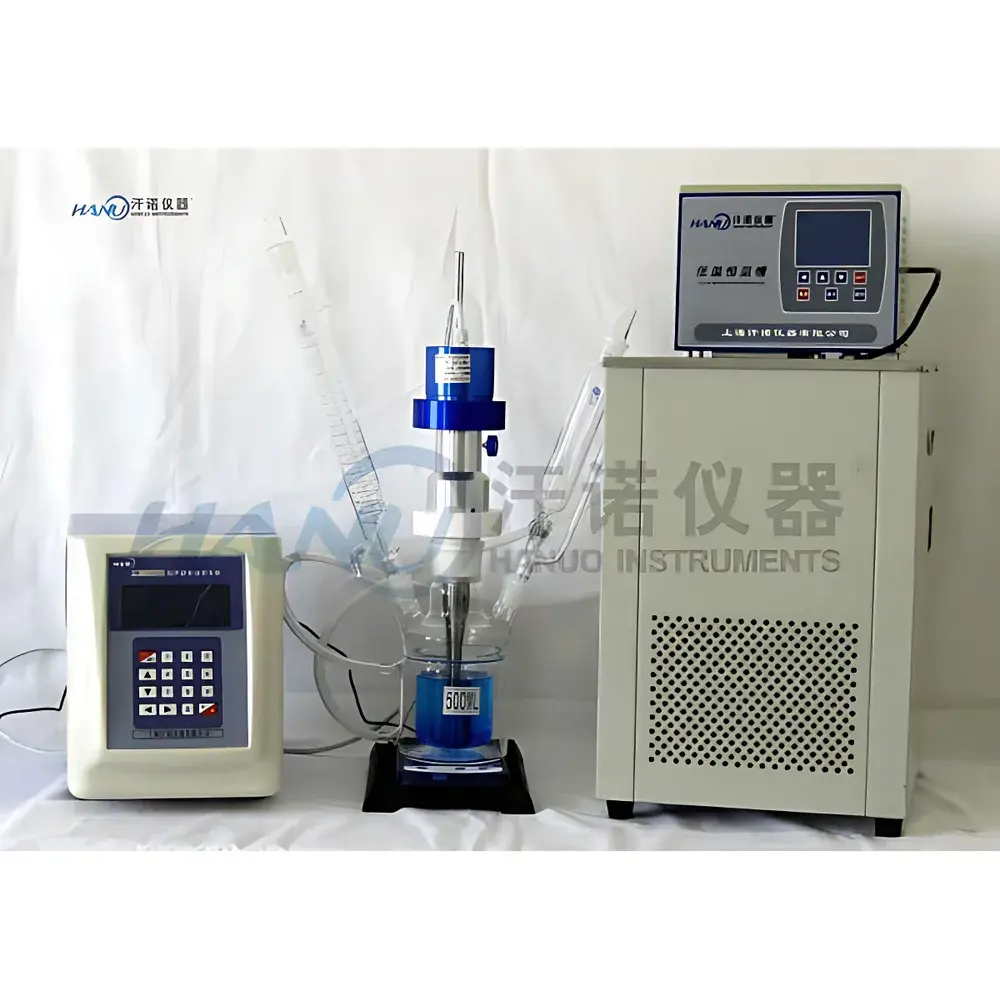
Hanuo HN-2008 Low-Temperature Ultrasonic Extraction System
| Brand | Hanuo |
|---|---|
| Model | HN-2008 |
| Ultrasonic Power | 100–1500 W (continuously adjustable) |
| Ultrasonic Frequency | 20–25 kHz |
| Temperature Control Range | −20 to 100 °C |
| Temperature Stability | ±0.05 °C |
| Reaction Volume Capacity | 10–500 mL |
| Probe Diameter Options | 6, 10, 15, 20, 25 mm |
| Magnetic Stirring Speed | 0–1200 rpm |
| Refrigeration System | Imported Tecumseh (USA) compressor, 650 W, 6 L cold bath capacity |
| Heating Power | 300 W |
| Sealed Reaction Vessel Configuration | Multi-port design with gas inlet, liquid addition port, vacuum outlet, and reflux condenser compatibility |
Overview
The Hanuo HN-2008 Low-Temperature Ultrasonic Extraction System is an integrated laboratory platform engineered for precision-controlled sonochemical synthesis and extraction under thermally regulated conditions. It operates on the principle of high-intensity ultrasonic cavitation—where acoustic energy in the 20–25 kHz range induces transient microbubble formation, growth, and violent collapse in liquid media. This process generates localized hotspots exceeding 5000 K and pressures above 1000 atm, enabling bond cleavage, radical generation, and enhanced mass transfer across phase boundaries. Unlike conventional thermal or mechanical agitation, ultrasonic cavitation delivers non-contact, volumetric energy input—particularly advantageous for temperature-sensitive biomolecules, thermolabile natural products, and low-yield organic transformations. The HN-2008 uniquely couples this cavitation mechanism with active cryogenic cooling (down to −20 °C), precise digital temperature regulation (±0.05 °C), and synchronized magnetic stirring—making it suitable for reproducible scale-up of reaction optimization studies in academic and industrial R&D laboratories.
Key Features
- Digitally controlled ultrasonic generator with continuous 100–1500 W power adjustment and real-time amplitude compensation to maintain consistent cavitation intensity across varying sample viscosities and volumes.
- Multi-zone thermal management system integrating a high-efficiency Tecumseh refrigeration unit (650 W, 6 L cold bath), 300 W resistive heating element, and PID-driven temperature control for stable operation from −20 to 100 °C.
- Modular stainless-steel ultrasonic probe assembly with interchangeable tip diameters (6, 10, 15, 20, 25 mm) optimized for different sample volumes and viscosity ranges—ensuring optimal energy coupling without probe erosion or overheating.
- Hermetically sealed, multi-port borosilicate glass reactor (10–500 mL working volume) compatible with inert gas purging (N₂, Ar), vacuum degassing, reflux condensation, and syringe-based reagent addition under controlled atmosphere.
- Integrated high-torque magnetic stirrer (0–1200 rpm) co-located beneath the ultrasonic transducer zone to eliminate thermal stratification and improve reagent homogeneity during prolonged sonication.
- Full-featured LCD controller with programmable time cycles, pulse-mode operation (on/off intervals), and automatic safety cutoffs for overtemperature, overcurrent, and dry-run conditions.
Sample Compatibility & Compliance
The HN-2008 supports aqueous, organic, and biphasic systems—including plant tissue extracts, microbial lysates, polymer solutions, nanoparticle dispersions, and catalytic reaction mixtures. Its sealed reactor configuration enables handling of volatile solvents (e.g., ethanol, acetone, ethyl acetate) and air-sensitive reagents under inert gas. All wetted parts comply with USP Class VI and ISO 10993 biocompatibility standards. The system architecture supports GLP-compliant documentation workflows: time-stamped operational logs (power, temperature, duration, probe ID) are exportable via USB interface. While not certified for FDA 21 CFR Part 11 out-of-the-box, audit trails meet baseline requirements for analytical method development per ICH Q5A and ASTM E2656 (Standard Guide for Sonochemical Reaction Optimization).
Software & Data Management
The embedded microcontroller records all critical process parameters—including instantaneous ultrasonic power output, bath temperature, setpoint deviation, stirring speed, and cumulative sonication time—with timestamp resolution of 1 second. Data is stored internally (≥1000 experiment records) and exportable as CSV files for integration into LIMS or statistical analysis platforms (e.g., JMP, OriginLab). Optional RS-485/Modbus RTU interface allows remote monitoring and synchronization with external environmental chambers or automated sampling modules. No proprietary software installation is required; raw data files are human-readable and compatible with standard spreadsheet applications.
Applications
- Accelerated extraction of polyphenols, alkaloids, and terpenoids from botanical matrices under sub-zero solvent conditions to suppress enzymatic degradation.
- Sonochemical synthesis of metal–organic frameworks (MOFs) and transition-metal nanocatalysts with narrow size distribution and high surface area.
- Controlled depolymerization of lignin and chitin under mild thermal conditions for green chemistry feedstock generation.
- Emulsification and nanoencapsulation of lipophilic actives (e.g., curcumin, resveratrol) in pharmaceutical formulations.
- Cell disruption and protein solubilization in proteomics workflows where thermal denaturation must be minimized.
- Development and validation of ultrasonic-assisted extraction (UAE) methods compliant with AOAC 2022.01 and ISO 17025-accredited laboratories.
FAQ
What is the maximum recommended duty cycle for continuous operation at full 1500 W power?
For sustained reliability, continuous operation at ≥1200 W is limited to 30-minute intervals followed by a 10-minute cooling pause. Intermittent pulsing (e.g., 5 s on / 2 s off) enables extended runs without thermal saturation.
Can the system accommodate custom reactor geometries beyond the standard multi-port vessel?
Yes—standard flange dimensions (ISO-KF 25 and 40) allow direct integration with third-party jacketed reactors, flow cells, or photochemical quartz sleeves using vacuum-compatible adapters.
Is calibration traceable to NIST or other national metrology institutes?
Temperature sensors are factory-calibrated against PT100 reference probes with ±0.02 °C uncertainty; users may perform field verification using certified thermistor standards per ISO/IEC 17025 clause 6.5.
Does the ultrasonic generator support frequency sweeping or impedance matching algorithms?
No—the HN-2008 operates at fixed resonant frequency (20–25 kHz, selected per probe model); impedance matching is achieved mechanically via torque-tuned horn assembly, not electronic tuning.
What maintenance intervals are recommended for the refrigeration system?
Compressor oil and refrigerant charge require inspection every 24 months under normal use; cold bath fluid (ethylene glycol/water) should be replaced annually to prevent viscosity drift and corrosion.



