
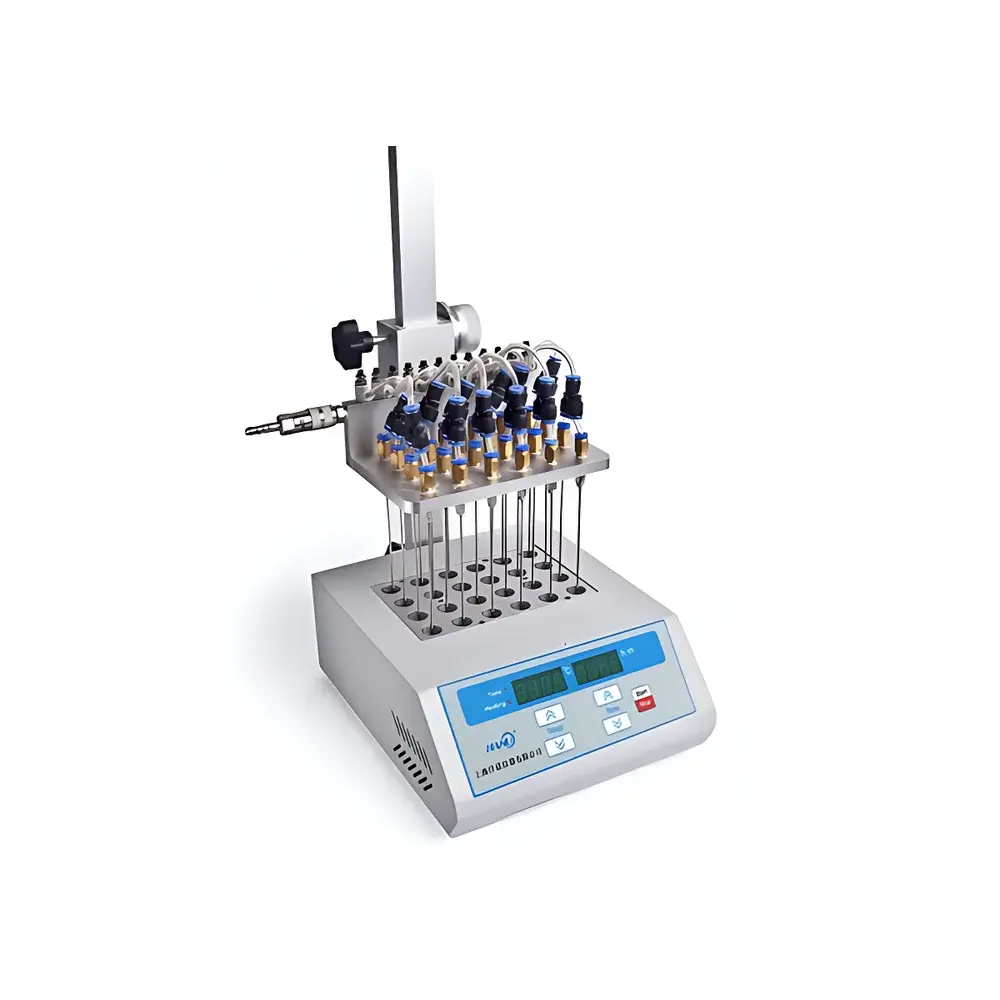
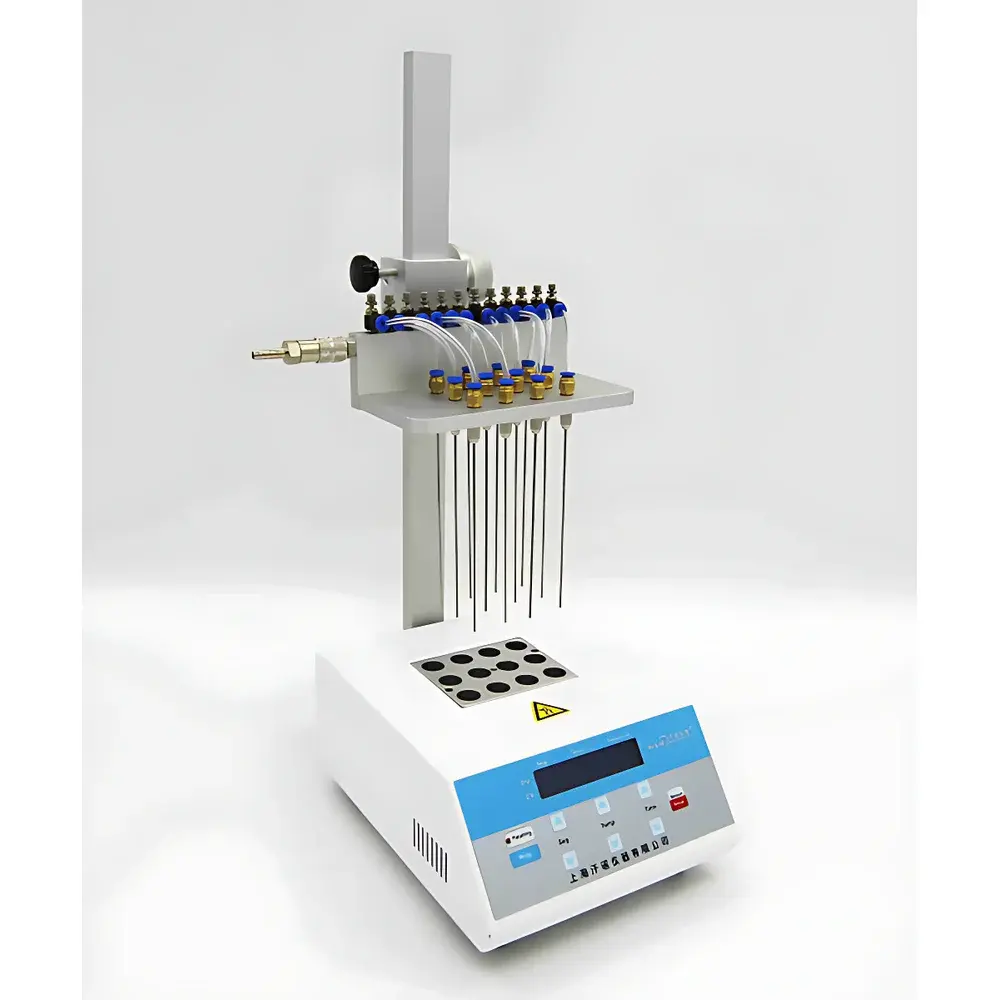
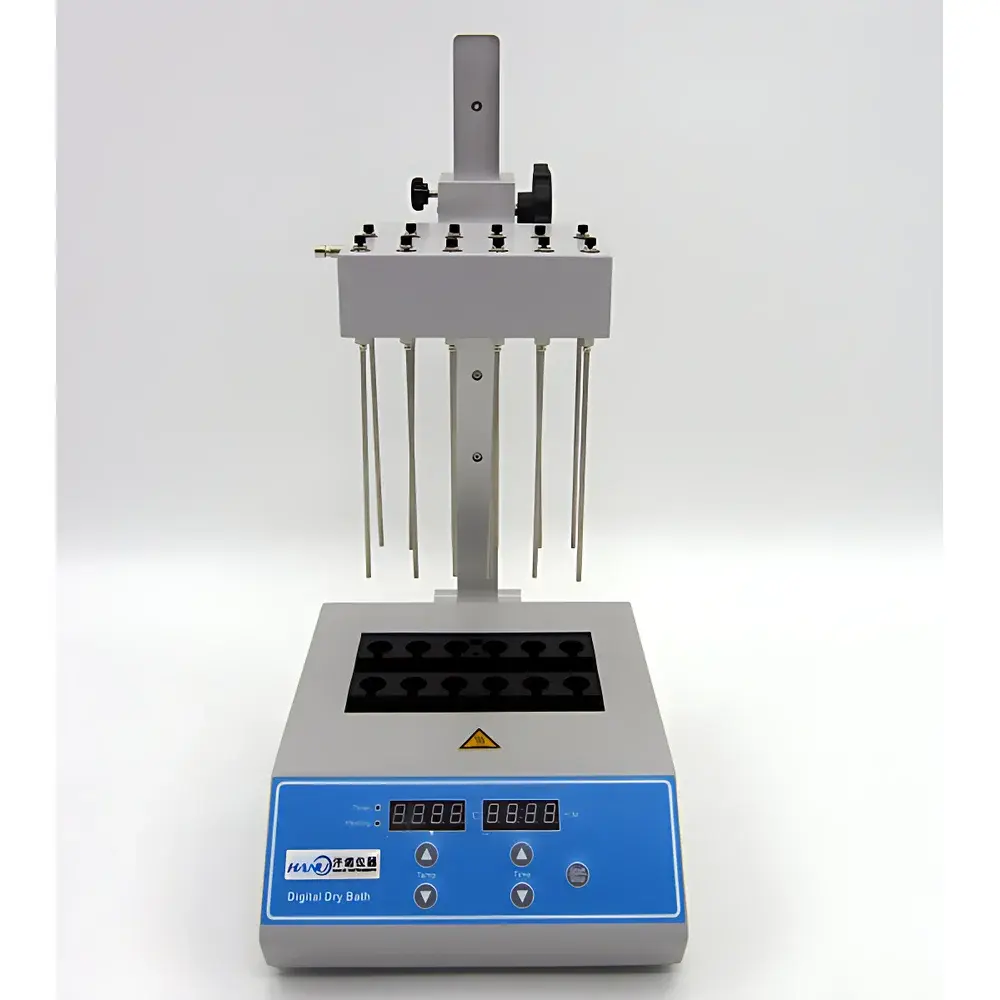
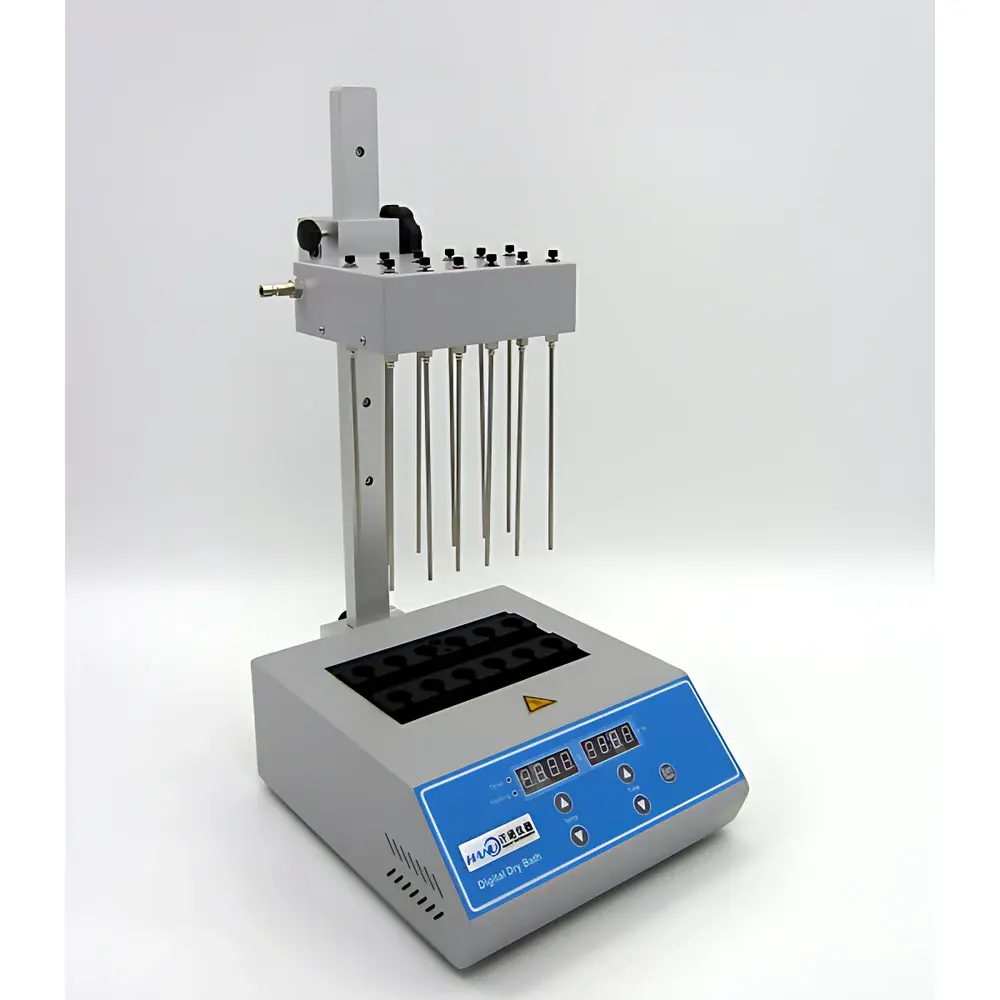
Hanuo HND300-1 96-Well Dry Block Nitrogen Evaporator
| Brand | Hanuo |
|---|---|
| Origin | Shanghai, China |
| Model | HND300-1 |
| Heating Method | Dry Block Heating |
| Temperature Range | Ambient +5°C to 160°C |
| Temperature Stability | ±0.5°C (at 40°C), ±1.0°C (at 120°C) |
| Temperature Uniformity | ±0.5°C |
| Display Resolution | 0.1°C |
| Timer Range | 1–99 h 59 min or continuous |
| Ramp Time | ≤15 min (25°C → 160°C) |
| Vertical Travel | 150 mm |
| Gas Flow Rate | 15 L/min |
| Operating Pressure | 0.05 MPa |
| Sample Capacity | 96 positions |
| Compatible Vessels | 0.2 mL PCR tubes, 96-well flat-bottom microplates |
| Heating Block Material | Aluminum alloy |
| Heating Power | 500 W |
| Dimensions (W×D×H) | 220 × 310 × 385 mm |
| Weight | 7.5 kg |
| Input Voltage | AC 220 V, 50–60 Hz |
| Operating Environment | 5–30°C, RH ≤70% |
Overview
The Hanuo HND300-1 96-Well Dry Block Nitrogen Evaporator is a precision-engineered sample concentration system designed for high-throughput laboratory workflows requiring gentle, oxygen-free solvent removal. It operates on the principle of controlled nitrogen gas impingement over heated sample surfaces—leveraging convective heat transfer and inert gas displacement to accelerate evaporation while minimizing thermal degradation and oxidation of analytes. Unlike water-bath evaporators, the HND300-1 employs a solid aluminum heating block with optimized thermal conductivity and uniformity, enabling rapid, reproducible temperature ramping and stable setpoint maintenance across all 96 positions. Its dry-block architecture eliminates contamination risks associated with liquid baths and supports compatibility with volatile organic solvents, acidic or basic matrices, and thermally labile compounds commonly encountered in regulated analytical environments.
Key Features
- Microprocessor-controlled PID temperature regulation with dual-point calibration capability (user-accessible offset adjustment) ensures traceable thermal accuracy across the full operating range (ambient +5°C to 160°C).
- Independent, height-adjustable nitrogen delivery nozzles—each pneumatically isolated—prevent cross-contamination between wells and allow selective activation per row or column.
- Aluminum heating block machined to ISO 2768-mK tolerances delivers ±0.5°C temperature uniformity (measured at 40°C) and ±1.0°C stability at elevated setpoints (e.g., 120°C), validated per ASTM E220-22 methodology.
- Integrated vertical lift mechanism (150 mm travel) enables precise nozzle-to-surface distance control—critical for balancing evaporation rate and sample splashing, particularly with low-volume (0.2 mL) PCR tubes or shallow-well microplates.
- Digital timer with continuous mode (INF) and fine-resolution display (0.1°C, 1-minute increments) supports unattended overnight operation under GLP-compliant logging conditions when paired with external data recorders.
- Front-panel lockout function and overtemperature cut-off (180°C fail-safe) meet IEC 61010-1 safety requirements for laboratory electrical equipment.
Sample Compatibility & Compliance
The HND300-1 accommodates standard 96-well formats including 0.2 mL skirted PCR plates and flat-bottom ELISA microplates (153 × 95.5 × 60 mm footprint). Its modular design allows direct integration into automated sample preparation lines via optional mounting brackets and pneumatic interface kits. The system complies with key regulatory expectations for sample prep instrumentation: temperature performance aligns with USP Analytical Instrument Qualification guidelines; gas flow consistency satisfies EPA Method 502.2 and 8081B requirements for purge-and-trap concentration; and its inert atmosphere operation supports FDA 21 CFR Part 11–aligned workflows when used with compliant electronic lab notebooks (ELNs) for audit-trail generation.
Software & Data Management
While the HND300-1 operates as a standalone instrument with intuitive push-button interface, it supports external data capture through RS-232 serial output (optional adapter). When connected to validated laboratory information management systems (LIMS) or chromatography data systems (CDS), temperature logs, timer status, and run completion signals can be archived with user-defined metadata—enabling full traceability from sample receipt to final extract. Firmware updates are delivered via secure USB flash drive, with version history and change logs maintained per ISO/IEC 17025 Clause 5.9.2 documentation standards.
Applications
- Pesticide residue analysis: Concentration of QuEChERS extracts from fruits, vegetables, and cereals prior to GC-MS/MS or LC-MS/MS quantitation.
- Environmental monitoring: Pre-concentration of trihalomethanes, PAHs, and organochlorines from drinking water, groundwater, and wastewater per EPA Methods 524.4, 8270E, and 8082A.
- Clinical and pharmaceutical research: Preparation of steroid hormone, vitamin D metabolite, and small-molecule drug candidates for bioanalysis—maintaining integrity under inert, low-temperature evaporation.
- Food safety testing: Cleanup and concentration steps in mycotoxin (e.g., aflatoxin B1) and veterinary drug residue workflows compliant with EU Commission Regulation (EU) No 2021/808.
- Omics sample prep: Desalting and buffer exchange for proteomics digests and metabolomics extracts prior to nano-LC injection.
FAQ
What types of consumables are compatible with the HND300-1?
Standard 0.2 mL PCR tubes (skirted or semi-skirted), 96-well polypropylene PCR plates, and flat-bottom polystyrene ELISA plates meeting ANSI/SBS dimensional specifications.
Can the instrument be validated for GMP environments?
Yes—the unit supports IQ/OQ protocols with documented temperature mapping (using NIST-traceable PT100 probes), gas flow verification (calibrated mass flow meter), and alarm response testing per Annex 15 of the EU Guidelines to Good Manufacturing Practice.
Is remote monitoring supported?
Not natively, but analog voltage outputs (0–5 V) for temperature and timer status are available via optional I/O module for connection to building management systems or PLC-based lab automation.
How often does the heating block require recalibration?
Annual calibration is recommended; however, built-in offset adjustment allows user-performed verification against a reference thermometer per ISO/IEC 17025 Clause 6.5.2 without disassembly.
Does the system meet CE marking requirements?
Yes—it carries CE marking under the Low Voltage Directive (2014/35/EU) and Electromagnetic Compatibility Directive (2014/30/EU), with technical documentation available upon request for lab quality assurance departments.



