
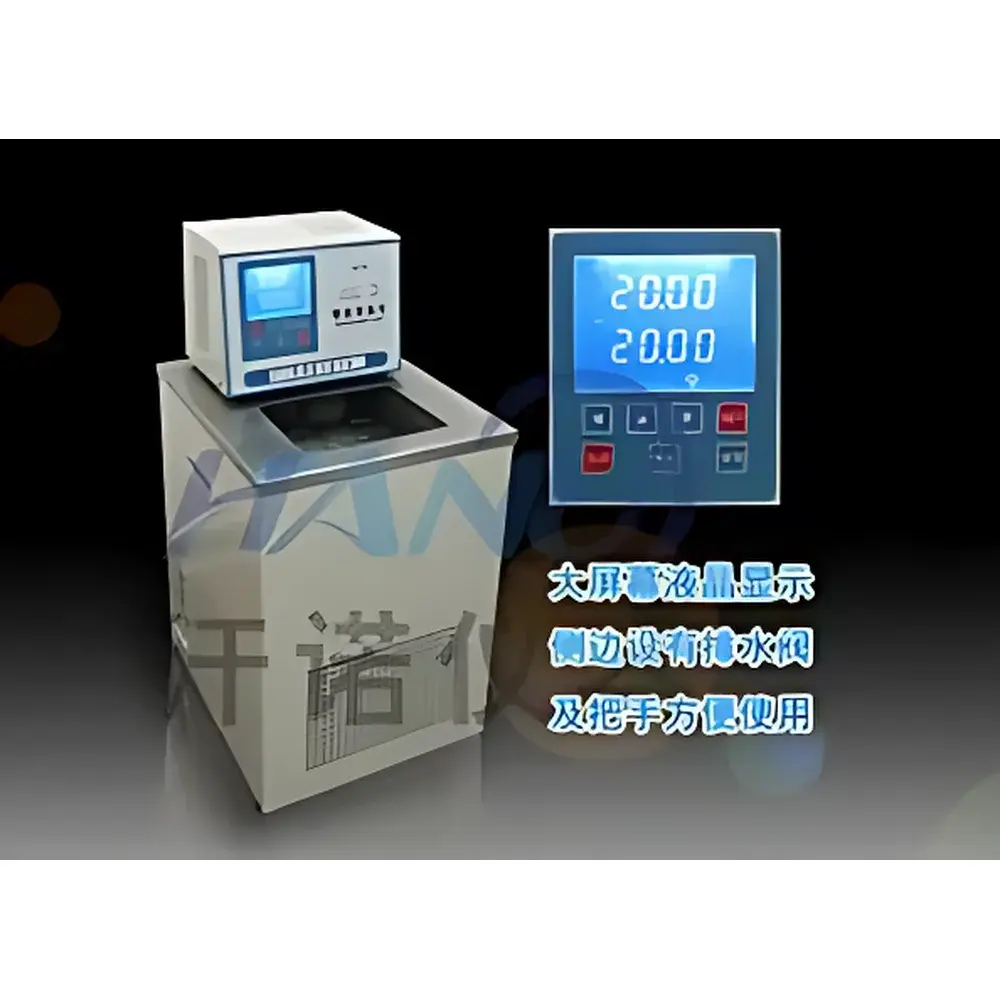
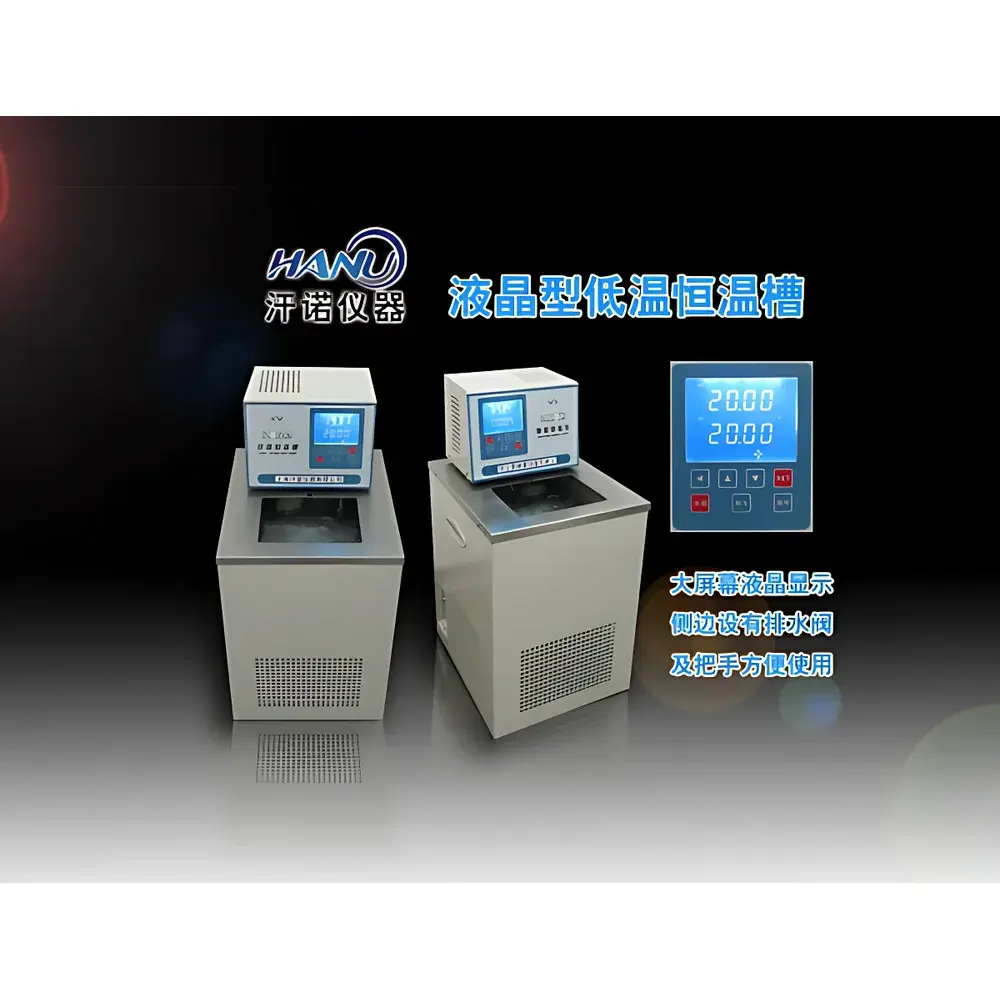
Hanuo HNGD-0200-5 Integrated High-Low Temperature Circulating Chiller
| Brand | Hanuo |
|---|---|
| Origin | Shanghai, China |
| Model | HNGD-0200-5 |
| Temperature Range | −40 °C to 200 °C |
| Temperature Stability | ±0.1 °C |
| Display Resolution | 0.1 °C |
| Bath Volume | 5 L |
| Circulation Flow Rate | 15 L/min |
| Maximum Head | 3.5 m |
| Internal Bath Material | Stainless Steel (304) |
| Cooling Method | Air-Cooled Hermetic Compressor |
| Control System | Microprocessor-Based PID Controller with Digital Display |
| Safety Protections | Over-Temperature Cut-Off, Compressor Overheat & Overcurrent Protection |
| Drain Valve | Integrated Manual Drain Valve |
Overview
The Hanuo HNGD-0200-5 is an integrated high-low temperature circulating chiller engineered for precise thermal control in laboratory and pilot-scale applications requiring stable fluid temperatures across an extended range of −40 °C to +200 °C. Unlike conventional single-function chillers or heaters, this unit combines refrigeration and heating capabilities within a single compact chassis using a dual-mode thermodynamic circuit—enabling seamless transition between sub-zero cooling and elevated heating without external heat exchangers or auxiliary equipment. Its operation relies on a closed-loop circulation system that delivers conditioned silicone oil, water-glycol mixtures, or other compatible heat transfer fluids to external reactors, jacketed vessels, or analytical instrumentation. Designed for continuous-duty operation under demanding thermal loads, the HNGD-0200-5 maintains temperature stability within ±0.1 °C (typical) through adaptive PID control logic, real-time sensor feedback, and dynamic power modulation of both compressor and electric heating elements.
Key Features
- Wide operational temperature span: −40 °C to 200 °C, supporting cryogenic synthesis, polymerization, distillation condensation, and high-temperature catalysis workflows.
- Air-cooled hermetic scroll compressor paired with high-efficiency plate heat exchangers ensures rapid cooldown rates and consistent thermal output without dependency on facility chilled water.
- Stainless steel (AISI 304) bath reservoir resists corrosion from organic solvents, acids, and glycol-based fluids—facilitating long-term reliability and ease of cleaning per GLP-compliant lab hygiene protocols.
- Dual-circulation architecture: Internal recirculation ensures uniform bath temperature distribution; external pump delivers up to 15 L/min at 3.5 m head pressure for integration with jacketed reactors, calorimeters, or spectroscopic cells.
- Microprocessor-based controller with large backlit LCD display provides intuitive navigation, setpoint programming, real-time temperature logging, and user-accessible calibration offset adjustment (±9.9 °C range).
- Comprehensive safety suite includes independent over-temperature cut-off (adjustable threshold), compressor thermal overload protection, current surge detection, and automatic system shutdown with audible/visual alarm indication.
- Integrated manual drain valve enables full fluid evacuation for maintenance, fluid replacement, or seasonal storage—reducing downtime and cross-contamination risk between experiments.
Sample Compatibility & Compliance
The HNGD-0200-5 accommodates a broad spectrum of heat transfer media, including deionized water, 30–60% aqueous ethylene glycol solutions, silicone oils (e.g., DC200 series), and low-volatility synthetic heat transfer fluids compatible with −40 °C pour points and >200 °C flash points. All wetted components—including pump housing, tubing connectors, and bath interior—are constructed from chemically inert stainless steel or fluoropolymer-sealed elastomers to ensure compatibility with common laboratory reagents. The unit complies with IEC 61010-1:2010 for electrical safety in laboratory equipment and meets CE marking requirements for electromagnetic compatibility (EMC Directive 2014/30/EU). While not certified to ISO/IEC 17025 or FDA 21 CFR Part 11 out-of-the-box, its deterministic control algorithm, non-volatile parameter storage, and audit-ready temperature logging (via optional RS485/Modbus interface) support validation under GMP/GLP environments when deployed with documented IQ/OQ protocols.
Software & Data Management
The embedded controller supports local data capture of setpoint, actual bath temperature, and runtime hours via internal memory (retains ≥10,000 timestamped records). Optional RS485 serial communication enables integration with SCADA systems, LIMS platforms, or custom LabVIEW/Python scripts using standard Modbus RTU protocol (function codes 03h/06h). No proprietary software is required; users may configure remote monitoring, alarm notifications, and periodic data export using open-source Modbus clients or vendor-neutral industrial gateways. For regulatory traceability, the device logs all critical events—including power cycles, safety interlock triggers, and manual parameter changes—with time/date stamps. When connected to a validated networked historian, the system satisfies ALCOA+ principles (Attributable, Legible, Contemporaneous, Original, Accurate, Complete, Consistent, Enduring, Available) for electronic record retention in quality-controlled laboratories.
Applications
- Chemical synthesis: Precise temperature ramping and hold profiles for Grignard reactions, lithium-aluminum hydride reductions, and Diels–Alder cyclizations requiring sub-ambient initiation followed by controlled exothermic progression.
- Materials testing: Thermal conditioning of polymer samples prior to DSC, TGA, or rheological analysis; stabilization of viscometer baths during shear-rate sweeps.
- Pharmaceutical R&D: Jacketed reactor control for crystallization studies, lyophilization cycle development, and dissolution apparatus temperature verification (USP ).
- Analytical instrumentation: Providing stable thermal environment for HPLC column ovens, GC injector blocks, and FTIR sample compartments where ambient drift compromises resolution.
- Calibration labs: Serving as a reference temperature source for thermometer and RTD calibration against NIST-traceable standards (e.g., ASTM E74, ISO 17025 Clause 6.5.2).
FAQ
What types of heat transfer fluids are recommended for operation below −20 °C?
For sustained operation below −20 °C, use low-viscosity silicone oils (e.g., Dow Corning DC200 Fluid 0.65 cs) or inhibited ethylene glycol/water mixtures (e.g., 60/40 v/v) with certified pour points ≤−45 °C. Avoid pure water or methanol-based fluids due to freezing risk and material incompatibility.
Can the external circulation pump be operated independently of the temperature control loop?
No—the pump operates only when the system is powered and in active temperature control mode. Pump speed is fixed at 15 L/min nominal flow; variable-speed drive is not supported in this model.
Is the temperature sensor calibrated to NIST-traceable standards?
The factory-installed Pt100 RTD sensor is calibrated against NIST-traceable references during final test. Users may perform field verification using a certified reference thermometer (e.g., Fluke 1523) and apply digital offset correction via the front-panel menu.
Does the unit support programmable ramp-and-soak profiles?
No—this model implements single-setpoint PID control only. For multi-step thermal profiles, integration with external programmable logic controllers (PLCs) or PC-based automation software via RS485 is required.
What maintenance intervals are recommended for optimal long-term performance?
Inspect condenser coils monthly for dust accumulation; clean with compressed air or soft brush. Replace compressor oil and filter-drier every 24 months under continuous operation. Verify bath fluid integrity annually via viscosity and acid number testing per ASTM D975 or equivalent.



