
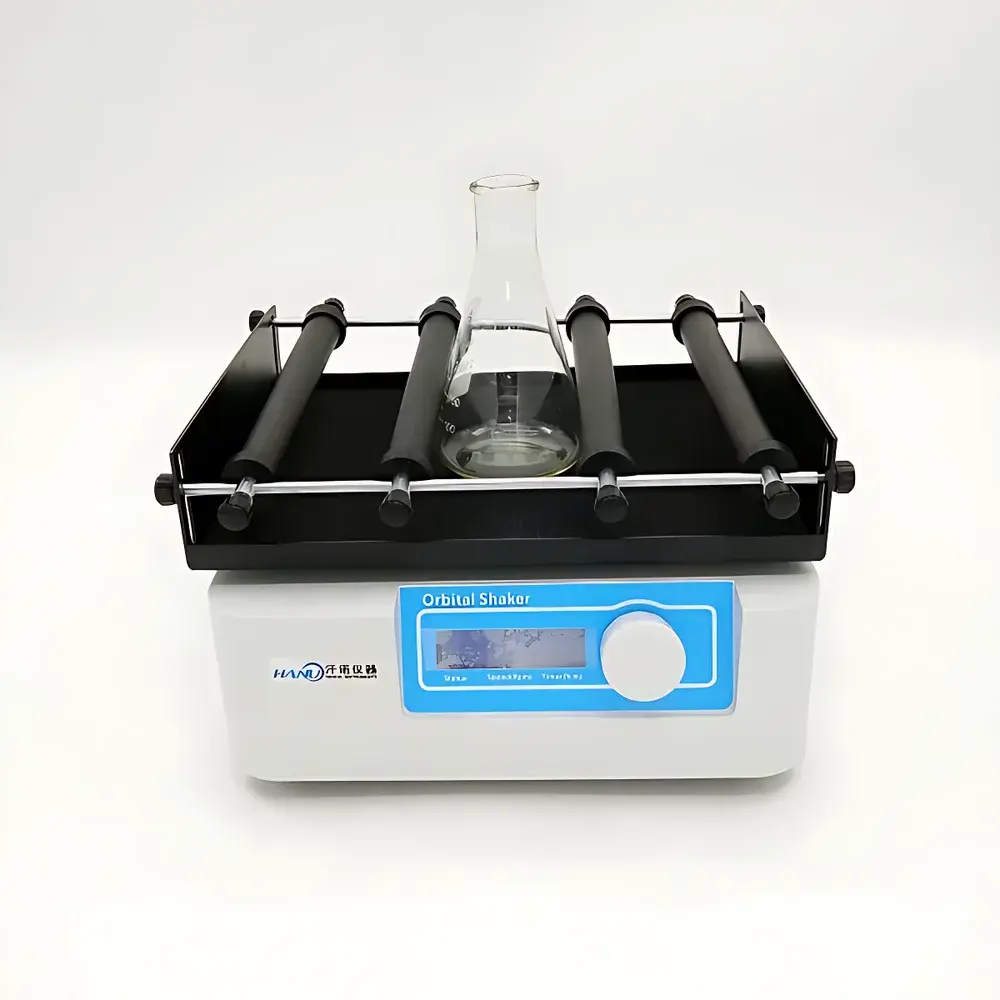
Hanuo HNGS-10 Orbital Shaker
| Brand | Hanuo |
|---|---|
| Origin | Shanghai, China |
| Model | HNGS-10 |
| Timer Range | 1 min – 99 h 59 min |
| Oscillation Speed | 50–350 rpm |
| Orbit Diameter | 10 mm |
| Load Capacity | 2 kg |
| Operating Temperature | 4–45 °C |
| Dimensions (W×D×H) | 284 × 264 × 90 mm |
| Power Supply | AC 100–230 V |
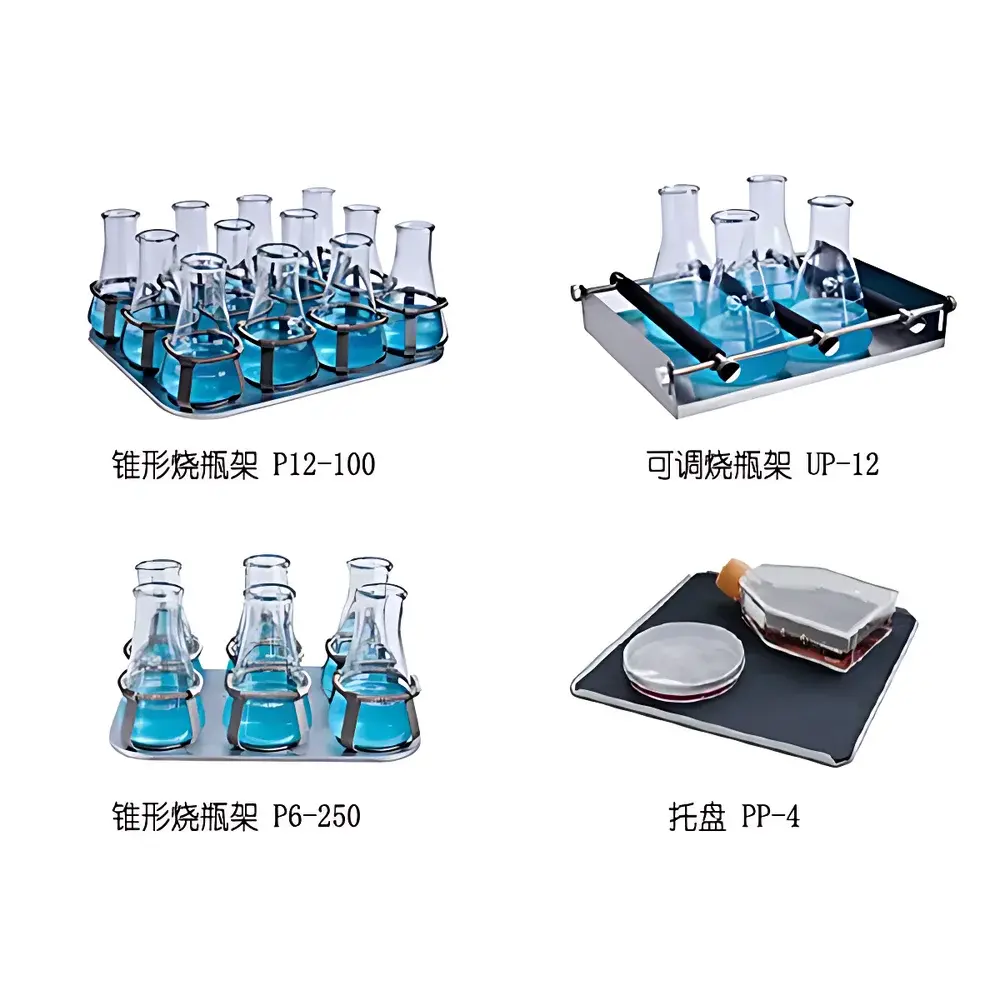
| Platform Options | Interchangeable trays (conical flask rack, adjustable flask holder, universal platform) |
| Platform Quantity | Up to 4 (optional) |
Overview
The Hanuo HNGS-10 Orbital Shaker is a compact, microprocessor-controlled laboratory shaker engineered for consistent, low-shear mixing across life science and clinical research applications. It operates on the principle of orbital motion—where the platform rotates in a precise circular path with a fixed 10 mm orbit diameter—generating uniform, gentle agitation ideal for cell culture maintenance, bacterial suspension, enzyme assays, immunoassays, and reagent homogenization. Unlike reciprocating or vortex shakers, orbital motion minimizes shear stress on sensitive biological samples while ensuring high reproducibility in mixing efficiency. Designed for benchtop use in standard laboratories, cold rooms (4 °C), and controlled-environment incubators (up to 45 °C), the unit features a brushless DC motor architecture that eliminates carbon brush wear, ensures long-term rotational stability, and delivers silent operation (<45 dB(A))—critical for shared lab spaces and continuous unattended runs.
Key Features
- Brushless DC motor drive: Ensures maintenance-free operation, extended service life (>20,000 hours MTBF), and stable speed control without drift across ambient temperature fluctuations.
- Microprocessor-based digital control system: Provides precise, real-time adjustment of speed (50–350 rpm) and timer (1 min – 99 h 59 min) via intuitive LED interface; parameters retained after power interruption.
- Low-profile, streamlined chassis (284 × 264 × 90 mm): Optimized for space-constrained environments including refrigerated cabinets and biosafety cabinets; smooth, non-porous surface resists microbial accumulation and facilitates ISO-compliant cleaning protocols.
- Universal platform compatibility: Supports rapid interchange of accessory trays—including conical flask racks (for 50–500 mL Erlenmeyer flasks), adjustable multi-vessel holders, and flat universal platforms—enabling seamless transition between assay formats without recalibration.
- Programmable auto-shutdown with audible alert: Timer completion triggers both visual (LED flash) and acoustic signal, supporting GLP-aligned unattended operation while preventing sample over-agitation or evaporation-related concentration shifts.
Sample Compatibility & Compliance
The HNGS-10 accommodates standard laboratory vessels up to 2 kg total load, including glass and polypropylene conical flasks, centrifuge tubes, multi-well plates (with optional plate clamps), and culture bottles. Its non-heated design complies with IEC 61010-1:2010 safety requirements for electrical equipment used in laboratory environments. While not a regulated medical device, its operational consistency supports adherence to common quality frameworks: routine performance verification aligns with CLSI EP17-A2 guidelines for mixing device qualification; timer accuracy (±0.5% over full range) satisfies internal SOPs for time-critical assays such as ELISA incubation steps or microbial growth phase synchronization. The unit is CE-marked and RoHS-compliant.
Software & Data Management
The HNGS-10 operates as a standalone instrument with no embedded software or network connectivity. All settings are configured directly via front-panel controls, eliminating cybersecurity vulnerabilities and reducing validation burden in regulated environments. For laboratories requiring audit trails, integration into electronic lab notebooks (ELN) or LIMS is achieved through manual entry of run parameters (speed, duration, date/time stamp) — a practice consistent with FDA 21 CFR Part 11 Annex A expectations for non-automated instruments. Optional third-party data loggers (e.g., USB-connected thermohygrometers with timestamping) may be deployed alongside the shaker to document ambient conditions during extended protocols.
Applications
- Molecular biology: Plasmid prep binding/wash steps, probe hybridization, and restriction digestion incubations requiring uniform low-shear agitation.
- Microbiology: Aerobic bacterial culture propagation in liquid media, biofilm formation studies, and antibiotic susceptibility testing (AST) broth dilution preparation.
- Clinical diagnostics: Homogenization of whole blood samples prior to serum separation, antigen-antibody binding kinetics in automated immunoassay workflows.
- Biopharmaceutical QC: Buffer exchange validation, excipient solubilization trials, and stability study sample agitation under ICH Q5C storage condition simulations (4 °C and 25 °C).
- Academic teaching labs: Robust platform for undergraduate microbiology, biochemistry, and cell biology experiments where reliability, ease of use, and cost-efficiency are prioritized.
FAQ
Is the HNGS-10 suitable for use inside a 4 °C cold room?
Yes. Its operating temperature range (4–45 °C) and condensation-resistant electronics allow uninterrupted operation in refrigerated environments without performance degradation.
Can the shaker accommodate microtiter plates?
Yes—when equipped with an optional universal platform featuring non-slip silicone matting or dedicated 96-well plate clamps (sold separately).
Does it support speed ramping or programmable multi-step protocols?
No. The HNGS-10 provides single-setpoint speed and timer control only. For gradient or multi-stage agitation, users should consider the HNGS-20 or HNGS-30 series with expanded firmware options.
What safety certifications does the unit hold?
It carries CE marking per EN 61010-1:2010 and complies with RoHS Directive 2011/65/EU. No UL or CSA certification is provided.
How is calibration verified?
Users may validate speed accuracy using a handheld tachometer traceable to NIST standards; timer function can be cross-checked against a certified stopwatch. Routine verification intervals are defined by institutional SOPs, typically every 6 months or per batch protocol requirements.
Related Products




