
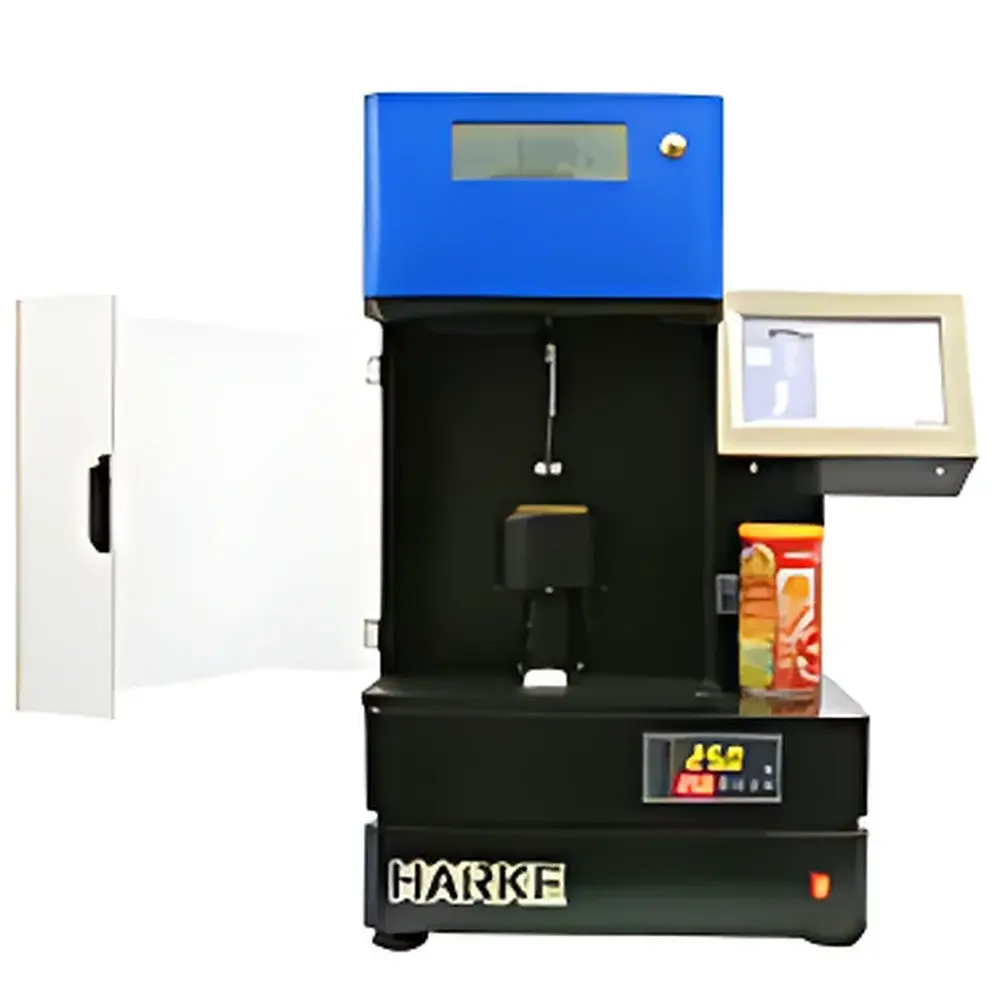
HARKE-CP Intelligent Fully Automatic Surface Tensiometer
| Origin | Beijing, China |
|---|---|
| Manufacturer Type | Authorized Distributor |
| Origin Category | Domestic (China) |
| Model | HARKE-CP |
| Pricing | Available Upon Request |
| Measurement Range | 5–200 mN/m |
| Accuracy | ±1% of reading |
| Minimum Resolution | 0.01 mN/m |
| Repeatability | ±0.1% F.S. |
| Electrical Supply | 220 V AC, 3 A |
| Temperature Control Range | Ambient to +190 °C (standard) |
Overview
The HARKE-CP Intelligent Fully Automatic Surface Tensiometer is a precision instrument engineered for the accurate and reproducible determination of surface tension (γSV) and interfacial tension (γSL) of liquid systems using the Du Noüy ring method—fully compliant with ISO 1409:2018 and GB/T 18396–2001. Based on the principle of measuring the maximum force required to detach a platinum-iridium ring from the liquid–air or liquid–liquid interface, the system employs high-resolution electromagnetic force compensation transduction and real-time dynamic peak detection. Its fully automated lift-and-detach sequence eliminates operator-dependent variability, ensuring consistent meniscus formation and rupture point identification. Designed for routine QC laboratories and academic research environments, the HARKE-CP delivers traceable, GLP-aligned measurements under controlled thermal conditions—critical for surfactant characterization, formulation stability assessment, and interfacial thermodynamics studies.
Key Features
- Fully motorized vertical axis with programmable immersion depth, lift speed, and dwell time—configurable per test protocol
- Integrated temperature-controlled sample stage supporting operation from ambient to +190 °C (standard heated bath); optional Peltier-cooled module extends range to –15 °C for low-temperature interfacial studies
- Real-time force curve acquisition with automatic peak-hold function—ensures precise identification of maximum detachment force without manual intervention
- Digital electromagnetic balance with 0.01 mN/m resolution and <0.1% full-scale repeatability across the 5–200 mN/m measurement range
- Platinum-iridium ring sensor (diameter 19.5 mm, wire diameter 0.37 mm) certified to ISO 1409 geometry tolerances; includes automated ring cleaning cycle and calibration verification routine
- Compliance-ready firmware architecture supporting audit trails, user-level access control (admin/operator), and timestamped measurement logs
Sample Compatibility & Compliance
The HARKE-CP accommodates aqueous and non-aqueous liquids, polymer melts, molten salts, and immiscible liquid–liquid systems—including hydrocarbon–water, silicone oil–aqueous surfactant solutions, and ionic liquid interfaces. It supports both static (equilibrium) and dynamic (time-resolved) surface tension profiling when paired with timed measurement sequences. Regulatory alignment includes conformance to ISO 1409:2018 (plastics—determination of surface tension of plastics by the ring method), ASTM D971 (standard test method for interfacial tension of oil against water by the ring method), and GB/T 18396–2001 (general requirements for surface and interfacial tension measurement). Instrument qualification documentation—including IQ/OQ templates and calibration certificate traceability to NIM (National Institute of Metrology, China)—is provided to support FDA 21 CFR Part 11 readiness and GMP/GLP audit requirements.
Software & Data Management
Controlled via HARKE-TensionPro v3.x software (Windows 10/11 compatible), the system enables method-driven workflow automation, multi-parameter test scheduling, and raw force–time curve export in CSV and XML formats. The software embeds built-in correction algorithms for buoyancy, ring geometry, and liquid density (user-input or database-referenced), applying the Harkins–Jordan correction factor automatically. All measurement sessions are logged with metadata including operator ID, environmental temperature/humidity (via optional external sensor input), calibration status, and version-stamped firmware/software identifiers. Exported datasets include statistical summaries (mean, SD, RSD, confidence intervals) and support direct integration into LIMS platforms via ODBC or REST API endpoints. Audit trail records preserve all parameter modifications, result deletions, and user logins—retained for ≥36 months per configurable retention policy.
Applications
- Surfactant critical micelle concentration (CMC) determination and adsorption kinetics modeling
- Formulation development for pharmaceutical emulsions, agrochemical adjuvants, and cosmetic microemulsions
- Quality control of crude oil demulsifiers, lubricant additives, and transformer oils
- Interfacial rheology pre-screening prior to oscillatory dilatational measurements
- Surface energy estimation of solid substrates via contact angle–surface tension correlation (Owens–Wendt method)
- Teaching laboratories: hands-on instruction in capillary phenomena, Gibbs adsorption isotherm validation, and interfacial thermodynamics
FAQ
What standard methods does the HARKE-CP validate against?
It complies with ISO 1409:2018, ASTM D971, and GB/T 18396–2001 for ring-method surface and interfacial tension measurement.
Is temperature control integrated or optional?
A heated sample stage (ambient to +190 °C) is standard; a Peltier-based cooling module (–15 °C to +100 °C) is available as an optional accessory.
Can the instrument perform dynamic surface tension measurements?
Yes—through programmable time-series acquisition at user-defined intervals (e.g., 1 s to 300 s between readings) to capture diffusion-controlled adsorption kinetics.
How is calibration verified during routine use?
The system includes a dual-point verification routine using certified reference liquids (e.g., ultrapure water at 25 °C: γ = 72.00 mN/m; 2-propanol: γ = 21.70 mN/m), generating a calibration report with uncertainty budget.
Does the software meet FDA 21 CFR Part 11 requirements?
Yes—HARKE-TensionPro v3.x provides electronic signatures, role-based access control, immutable audit trails, and data integrity safeguards aligned with Part 11 Annex 11 expectations.



