
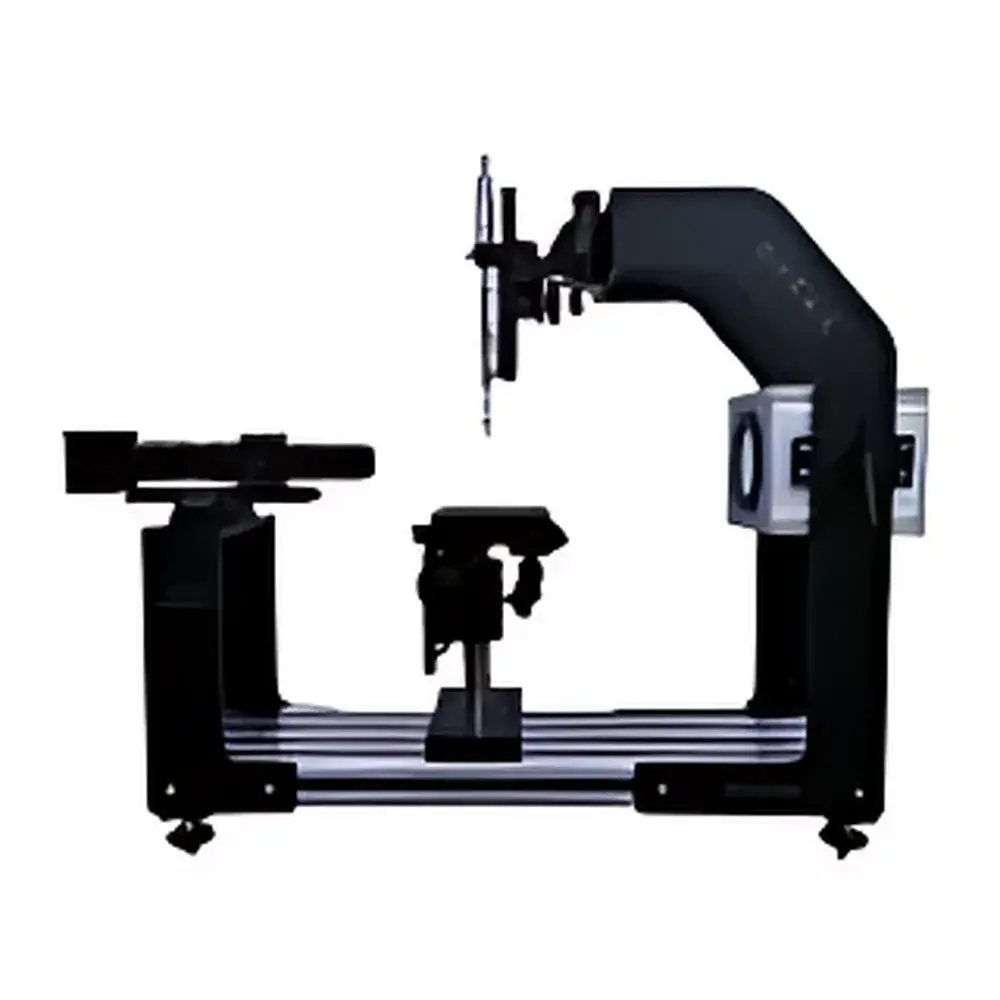
HARKE HK-EVM-SPCA Contact Angle Goniometer
| Brand | HARKE |
|---|---|
| Model | HK-EVM-SPCA |
| Origin | Beijing, China |
| Manufacturer Type | Direct Manufacturer |
| Instrument Type | Benchtop Laboratory Goniometer |
| Contact Angle Measurement Range | 0–180° |
| Contact Angle Accuracy | ±0.1° |
| Contact Angle Resolution | 0.01° |
| Sample Stage Dimensions | 400 mm × 400 mm (standard) |
| Optical Zoom Ratio | 0.7×–4.5× |
| Surface/Interfacial Tension Measurement Range | 0–1000 mN/m |
| Surface/Interfacial Tension Accuracy | ±0.01 mN/m |
| Imaging System | USB 2.0 high-speed camera (30 fps standard |
| Lens Travel | 120 mm |
| Dimensions (W×D×H) | 260 mm × 700 mm × — mm (height not specified) |
| Weight | ~30 kg |
| Software | HARKE-SPCA v1.0 |
| Power Supply | 220 V / 3 A / 50 Hz |
| Operating Temperature | Ambient |
| Surface Energy Analysis Method | Equation of State (EOS) |
| Fitting Algorithms | Circle, Ellipse, Young-Laplace (Sessile Drop & Pendant Drop), SCA (Solid Contact Angle) |
| Optional Accessories | Motorized Tilt Stage, Peltier-based Heating Stage, Automated Syringe Pump Module |
| Compliance | Designed for ISO 19403-2, ASTM D7334, and ISO 21365-compliant workflows |
Overview
The HARKE HK-EVM-SPCA Contact Angle Goniometer is a precision-engineered benchtop instrument designed for quantitative characterization of solid–liquid interfacial interactions. It operates on the principle of optical goniometry—capturing high-resolution side-view images of sessile or pendant liquid drops deposited on solid substrates, followed by geometric or physical modeling to extract contact angle (θ), surface free energy (γS), and interfacial tension (γLV). The system integrates a motorized XYZ-adjustable optical train with a high-stability sample stage (400 mm × 400 mm), enabling reproducible positioning of heterogeneous or large-area samples—including wafers, coated films, textiles, and biomaterials. Its dual-capability architecture supports both static and dynamic contact angle analysis (advancing/receding, roll-off, hysteresis), as well as interfacial tension quantification via pendant drop analysis using the Young–Laplace equation. The instrument is engineered for long-term stability in ambient laboratory environments and meets foundational metrological requirements for GLP-compliant surface science laboratories.
Key Features
- High-precision contact angle measurement across full 0–180° range, with resolution of 0.01° and accuracy of ±0.1° under standardized calibration conditions
- Modular optical path featuring ZF-180 fixed-position zoom lens (0.7×–4.5× magnification), optimized for minimal distortion and consistent depth-of-field across variable working distances
- USB 2.0 high-speed imaging platform supporting frame rates from 30 fps (standard) to 1000 fps (optional), enabling time-resolved wetting kinetics studies such as absorption, spreading, and droplet relaxation
- Dual-mode software analysis: geometric fitting (circle, ellipse, conic section) for rapid screening; physics-based Young–Laplace fitting for rigorous interfacial tension and surface energy derivation
- Integrated EOS (Equation of State) method for solid surface free energy calculation, compatible with multiple polarity models (e.g., Owens–Wendt, Wu, van Oss–Chaudhury–Good)
- Benchtop mechanical architecture with rigid aluminum frame, low-vibration base, and 120 mm vertical lens travel for precise focus control over uneven or thick samples
Sample Compatibility & Compliance
The HK-EVM-SPCA accommodates diverse sample geometries—from flat rigid substrates (glass slides, silicon wafers, polymer films) to porous media (filter papers, membranes), flexible materials (foils, elastomers), and irregular 3D components (via adjustable stage tilt or custom fixtures). Its large 400 mm × 400 mm stage allows multi-point mapping across macroscopic surfaces. All measurement protocols align with internationally recognized standards including ISO 19403-2 (contact angle determination), ASTM D7334 (surface energy of plastics), and ISO 21365 (interfacial tension by pendant drop). The system supports audit-ready data logging with timestamped image capture, parameter traceability, and user-defined metadata tagging—facilitating compliance with FDA 21 CFR Part 11 when paired with validated software configuration and electronic signature workflows.
Software & Data Management
HARKE-SPCA v1.0 software provides a modular, Windows-based interface for acquisition, real-time analysis, batch processing, and report generation. Core functions include automated drop detection, dynamic contact angle tracking (with manual override), surface energy matrix export (polar/dispersive components), and interfacial tension curve fitting. Raw image sequences (.avi/.tiff) and processed results (.csv/.xlsx) are stored with embedded instrument metadata (lens setting, lighting intensity, syringe volume, environmental temperature). The software architecture supports version-controlled method templates, user role permissions, and export formats compatible with LIMS integration. Optional modules enable GLP audit trails, electronic signatures, and PDF report automation compliant with internal quality management systems.
Applications
- Quality control of hydrophobic/hydrophilic coatings in semiconductor, automotive, and medical device manufacturing
- Surface modification validation (plasma treatment, corona discharge, silanization)
- Adhesion prediction in inkjet printing, adhesive bonding, and thin-film deposition processes
- Biocompatibility assessment of implant materials via protein adsorption correlation studies
- Formulation development for agrochemicals, cosmetics, and pharmaceutical suspensions requiring controlled wetting behavior
- Research into smart surfaces (stimuli-responsive polymers, switchable wettability, superhydrophobicity)
FAQ
What contact angle analysis methods does the HK-EVM-SPCA support?
It implements circle fitting, ellipse fitting, conic section fitting, and Young–Laplace-based pendant/sessile drop modeling—including advanced variants for asymmetric or distorted drops.
Can the system measure interfacial tension between two immiscible liquids?
Yes—using pendant drop analysis on the liquid–liquid interface, with accuracy validated against standard reference fluids (e.g., water–toluene, water–hexadecane).
Is the software compliant with 21 CFR Part 11 for regulated environments?
The base software supports audit trail generation and user authentication; full Part 11 compliance requires documented validation protocol execution and optional secure electronic signature module.
What accessories extend the instrument’s functional scope?
Motorized tilt stage (±90°, programmable speed), Peltier heating/cooling stage (−10°C to +120°C), high-precision syringe pump (0.1 µL resolution), and environmental chamber integration kits.
How is calibration performed and verified?
Using NIST-traceable contact angle calibration standards (e.g., 30°, 60°, 90°, 120° certified glass slides) and interfacial tension reference oils; calibration logs are stored within the software database.



