
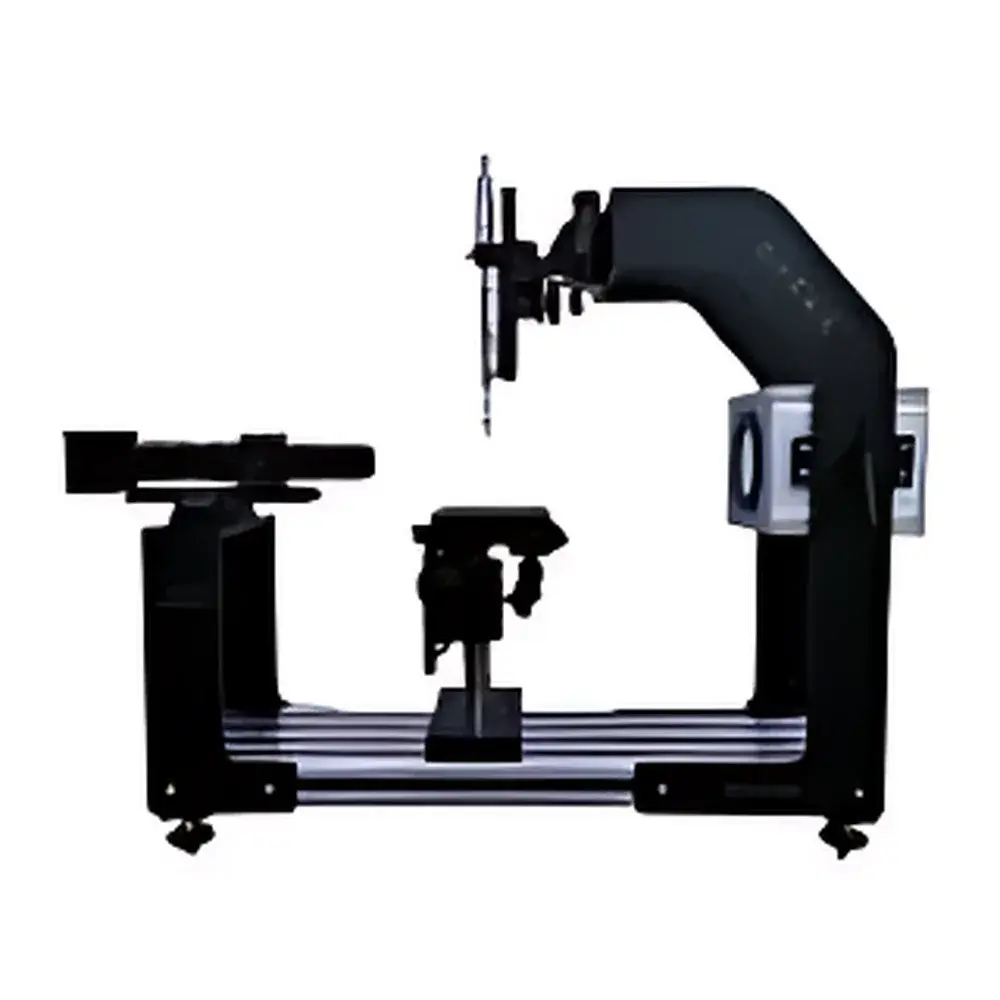
HARKE HK-EY-SPCA Economical Contact Angle Goniometer
| Brand | HARKE |
|---|---|
| Origin | Beijing, China |
| Manufacturer Type | Direct Manufacturer |
| Instrument Category | Domestic |
| Model | HK-EY-SPCA |
| Instrument Type | Benchtop Laboratory System |
| Contact Angle Measurement Range | 0–180° |
| Contact Angle Measurement Accuracy | ±0.1° |
| Contact Angle Display Resolution | 0.01° |
| Sample Stage Dimensions | 400 mm × 400 mm |
| Optical Magnification | 0.7×–4.5× |
| Surface/Interfacial Tension Measurement Method | Pendant Drop |
| Surface/Interfacial Tension Range | 0–100 mN/m |
| Surface/Interfacial Tension Accuracy | 0.01 mN/m |
| Imaging System | USB 2.0 Camera (30 fps standard |
| Lens Travel | 120 mm |
| Dimensions (W × D × H) | 260 mm × 700 mm × — mm |
| Weight | ~30 kg |
| Software | HARKE-SPCA v1.0 |
| Power Supply | 220 V / 3 A / 50 Hz |
| Operating Temperature | Ambient |
| Surface Energy Analysis Method | Equation of State (EOS), Circle Fit, Ellipse Fit, Small-Drop Method |
| Additional Capabilities | Advancing/Receding Angle, Roll-off Angle, Contact Angle Hysteresis, Dynamic Wetting Kinetics, Submerged Drop (Adhesion Drop), Solid Surface Free Energy Decomposition (Polar/Dispersive Components) |
Overview
The HARKE HK-EY-SPCA Economical Contact Angle Goniometer is an optically based benchtop instrument engineered for precise, repeatable quantification of interfacial interactions at solid–liquid–vapor boundaries. It operates on the principle of high-resolution silhouette imaging: a calibrated optical path captures side-view profiles of sessile, pendant, or captive droplets deposited on or immersed in test substrates; proprietary image analysis algorithms then compute contact angles via tangent-line fitting at the three-phase boundary line. This method adheres to ISO 19403-2 (2017) and ASTM D7334–22 guidelines for static and dynamic contact angle determination. Designed for routine laboratory use—not R&D-grade ultra-high-speed or nanoscale metrology—the HK-EY-SPCA delivers robust performance across academic teaching labs, QC/QA environments, and industrial process development settings where reproducibility, ease of operation, and cost-efficiency are prioritized over sub-millisecond temporal resolution or sub-pixel edge detection.
Key Features
- Benchtop modular architecture with rigid aluminum frame and precision Z-axis lens translation (120 mm travel) for optimal focus control across diverse sample heights and geometries.
- Motorized syringe pump system enabling automated liquid dispensing with programmable volume increments (0.1–10 µL steps), supporting both single-drop and sequential deposition protocols.
- Integrated tilt stage (±90° range, 0.1° incremental control) for dynamic contact angle measurement—including advancing/receding angles, roll-off (sliding) angle, and hysteresis analysis—without manual repositioning.
- High-fidelity optical train featuring a ZF-180 parfocal zoom lens (0.7×–4.5× magnification) and USB 2.0 monochrome camera (30 fps baseline; upgrade paths to 100/300/1000 fps available for kinetic studies).
- HARKE-SPCA v1.0 software suite with dual-mode analysis: real-time contour tracking for time-resolved wetting kinetics and batch processing for multi-sample statistical reporting.
- Comprehensive surface energy modeling engine implementing the Equation of State (EOS), Wu harmonic mean, and Owens–Wendt–Rabel–Kaelble (OWRK) methods—enabling polar/dispersive component decomposition per ISO 19403-4.
Sample Compatibility & Compliance
The HK-EY-SPCA accommodates flat, curved, porous, and particulate samples within its 400 mm × 400 mm horizontal stage. Standard configurations support rigid substrates (glass, silicon wafers, polymer films, metals); optional accessories extend capability to powders (via powder compression cell), fibers (using fiber holder), and submerged interfaces (adhesion drop module). All measurements comply with internationally recognized standards: contact angle determinations follow ISO 19403-1/2/3 (2017), surface tension via pendant drop aligns with ISO 19403-4 and ASTM D1331, while surface energy calculations reference ISO 19403-4 and DIN EN 15557. The system supports audit-ready data export (CSV, PNG, AVI) and meets GLP documentation requirements for traceability—though it does not implement FDA 21 CFR Part 11 electronic signature functionality out-of-the-box.
Software & Data Management
HARKE-SPCA v1.0 provides intuitive GUI-driven workflow management—from hardware initialization and droplet placement to post-acquisition analysis and report generation. Key modules include: (i) Auto-edge detection with manual correction overlay for ambiguous contours; (ii) Time-series plotter for contact angle vs. time curves (with derivative calculation for absorption rate estimation); (iii) Batch analysis mode for comparative evaluation across ≥50 samples; (iv) Exportable calibration logs, metadata tagging (operator, date, ambient RH/T), and timestamped video archives. Raw images and processed results are stored in vendor-neutral formats compatible with third-party statistical packages (e.g., MATLAB, JMP, Python pandas). No cloud connectivity or remote access features are embedded—data remains fully local and under user administrative control.
Applications
This goniometer serves as a foundational tool for surface characterization in materials science, coatings development, microelectronics packaging, biomedical device manufacturing, and textile engineering. Typical use cases include: validating plasma or corona treatment efficacy on polymer films; quantifying hydrophobicity/hydrophilicity shifts after chemical functionalization; assessing cleaning residue impact on semiconductor wafer surfaces; evaluating inkjet printability of functional inks on flexible substrates; monitoring time-dependent swelling behavior of hydrogels; and benchmarking anti-fouling performance of marine coatings. While not intended for ultra-low surface tension (95% of routine industrial and academic contact angle testing scenarios.
FAQ
What sample thickness limitations apply?
The maximum usable sample height is constrained by lens working distance and stage clearance—typically ≤50 mm for full-field imaging at lowest magnification. Thicker specimens require stage lowering or lens repositioning.
Can the system measure contact angles on rough or heterogeneous surfaces?
Yes—multi-point averaging and local ROI selection mitigate topographic noise. However, quantitative surface energy decomposition assumes chemical homogeneity; significant heterogeneity requires complementary techniques (e.g., XPS, AFM).
Is temperature or humidity control integrated?
No. Environmental parameters must be externally stabilized. Optional chamber integration (not included) enables controlled RH (20–90%) and T (15–60°C) operation.
Does the software support GMP-compliant audit trails?
Basic operator log and timestamping are provided. Full 21 CFR Part 11 compliance requires third-party validation and supplemental electronic signature infrastructure.
What maintenance is required for long-term accuracy?
Annual recalibration of the optical axis and syringe pump volume delivery is recommended. Lens cleaning with spectroscopic-grade solvents and periodic verification using NIST-traceable contact angle standards (e.g., PTFE, silicon) ensure ongoing metrological integrity.



