
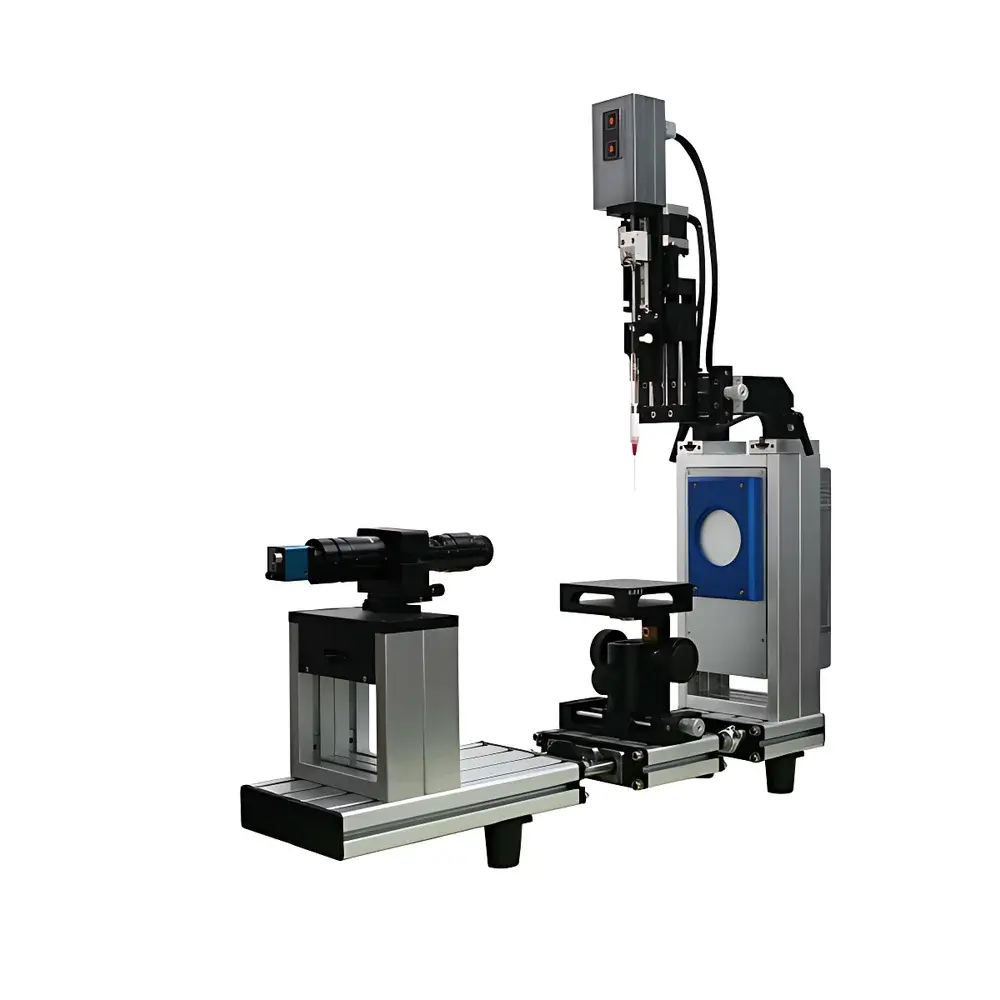
HARKE HKCA-15 Video-Based Optical Contact Angle Analyzer
| Brand | HARKE |
|---|---|
| Origin | Beijing, China |
| Manufacturer Type | Direct Manufacturer |
| Instrument Category | Domestic (China-made) |
| Model | HKCA-15 |
| Instrument Type | Benchtop Laboratory System |
| Contact Angle Measurement Range | 0–180° |
| Contact Angle Measurement Accuracy | ±0.1° |
| Sample Stage Dimensions | 100 mm × 100 mm |
| Optical Magnification | 0.75×–4.5× (Parfocal Zoom) |
| Surface/Interfacial Tension Measurement Range | 0–180° (via Sessile Drop Method) |
| Surface/Interfacial Tension Resolution | 0.01 mN/m (derived from contact angle and known liquid properties) |
| Imaging System | High-Resolution CMOS Camera with Real-Time Capture |
| Analysis Methods | Circle Fitting, Baseline-Circle Fitting |
| Image Processing Modes | Manual & Auto Edge Detection |
| Stage Translation | Vertical ±50 mm, Horizontal ±60 mm, Microscope Translation: ±10 mm (X-axis) |
| Overall Dimensions | 160 mm (W) × 880 mm (D) × 720 mm (H) |
| Frame Construction | Aerospace-Grade Aluminum Base with Four-Point Leveling Feet |
Overview
The HARKE HKCA-15 is a benchtop video-based optical contact angle analyzer engineered for precise, repeatable quantification of solid–liquid interfacial behavior. It operates on the sessile drop method—capturing high-contrast silhouette images of liquid droplets deposited on solid substrates—and applies geometric fitting algorithms to determine the tangent angle at the three-phase boundary (solid–liquid–vapor). This principle enables direct measurement of static, advancing, and receding contact angles, as well as dynamic wettability transitions under controlled dispensing or substrate tilting (when integrated with optional tilt stages). The system is calibrated traceably against standard reference surfaces and certified liquids (e.g., ultrapure water, diiodomethane), supporting quantitative surface energy estimation via Owens–Wendt, Wu, or van Oss–Chaudhury–Good models. Designed for ISO 19403-2 and ASTM D7334-compliant workflows, the HKCA-15 serves as a foundational tool in R&D labs evaluating hydrophobicity, coating uniformity, membrane filtration efficiency, biomedical implant surface modification, and inkjet printability.
Key Features
- Benchtop modular architecture with rigid aerospace-grade aluminum base and four-point precision leveling feet for vibration-damped stability
- Parfocal zoom optical path (0.75×–4.5×) ensuring consistent focus across magnification range—critical for accurate edge detection across varying droplet sizes
- High-sensitivity CMOS imaging system with real-time frame capture (up to 60 fps), enabling dynamic contact angle tracking during droplet growth or evaporation
- Motorized XYZ sample stage: ±50 mm vertical travel, ±60 mm lateral translation, and ±10 mm microscope longitudinal adjustment for optimal focal plane alignment
- Dual-mode analysis engine supporting both manual contour selection and automated edge detection with adaptive thresholding and noise suppression
- Multi-algorithm contact angle computation: Circle fitting for symmetric drops; baseline-circle fitting for asymmetric or low-contact-angle systems
- Integrated LED illumination with adjustable intensity and coaxial/diffuse lighting modes to minimize glare and enhance droplet profile contrast on reflective or textured surfaces
Sample Compatibility & Compliance
The HKCA-15 accommodates flat, rigid, or flexible planar samples up to 100 mm × 100 mm and 25 mm thick—including polymer films, metal foils, ceramic wafers, textile swatches, and biological membranes. Its open-stage design allows direct placement without clamping-induced deformation. All hardware and software components comply with CE electromagnetic compatibility (EMC) directives and RoHS material restrictions. Data acquisition and processing align with GLP documentation requirements: timestamped image metadata, user audit logs, and raw pixel-coordinate export support full traceability. While not FDA 21 CFR Part 11–validated out-of-the-box, the system’s deterministic image processing pipeline and immutable data export (TIFF, CSV, PDF) facilitate validation by end-user QA departments per internal SOPs or ISO/IEC 17025 accreditation protocols.
Software & Data Management
The proprietary HARKE Contact Angle Suite (v4.x) provides a native Windows-based interface with dual-language support (English/Chinese), intuitive workflow navigation, and embedded calibration wizards. Core capabilities include real-time contact angle plotting, time-resolved curve generation (e.g., θ vs. t during evaporation), synchronized video recording with frame-by-frame playback, and programmable auto-capture at user-defined intervals. All measurements are stored in a structured SQLite database with searchable tags (sample ID, operator, date, solvent, temperature). Export options include publication-ready vector graphics (SVG, EPS), tabular data (CSV, Excel), annotated screenshots (PNG/JPEG), and batch-processed reports compliant with internal lab templates. Software updates are delivered via secure HTTPS portal with version-controlled release notes and backward-compatible project file handling.
Applications
- Quality control of hydrophobic coatings on automotive glass, solar panels, and medical device housings
- Surface energy mapping of plasma-treated polymeric packaging films for adhesive bonding optimization
- Wettability screening of porous scaffolds in tissue engineering prior to cell seeding
- Quantitative assessment of oil–water–rock interactions in enhanced oil recovery (EOR) research
- Development and validation of anti-fouling marine coatings using seawater simulants
- Characterization of nanofiber mat anisotropy via directional contact angle hysteresis analysis
FAQ
What contact angle analysis methods does the HKCA-15 support?
Circle fitting, baseline-circle fitting, and tangent fitting—each selectable per image based on droplet symmetry and substrate homogeneity.
Can the system measure surface free energy?
Yes—via contact angle inputs from at least two probe liquids (e.g., water and diiodomethane), the software computes dispersive and polar surface energy components using Owens–Wendt or Wu harmonic mean models.
Is the camera resolution sufficient for sub-1° angle resolution?
With 1920 × 1080 pixel resolution, 0.75×–4.5× parfocal optics, and sub-pixel edge interpolation, the system achieves ±0.1° repeatability under controlled ambient lighting and stable thermal conditions.
Does the software support GMP/GLP-compliant reporting?
It generates fully traceable, timestamped reports with embedded raw images and metadata; however, formal 21 CFR Part 11 compliance requires site-specific electronic signature implementation and IT infrastructure validation.
What is the maximum sample thickness the stage accommodates?
25 mm—verified with standard mounting fixtures; custom stage inserts are available for thicker or irregularly shaped specimens upon request.



