
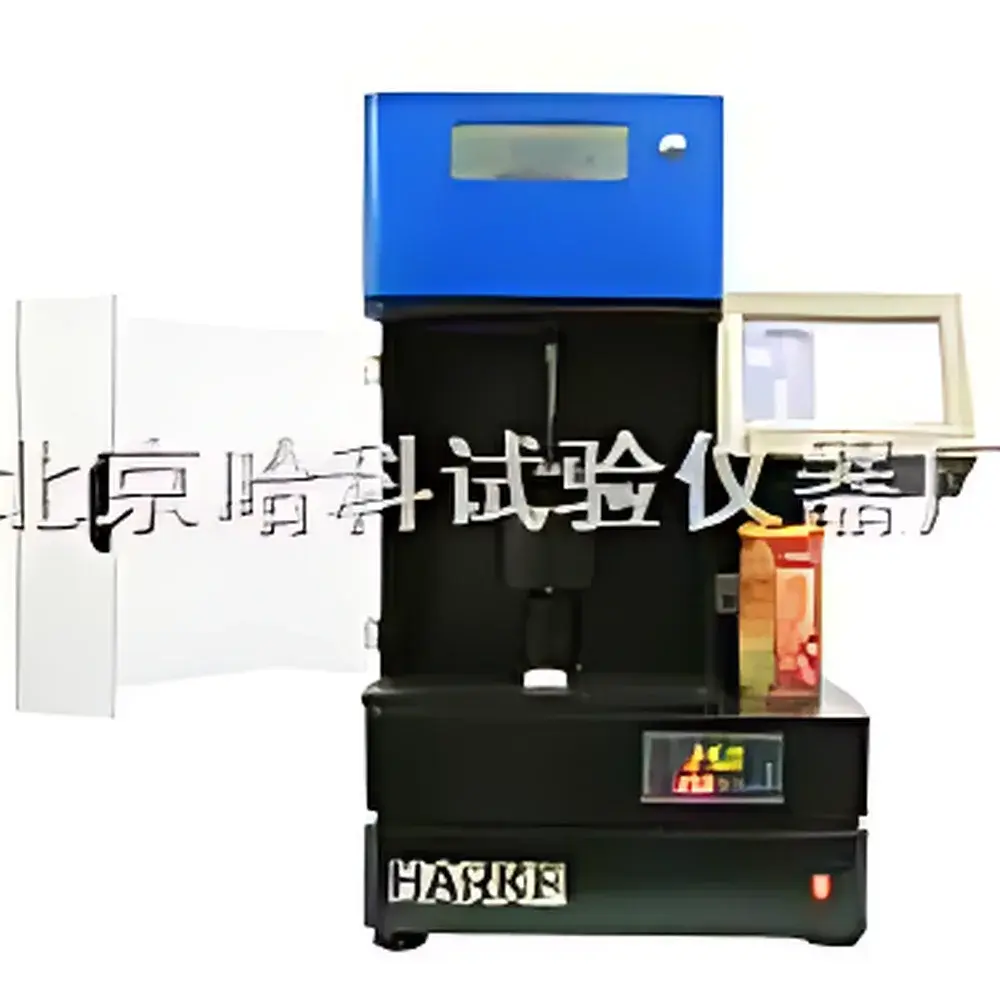
Harke SFT-A1 Surface Tensiometer
| Origin | Beijing, China |
|---|---|
| Manufacturer Type | Authorized Distributor |
| Origin Category | Domestic (China) |
| Model | SFT-A1 |
| Quotation | Available upon Request |
| Measurement Range | 0–1000 mN/m |
| Resolution | 0.01 mN/m |
| Accuracy | ±0.01 mN/m |
| Data Acquisition Rate | Up to 23 Hz |
| Zeroing | One-touch automatic zero calibration |
| Operating System | 7-inch full-color WinCE embedded interface |
| Data Export | USB 2.0 port for flash drive transfer |
| Peripheral Support | External mouse compatible |
| Stage Vertical Travel | 0–50 mm |
| Stage Repeatability | ±0.5 µm |
| Stage Speed Control | Programmable and variable-speed motorized control via USB software interface |
| Drive Mechanism | Low-noise precision lead screw |
| Temperature Sensing Accuracy | ±0.01 °C |
| Temperature Readout | Software-synchronized, independent digital display |
| Measurement Method | Du Noüy Ring (ISO 4885, ASTM D971) |
| Automation Level | Fully automated surface/interfacial tension measurement with optional manual mode |
| Liquid Level Detection | Real-time electronic sensor-based meniscus recognition |
| Data Management | On-screen real-time plotting, timestamped storage, searchable historical database, export to Origin-compatible ASCII/CSV formats |
| Proprietary Methods | Harke A3/A4/A5 tension calculation algorithms |
| Dimensions (L×W×H) | 330 × 350 × 580 mm |
| Weight | 20 kg |
| Power Supply | 220 V AC, 3 A |
Overview
The Harke SFT-A1 Surface Tensiometer is an engineered solution for precise, reproducible measurement of surface tension and interfacial tension using the classical Du Noüy Ring method—fully compliant with ISO 4885 and ASTM D971 standards. Designed for routine quality control laboratories, R&D facilities, and academic surface science research, the instrument employs a high-resolution force transducer coupled with a motorized, low-vibration vertical stage to quantify the maximum pull force required to detach a platinum-iridium ring from the liquid–air or liquid–liquid interface. Its embedded WinCE operating system integrates real-time force acquisition, temperature synchronization, and meniscus detection—enabling traceable, operator-independent measurements without external PC dependency. The system’s mechanical architecture prioritizes stability: a custom low-noise precision lead screw ensures sub-micron positional repeatability (±0.5 µm), critical for minimizing hysteresis and drift during dynamic interfacial relaxation studies.
Key Features
- High-precision force sensor with 0.01 mN/m resolution and ±0.01 mN/m accuracy across the full 0–1000 mN/m range
- Motorized sample stage with programmable speed profiles and 50 mm travel—supporting both static equilibrium and dynamic detachment protocols
- Integrated temperature sensor with ±0.01 °C accuracy and software-synchronized readout, enabling thermodynamic characterization of tension vs. temperature dependencies
- 7-inch full-color WinCE touchscreen interface with on-device data visualization, real-time curve rendering, and timestamped storage
- Electronic meniscus detection algorithm that autonomously identifies the liquid baseline—eliminating subjective visual alignment errors
- One-touch automatic zero calibration routine executed prior to each measurement cycle, ensuring long-term baseline stability
- USB 2.0 host port for direct data export to removable flash drives in CSV/ASCII format—compatible with OriginLab, MATLAB, and Excel for downstream statistical analysis
- Support for external input devices including USB mice for enhanced operational flexibility in glove-box or fume hood environments
Sample Compatibility & Compliance
The SFT-A1 accommodates a broad spectrum of Newtonian and weakly non-Newtonian liquids—including aqueous surfactant solutions, polymer melts, ionic liquids, crude oil–water systems, and pharmaceutical emulsions. Its platinum-iridium ring geometry (standard 19.2 mm circumference per ISO 4885) ensures compatibility with standard reference materials such as ultra-pure water (72.75 mN/m at 20 °C) and diiodomethane (50.8 mN/m). All measurement routines adhere to GLP principles: audit-trail-capable data logging, user-access-controlled parameter locking, and immutable timestamped records. While the instrument itself does not require FDA 21 CFR Part 11 certification (as it operates as a standalone embedded system without network connectivity), its output files are structured to support validation workflows in regulated environments under ICH Q5C and USP <1058> analytical instrument qualification guidelines.
Software & Data Management
The embedded firmware implements Harke’s proprietary A3/A4/A5 calculation algorithms—each optimized for distinct interfacial conditions: A3 for clean liquid–air interfaces, A4 for surfactant-laden systems exhibiting viscoelastic film formation, and A5 for liquid–liquid systems where buoyancy correction and density differential must be rigorously applied. Data acquisition occurs at up to 23 Hz, capturing transient force responses during ring immersion and withdrawal. All results are stored locally with metadata (operator ID, date/time, temperature, method ID, ring calibration factor). Historical datasets are indexed and searchable by date range, sample ID, or measurement type. Exported files include raw force–distance traces alongside processed tension values—formatted for direct import into OriginLab for advanced curve fitting (e.g., exponential decay modeling of adsorption kinetics) or statistical process control (SPC) charting.
Applications
- Surfactant critical micelle concentration (CMC) determination via concentration–tension isotherms
- Emulsion and foam stability assessment through interfacial rheology proxies
- Quality assurance of coating formulations, inkjet fluids, and agrochemical adjuvants
- Surface energy estimation of solid substrates using contact angle–tension correlations
- Crude oil–brine interfacial tension profiling for enhanced oil recovery (EOR) screening
- Biopharmaceutical formulation development—monitoring protein-induced interfacial denaturation
- Academic research in colloidal science, soft matter physics, and interfacial thermodynamics
FAQ
Does the SFT-A1 support Wilhelmy plate method?
No—the SFT-A1 is configured exclusively for the Du Noüy Ring method. It does not include a Wilhelmy plate holder or associated calibration routines.
Can the instrument be connected to a laboratory network or LIMS?
The device lacks Ethernet or Wi-Fi capability; data transfer is limited to USB 2.0 host mode. Integration with LIMS requires manual file upload or third-party middleware scripting.
Is ring calibration traceable to NIST standards?
Calibration uses certified reference weights (traceable to national metrology institutes); however, Harke does not provide NIST-certified calibration certificates as standard—available optionally upon request with accredited third-party verification.
What maintenance is required for long-term accuracy?
Monthly cleaning of the platinum ring with chromic acid or piranha solution (followed by thorough rinsing and annealing), biannual verification of stage repeatability, and annual transducer linearity check using certified dead-weight loads.
Is temperature control of the sample bath supported?
The SFT-A1 measures ambient or externally stabilized bath temperature but does not include integrated Peltier heating/cooling. Users must pair it with external thermostated baths (e.g., Julabo or Thermo Scientific models) for controlled-temperature experiments.



