
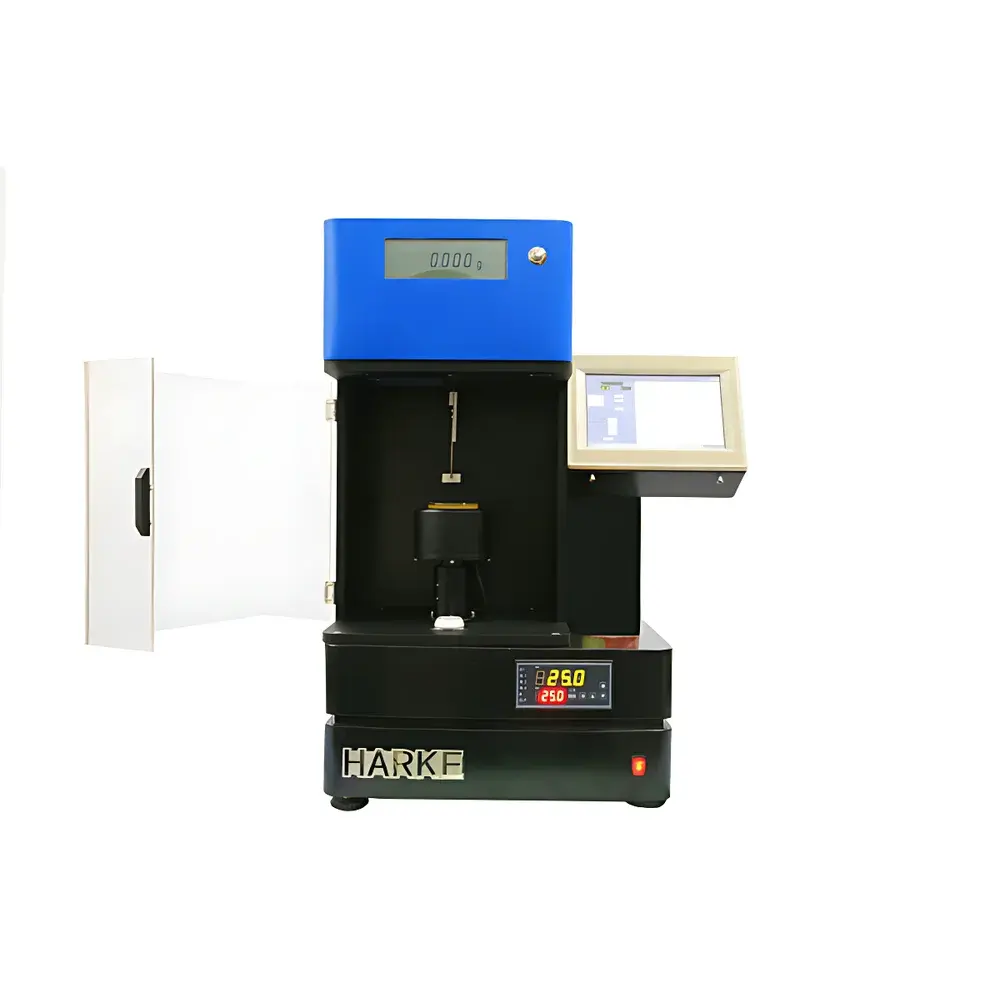
HARKE SFT-A3 Advanced Surface Tensiometer
| Brand | HARKE |
|---|---|
| Model | SFT-A3 |
| Measurement Principle | Du Noüy Ring Method & Wilhelmy Plate Method |
| Surface/Interfacial Tension Range | 0–400 mN/m |
| Resolution | 0.01 mN/m |
| Accuracy | ±0.1 mN/m |
| Temperature Control Range | 1–90 °C |
| Temperature Accuracy | ±0.1 °C |
| Sensor Type | Electromagnetic Balance Force Sensor (0–120 g capacity) |
| Stage Vertical Speed | 0–10 mm/s |
| Stage Travel Distance | 0–80 mm |
| Stage Positioning Accuracy | ±0.1 mm |
| Sample Holder Diameter | Φ50 mm |
| Software | SFT-A1 v3.x (with ASTM D971, ISO 6295, ISO 1409, USP <1042> compliant modules) |
| Dimensions (W×D×H) | 360 × 360 × 620 mm |
| Weight | 20 kg |
| Optional Accessories | Peltier-based temperature control module, External recirculating chiller interface, Precision density measurement mode (via buoyancy calibration) |
Overview
The HARKE SFT-A3 Advanced Surface Tensiometer is a dual-method, benchtop instrument engineered for high-reproducibility measurement of surface and interfacial tension in liquids and liquid–liquid systems. It operates on two internationally standardized physical principles: the Du Noüy ring method (ASTM D971, ISO 6295) and the Wilhelmy plate method (ISO 1409, USP ). Unlike legacy torsion-wire tensiometers, the SFT-A3 employs a high-stability electromagnetic balance force sensor with a full-scale capacity of 120 g and sub-microgram resolution—eliminating mechanical drift, zero-point instability, and operator-induced torque artifacts. Its embedded computing architecture replaces external PCs while maintaining full computational parity: real-time force acquisition at ≥100 Hz, synchronized thermal monitoring, and native support for dynamic surface tension profiling via programmable immersion dwell time (0.1–300 s). The system is calibrated traceably to NIST-traceable reference standards and validated for GLP-compliant laboratories.
Key Features
- Dual-standard compliance: Fully implements ASTM D971 (ring), ISO 1409 (plate), and ISO 6295 (interfacial tension) protocols with automated correction algorithms for ring geometry, buoyancy, and meniscus curvature.
- Integrated precision weighing function: Leverages the same electromagnetic balance to perform density determination (via hydrostatic weighing) and micro-mass measurement (0.1 mg resolution), enabling concurrent surface tension and density analysis without hardware reconfiguration.
- Programmable stage dynamics: Motorized vertical stage with adjustable speed (0–10 mm/s), travel range (0–80 mm), and positioning accuracy (±0.1 mm) supports both static equilibrium and dynamic surface tension measurements.
- Thermal management flexibility: Standard ambient operation; optional Peltier heating/cooling module or external recirculating chiller interface enables precise temperature control from 1 °C to 90 °C (±0.1 °C stability).
- Standardized hardware: Platinum–iridium alloy Du Noüy rings and Wilhelmy plates conform to ISO 6295 dimensional tolerances (ring diameter 19.2 mm ± 0.02 mm; plate perimeter 60 mm ± 0.05 mm); all components undergo certified welding and surface passivation.
- Embedded SFT-A1 software v3.x: Features audit-trail logging per FDA 21 CFR Part 11 requirements, customizable report templates (PDF/CSV/XLSX), multi-user permission levels, and built-in uncertainty calculation per GUM (JCGM 100:2008).
Sample Compatibility & Compliance
The SFT-A3 accommodates aqueous solutions, organic solvents, polymer melts, surfactant micellar systems, crude oil–water interfaces, and biopharmaceutical formulations. Sample volume requirement is ≤15 mL per test (Φ50 mm standard cell). All measurement modes comply with ISO/IEC 17025:2017 general requirements for competence of testing and calibration laboratories. Instrument validation documentation includes IQ/OQ/PQ protocols aligned with pharmaceutical QA workflows. Raw data files retain full metadata (operator ID, timestamp, environmental conditions, calibration certificate IDs) to satisfy GMP audit trails.
Software & Data Management
SFT-A1 software provides a unified interface for method setup, real-time force–distance curve visualization, automatic peak detection, and post-acquisition correction (e.g., Harkins–Jordan factor for ring method, wetting angle compensation for plate method). Data export supports LIMS integration via ASTM E1384-compliant structured XML. Version-controlled method libraries include HARKE’s proprietary A3/A4/A5 protocols—designed for cross-platform comparability with Krüss K100, Dataphysics DCAT21, and Biolin Theta instruments. All software updates are digitally signed and delivered via secure HTTPS repository.
Applications
- Quality control of surfactants, emulsifiers, and wetting agents in agrochemical and personal care formulations.
- Stability assessment of oil-in-water and water-in-oil emulsions in food and petroleum industries.
- Surface activity profiling of monoclonal antibodies and recombinant proteins under varying pH and ionic strength conditions.
- Interfacial rheology pre-screening prior to oscillatory interfacial shear measurements.
- Evaluation of cleaning efficacy in semiconductor wafer processing fluids.
- Academic research in colloid and interface science, including critical micelle concentration (CMC) determination and adsorption kinetics modeling.
FAQ
Does the SFT-A3 support both ring and plate methods simultaneously?
Yes—the instrument automatically detects the mounted probe (ring or plate) via mechanical switch feedback and loads the corresponding calibration and correction parameters.
Is temperature control mandatory for accurate surface tension measurement?
While ambient-temperature measurements are valid, ISO 6295 requires temperature reporting; the SFT-A3 records thermal data at 0.1 °C resolution and applies temperature-dependent correction factors to raw force values.
Can the SFT-A1 software generate 21 CFR Part 11–compliant electronic records?
Yes—audit trail, electronic signatures, and role-based access control are enabled by default; full configuration documentation is provided in the Validation Support Package.
What is the calibration frequency recommendation?
Annual calibration against certified reference standards (e.g., ethanol/water mixtures per ISO 6295 Annex B) is recommended; daily verification using distilled water (72.75 mN/m at 20 °C) is required per GLP practice.
Is the density measurement function ISO 1183-1 compliant?
Yes—the buoyancy-based density mode follows ISO 1183-1 procedures for liquids, with automatic air buoyancy correction and temperature-compensated water density lookup.
Related Products



