
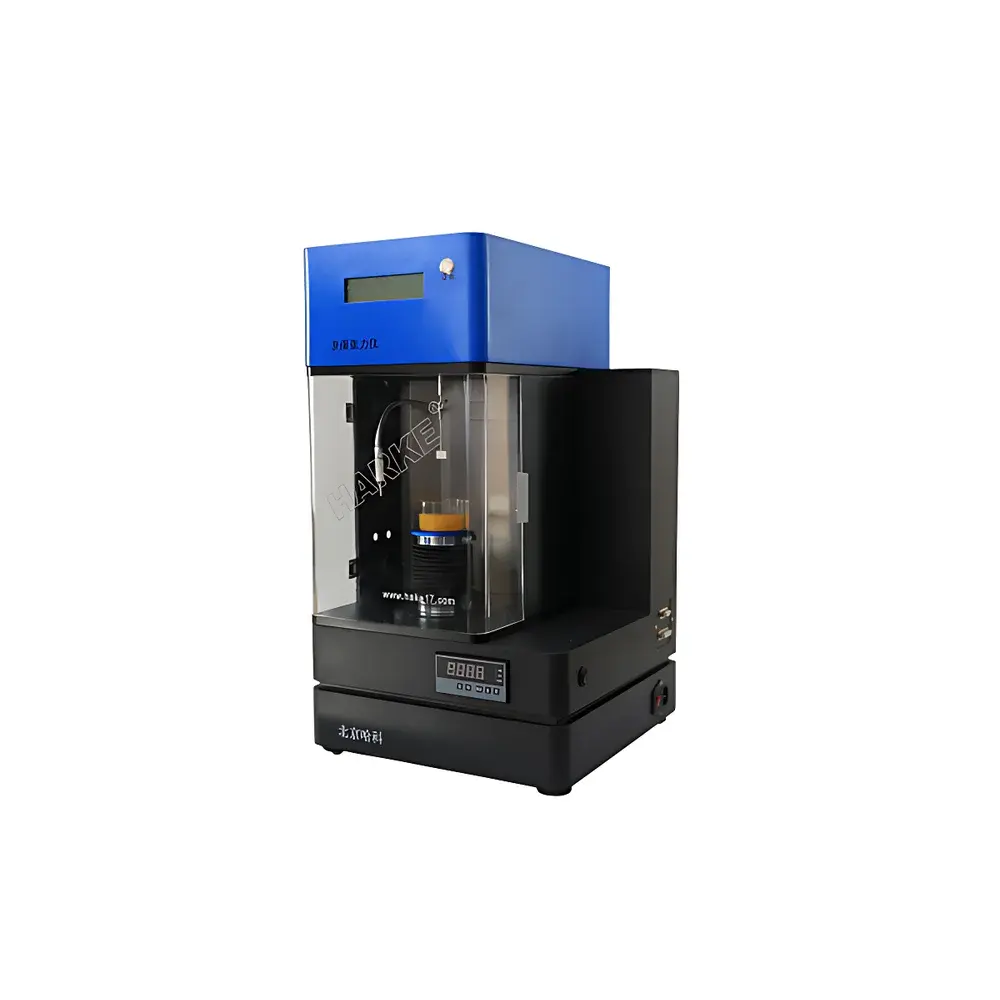
HARKE SFT-D1 Advanced Surface Tensiometer
| Brand | HARKE |
|---|---|
| Model | SFT-D1 |
| Type | Surface & Interfacial Tensiometer |
| Measurement Principle | Wilhelmy Plate (Du Noüy Ring & Plate) Method |
| Origin | Beijing, China |
| Manufacturer | HARKE Instrument Co., Ltd. |
| Surface/Interfacial Tension Range | 0–400 mN/m |
| Accuracy | ±0.1 mN/m |
| Display Resolution | ±0.01 mN/m |
| Density Measurement Range | 0–1000 g/L (converted from g/cm³ for SI consistency) |
| Sensor Capacity | 0–120 g |
| Vertical Stage Speed | 0–10 mm/s |
| Vertical Travel | 0–80 mm |
| Positioning Accuracy | ±0.1 mm |
| Sample Vessel Diameter | Φ50 mm |
| Temperature Control Range | 0–98 °C |
| Software | SFT-D1 v3.x (Windows-based, GLP-compliant) |
| Dimensions (W×D×H) | 360 × 360 × 620 mm |
| Net Weight | 25 kg |
| Compliance | ASTM D971, ISO 6295, ISO 1409, USP <1046>, DIN 53914 |
| Optional Accessories | Peltier-heated stage, External thermostatic circulator interface, Automated liquid dispensing module |
Overview
The HARKE SFT-D1 Advanced Surface Tensiometer is a precision benchtop instrument engineered for the quantitative determination of surface and interfacial tension using the classical Wilhelmy plate and Du Noüy ring methods. It operates on the principle of measuring the force exerted on a vertically immersed solid probe—either a platinum-iridium plate or ring—as it is withdrawn from a liquid phase. This force, directly proportional to the surface tension coefficient (γ, in mN/m), is captured via a high-stability electromagnetic balance sensor with sub-micron force resolution. Unlike torsion-wire-based systems, the SFT-D1 eliminates mechanical hysteresis, zero-drift, and manual locking artifacts, delivering repeatable measurements under dynamic or static conditions. Designed for laboratories requiring traceable, standards-aligned results, the instrument supports full thermoregulation (0–98 °C) and integrates density measurement functionality via buoyancy-based mass calibration—enabling concurrent determination of liquid density (0–1000 g/L) without auxiliary equipment.
Key Features
- Electromagnetic balance sensor with 0–120 g capacity and ±0.1 mN/m absolute accuracy per ASTM D971 calibration protocols
- Dual-method capability: Wilhelmy plate (ASTM D1331, ISO 1409) and Du Noüy ring (ISO 6295, DIN 53914), both using certified HARKE alloy probes manufactured to ISO-defined dimensions and surface finish
- Motorized vertical stage with programmable speed (0–10 mm/s) and positional repeatability of ±0.1 mm over 80 mm travel
- Integrated temperature control via PID-regulated heating element and optional external circulator interface (±0.2 °C stability at setpoint)
- Real-time dual-display mode: simultaneous visualization of raw force signal (mN) and calculated surface tension (mN/m) with time-stamped curve overlay
- Onboard embedded computing architecture—no external PC required—running HARKE’s proprietary SFT-D1 v3.x software with audit-trail logging compliant with FDA 21 CFR Part 11 Annex 11 requirements
- Calibration suite supporting A3 (plate), A4 (ring), and A5 (density correction) methods per international standard practice
Sample Compatibility & Compliance
The SFT-D1 accommodates aqueous, organic, and surfactant-laden solutions in standard Φ50 mm glass or quartz sample vessels. Its probe geometry adheres strictly to ISO 1409 specifications for plate width (19.2 mm), thickness (0.2 mm), and edge radius (<0.05 mm), ensuring cross-platform comparability with data generated on Krüss K100, DataPhysics DCAT, or Biolin Theta instruments. All measurements are traceable to NIST-certified reference liquids (e.g., distilled water at 20 °C: γ = 72.75 mN/m). The system meets GLP/GMP documentation requirements through automated metadata capture—including operator ID, ambient humidity/temperature, probe serial number, calibration certificate expiry, and raw sensor output logs. Regulatory alignment includes ASTM D971 (petroleum products), ISO 6295 (emulsions), USP (pharmaceutical surfactants), and ISO 1409 (plastics testing).
Software & Data Management
The SFT-D1 v3.x software provides a Windows-native interface with multilingual support (English, German, Japanese, Chinese), configurable report templates (PDF/CSV/XLSX), and role-based user access control. Each measurement session automatically generates a timestamped .sft file containing raw force vs. displacement data, environmental metadata, and post-processed tension values with uncertainty estimation. Audit trails record all parameter modifications, calibration events, and user logins with immutable timestamps—fully satisfying 21 CFR Part 11 electronic signature and retention mandates. Data export supports third-party statistical packages (JMP, OriginLab) and LIMS integration via ODBC drivers. Firmware updates are delivered via secure HTTPS channel with SHA-256 integrity verification.
Applications
- Quality control of surfactants, detergents, and emulsifiers in chemical manufacturing
- Rheological characterization of polymer melts and nanofluids at air–liquid and liquid–liquid interfaces
- Formulation development for pharmaceutical suspensions, liposomal drug carriers, and topical creams
- Corrosion inhibitor evaluation in oilfield chemistry and metalworking fluids
- Academic research on Langmuir monolayers, micelle formation kinetics, and Marangoni flow phenomena
- Density-dependent interfacial tension mapping for enhanced oil recovery (EOR) screening
FAQ
Does the SFT-D1 comply with ISO/ASTM standard test methods?
Yes—the instrument implements Wilhelmy plate (ISO 1409, ASTM D1331) and Du Noüy ring (ISO 6295, ASTM D971) protocols with geometrically certified probes and traceable calibration routines.
Can the system measure interfacial tension between two immiscible liquids?
Yes—by configuring the lower phase as a dense solvent (e.g., chloroform) and the upper phase as aqueous surfactant solution, the SFT-D1 quantifies liquid–liquid interfacial tension with the same accuracy as air–liquid measurements.
Is temperature control mandatory for surface tension measurement?
While not mandatory, temperature stabilization is strongly recommended: surface tension exhibits a linear negative temperature coefficient (~0.15 mN/m per °C for water); uncontrolled drift introduces systematic error exceeding ±1 mN/m over 5 °C variation.
What materials are used for the Wilhelmy plate and Du Noüy ring?
Both are fabricated from Pt/Ir (90/10 wt%) alloy, electropolished to Ra < 0.02 µm, and laser-welded to stainless-steel holders—ensuring corrosion resistance, dimensional stability, and compliance with ISO 1409 surface roughness and edge-radius tolerances.
How is density measured on the SFT-D1?
Using Archimedes’ principle: the instrument weighs a calibrated sinker (e.g., fused silica sphere) first in air, then fully immersed in the test liquid; density is calculated from the buoyant mass loss and sinker volume, traceable to NIST SRM 1464a.



