
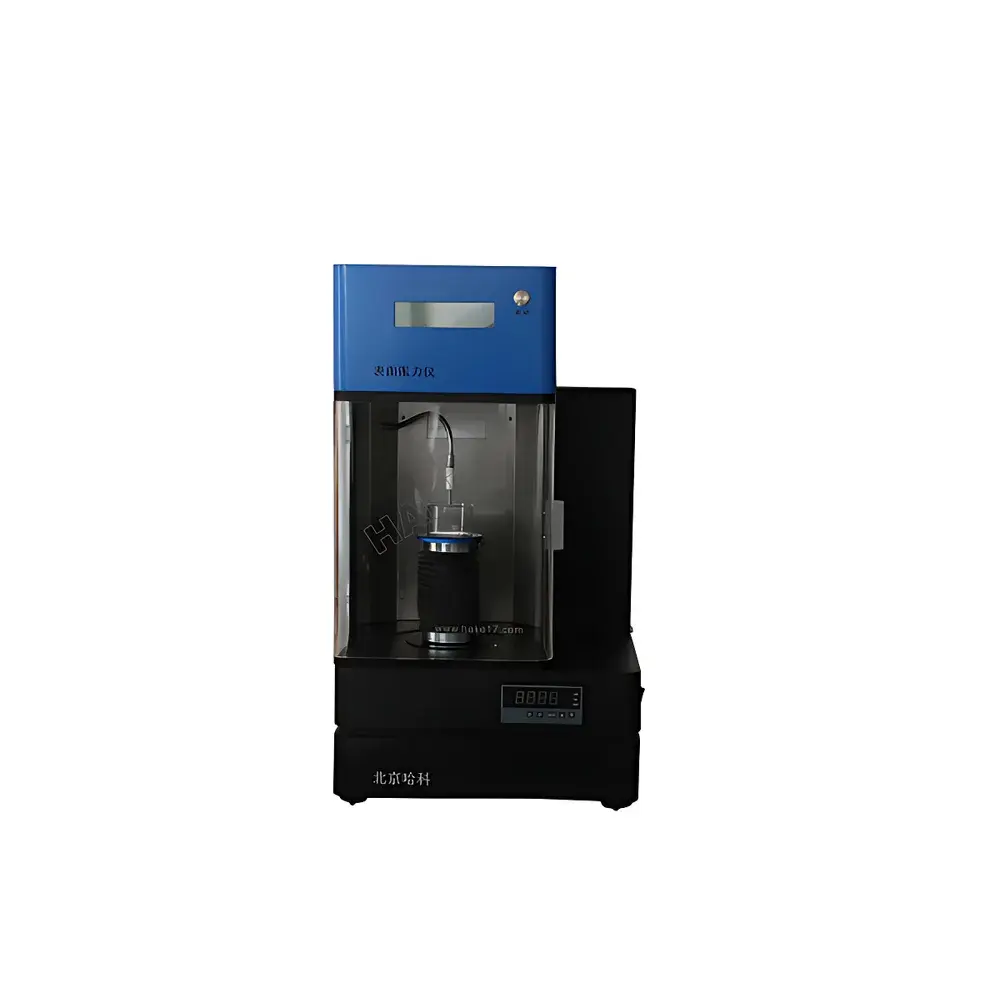
HARKE SFT-D2 Dynamic Contact Angle and Surface Tension Analyzer
| Brand | HARKE |
|---|---|
| Origin | Beijing, China |
| Manufacturer Type | Manufacturer |
| Product Category | Domestic |
| Model | SFT-D2 |
| Price | Upon Request |
| Surface/Interfacial Tension Range | 0–1000 mN/m |
| Resolution | 0.01 mN/m |
| Accuracy | 0.01 mN/m |
| Temperature Display Range | 0–95 °C |
| Temperature Readout Accuracy | ±0.01 °C |
| Sample Stage Vertical Travel | 0–50 mm |
| Stage Positioning Repeatability | ±0.5 µm |
| Data Acquisition Rate | Up to 23 Hz |
| Communication Interface | USB 2.0 |
Overview
The HARKE SFT-D2 Dynamic Contact Angle and Surface Tension Analyzer is a fully automated, high-precision instrument engineered for comprehensive surface and interfacial property characterization in research laboratories and quality control environments. It operates on the fundamental principles of Wilhelmy plate and du Noüy ring methodologies—both standardized by ISO 1409 and ASTM D971—for surface tension (ST) and interfacial tension (IT) measurement. In addition, it implements gravimetric contact angle analysis based on the Wilhelmy principle (ISO 15989), enabling dynamic contact angle determination for solids—including powders, fibers, and films—under controlled immersion/dewetting cycles. The system integrates real-time temperature monitoring (0–95 °C, ±0.01 °C accuracy), high-stability load cell sensing (0.01 mN/m resolution), and precision motorized stage control (±0.5 µm repeatability) to ensure metrological traceability and experimental reproducibility across diverse liquid–solid and liquid–liquid systems.
Key Features
- Multi-method platform supporting seven standardized test protocols: Wilhelmy plate ST/IT, du Noüy ring ST/IT, buoyancy-based liquid density, Wilhelmy-based dynamic contact angle (advancing/receding), CMC titration, mass measurement, and powder wettability analysis.
- High-resolution force transducer with 0.01 mN/m resolution and accuracy, calibrated in situ via software-driven self-validation routines compliant with GLP documentation requirements.
- Optically ground micrometer screw-driven vertical stage with programmable speed control, 0–50 mm travel range, and sub-micron positioning repeatability (±0.5 µm) for precise meniscus engagement and immersion depth control.
- Automated meniscus detection algorithm that identifies the liquid baseline in real time, eliminating manual threshold setting and reducing operator-dependent variability.
- One-touch auto-zero function executed prior to each measurement cycle, ensuring thermal and mechanical drift compensation without interrupting workflow.
- USB 2.0 native interface with plug-and-play compatibility across Windows-based laboratory PCs; no legacy RS-232 adapters or driver conflicts.
- Modular architecture supporting optional add-ons: fiber contact angle module, powder dispersion kit, and temperature-controlled sample chamber (not included).
Sample Compatibility & Compliance
The SFT-D2 accommodates a broad spectrum of sample types: Newtonian and non-Newtonian liquids (aqueous, organic, surfactant solutions), low-surface-tension solvents (e.g., alcohols, hydrocarbons), polymer melts, colloidal dispersions, lyophilized powders, woven/nonwoven textiles, and thin-film substrates. All measurement modes adhere to internationally recognized standards: ISO 1409 (plasticizers in PVC), ISO 6295 (petroleum products), ASTM D1331 (foam stability), ASTM D971 (interfacial tension of oil–water systems), and ISO 15989 (contact angle of plastics). Data acquisition and storage support audit trails required under FDA 21 CFR Part 11 when operated in validated mode with user access controls and electronic signature configuration.
Software & Data Management
The proprietary HARKE Analysis Suite provides a unified interface for method selection, parameter configuration, real-time curve visualization, and post-processing. Each test session generates timestamped metadata—including ambient temperature, operator ID, calibration status, and environmental logs—stored in an encrypted SQLite database. Historical datasets are searchable by date, sample ID, or method type; raw force vs. position/time data can be exported directly to OriginLab (.opj), CSV, or Excel formats for statistical analysis or publication-ready plotting. The software includes built-in CMC calculation algorithms (first derivative inflection point detection), contact angle hysteresis quantification, and density-to-concentration conversion tables for common solvent systems.
Applications
- Formulation development of surfactants, detergents, and emulsifiers through CMC mapping and interfacial rheology screening.
- Quality assurance of pharmaceutical excipients, including wettability assessment of microcrystalline cellulose and lactose powders per USP <1058>.
- Surface energy evaluation of polymer films, coatings, and printed electronics substrates using contact angle hysteresis and Owens–Wendt modeling.
- Corrosion inhibitor efficiency testing via oil–water interfacial tension reduction at elevated temperatures.
- Biomedical material characterization, such as protein adsorption kinetics on biomaterial surfaces using dynamic contact angle profiles.
- Environmental analysis of oil spill dispersants and soil surfactant leaching behavior under variable ionic strength conditions.
FAQ
What surface tension methods does the SFT-D2 support?
It supports Wilhelmy plate (ISO 1409), du Noüy ring (ASTM D971), and HARKE’s proprietary A3/A4/A5 methods—each validated against NIST-traceable reference fluids.
Can the instrument measure contact angles for irregularly shaped powders?
Yes, using the optional powder contact angle module, which applies the Washburn equation to capillary rise data under controlled humidity and compaction pressure.
Is temperature control integrated into the base unit?
The SFT-D2 includes a high-accuracy Pt100 sensor and digital readout (0–95 °C, ±0.01 °C), but active heating/cooling requires an external Peltier or water-jacketed bath.
How is data integrity ensured during long-term CMC experiments?
The system logs every data point with hardware timestamps, performs automatic baseline correction between injections, and flags outliers using configurable statistical thresholds.
Does the software comply with regulatory data governance standards?
When deployed with role-based login, audit trail activation, and electronic signature modules, it meets core requirements of FDA 21 CFR Part 11 and EU Annex 11 for GxP environments.



