
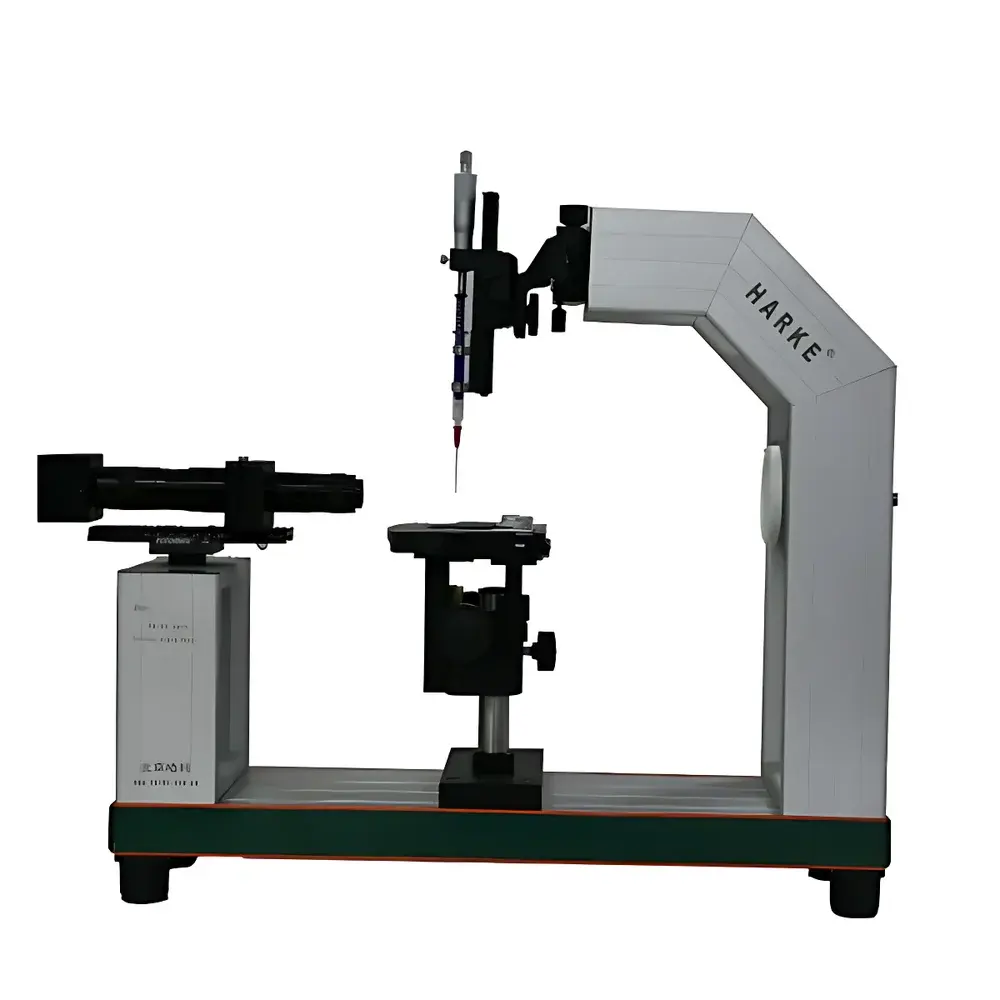
HARKE SPCA-1 Video-Based Optical Contact Angle Analyzer
| Brand | HARKE |
|---|---|
| Origin | Beijing, China |
| Manufacturer Type | Direct Manufacturer |
| Instrument Type | Benchtop Laboratory System |
| Instrument Category | Video Optical Contact Angle Meter |
| Model | HARKE SPCA-1 |
| Contact Angle Range | 0–180° |
| Measurement Accuracy | ±0.1° |
| Droplet Formation Methods | Sessile Drop, Captive Bubble |
| Analysis Algorithms | Automated Circle Fitting, Ellipse Fitting, Full-Profile Tangent, Local-Profile Tangent, Height-Width Method, Young–Laplace Fitting, Curve Ruler Method |
| Surface Adaptations | Convex/Concave Surface Correction, Tilted-Plane Measurement, Dynamic Contact Angle Tracking |
| Image Processing Modes | Manual & Fully Automated |
| Syringe Dispensing Volume | 0–100 µL (Computer-Controlled), 1 mL (Manual) |
| Dispensing Precision | ±0.1 µL |
| Surface Energy Calculation Methods | Zisman Plot, Fowkes, Owens–Wendt–Rabel–Kaelble (OWRK) |
| Microscope | 0.75×–4.5× Continuous Zoom, Parfocal Design (HARKE Custom-Engineered) |
| Camera | High-Resolution Digital CMOS Sensor |
| Video Capabilities | Real-Time Recording, Frame-by-Frame Playback, Time-Interval Snapshot Capture, Single-Frame Export from Video |
| Stage Dimensions | 100 mm × 120 mm |
| Stage Travel | Vertical 50 mm, Horizontal (X/Y) 70 mm × 40 mm |
| Stage Vertical Extension | 30 mm |
| Fixed Mount Translation | 150 mm (Z-axis) |
| Syringe Holder Movement | Vertical 100 mm, Horizontal 100 mm |
| Microscope Translation | 100 mm (Z-axis) |
| Maximum Sample Size | 100 mm (W) × 80 mm (D) × Unlimited Height |
| Overall Dimensions | 240 mm (W) × 640 mm (D) × 630 mm (H) |
Overview
The HARKE SPCA-1 is a precision-engineered video-based optical contact angle analyzer designed for rigorous surface wettability characterization in academic research laboratories, materials science departments, and industrial quality control environments. It operates on the principle of digital image capture and geometric contour analysis of liquid–solid–vapor interfaces, enabling quantitative measurement of static, advancing, receding, and dynamic contact angles under controlled environmental conditions. The system integrates a parfocal zoom microscope with a high-sensitivity CMOS camera to ensure stable focus across magnification ranges—critical for reproducible interfacial geometry extraction. Its modular mechanical architecture supports complex sample geometries including curved, tilted, and textured substrates, making it suitable for evaluating functional coatings, biomaterials, microstructured surfaces, and porous membranes where conventional flat-surface assumptions fail.
Key Features
- High-accuracy contact angle measurement across full 0–180° range with ±0.1° repeatability—validated per ISO 19403-2 and ASTM D7334 standards for interfacial characterization.
- Multi-algorithm image analysis engine supporting seven distinct fitting methods: automated circle, ellipse, full-profile tangent, local-profile tangent, height-width, Young–Laplace, and curve-ruler approaches—ensuring optimal fit selection based on droplet symmetry, substrate curvature, and interfacial distortion.
- Dual droplet formation capability: sessile drop for hydrophilic/hydrophobic surface evaluation and captive bubble for inverse measurements on transparent or submerged substrates.
- Computer-controlled microdispensing system with ±0.1 µL resolution over 0–100 µL range; manual 1 mL syringe option for rapid prototyping or viscous fluid handling.
- Motorized, multi-axis translation stage with independent X/Y/Z motion (70 mm × 40 mm × 50 mm travel), plus extended vertical lift (30 mm) and fixed-mount longitudinal translation (150 mm)—enabling precise positioning of irregular or oversized specimens.
- Custom HARKE parfocal zoom optics (0.75×–4.5×) eliminates refocusing during magnification changes, preserving measurement consistency across sequential frame captures.
- Comprehensive dynamic analysis suite: time-resolved contact angle tracking, hysteresis quantification, and real-time video export with timestamped frame indexing for post-acquisition kinetic modeling.
Sample Compatibility & Compliance
The SPCA-1 accommodates samples up to 100 mm wide and 80 mm deep, with no height restriction due to its open-stage design and vertically adjustable microscope column. It supports convex, concave, and inclined surfaces through built-in geometric correction algorithms that compensate for lens distortion and perspective projection errors. All measurement protocols comply with international surface science guidelines—including ISO 19403 (Parts 1–4) for contact angle and surface energy determination—and are compatible with GLP/GMP documentation workflows when paired with HARKE’s optional audit-trail-enabled software module (v3.2+). The system meets CE safety directives and RoHS material restrictions for laboratory instrumentation.
Software & Data Management
HARKE SPCA Control Suite v4.1 provides intuitive, menu-driven operation with dual-mode image processing: fully automated batch analysis for routine QC testing and manual intervention mode for research-grade validation. Raw image sequences are stored in lossless TIFF format with embedded metadata (timestamp, magnification, lighting intensity, dispensing volume). Surface energy calculations support Zisman, Fowkes, OWRK, and Wu models, with output tables exportable to CSV or Excel for statistical analysis. The software includes FDA 21 CFR Part 11-compliant user access control, electronic signatures, and immutable audit logs—essential for regulated pharmaceutical, medical device, and aerospace coating development labs.
Applications
- Surface energy mapping of polymer films, thin-film solar cells, and OLED substrates for adhesion optimization.
- Dynamic wettability assessment of self-cleaning, anti-fog, and superhydrophobic coatings under humidity or thermal cycling.
- Biointerfacial studies: protein adsorption kinetics, cell-substrate interaction screening, and hydrogel swelling behavior.
- Quality assurance of printed electronics, inkjet-printed conductive traces, and lithographic photoresist formulations.
- Characterization of filtration membranes, battery separator films, and catalyst supports requiring pore-wetting analysis.
- Corrosion inhibition layer evaluation via contact angle hysteresis and retraction dynamics.
FAQ
What environmental controls are supported?
While the base SPCA-1 operates in ambient lab conditions, optional environmental chambers (temperature: −20°C to 120°C; humidity: 5–95% RH non-condensing) can be integrated for controlled-atmosphere measurements.
Can the system measure contact angles on moving substrates?
No—the current platform is optimized for static or stepwise repositioning. In-situ dynamic substrate motion requires custom integration with external motorized stages and synchronized triggering, available as an OEM engineering service.
Is calibration traceable to NIST or other national standards?
Yes. HARKE provides optional factory calibration certificates traceable to NIST SRM 2800 (contact angle reference standards) upon request, with uncertainty budgets reported per ISO/IEC 17025.
How is data integrity ensured during long-duration dynamic tests?
Continuous write-caching, automatic file segmentation every 10 minutes, and SHA-256 checksum generation prevent corruption during multi-hour video acquisition—critical for evaporation rate or absorption kinetics studies.
Does the software support third-party scripting (e.g., Python or MATLAB)?
Yes. A documented COM/ActiveX API enables bidirectional communication with external analysis environments, allowing custom algorithm deployment and automated report generation.



