
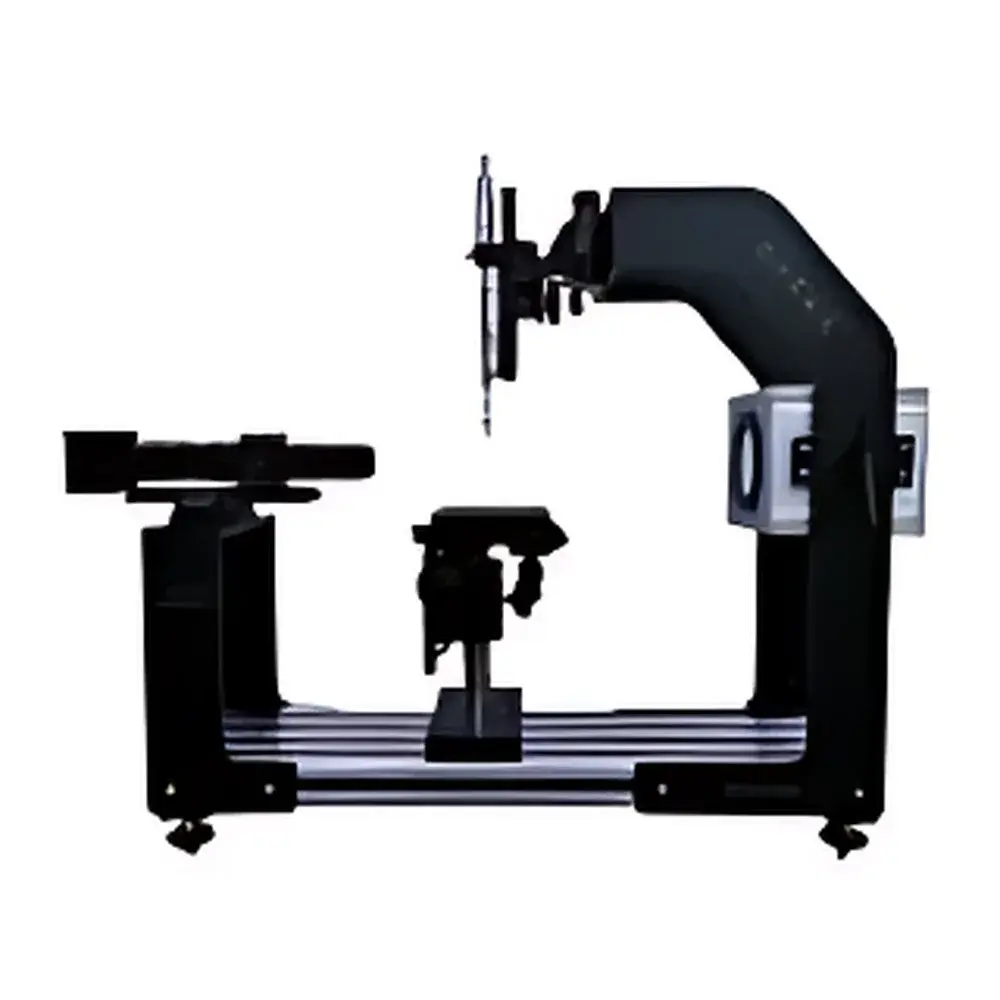
HARKE SPCA-10 Video-Based Optical Contact Angle Goniometer
| Brand | HARKE |
|---|---|
| Origin | Beijing, China |
| Manufacturer Type | Direct Manufacturer |
| Instrument Type | Benchtop Laboratory System |
| Contact Angle Measurement Range | 0–180° |
| Contact Angle Accuracy | ±0.1° |
| Contact Angle Display Resolution | ±0.01° |
| Sample Stage Dimensions | 100 mm × 120 mm |
| Optical Zoom Magnification | 0.7×–5× (ZF-180 Precision Stepping Zoom Lens) |
| Surface/Interfacial Tension Measurement Method | Pendant Drop Method |
| Surface/Interfacial Tension Range | 0–1000 mN/m |
| Surface/Interfacial Tension Accuracy | ±0.01 mN/m |
| Video Capture | USB 2.0 Camera, 30 fps standard (optional: 100/300/1000+ fps high-speed acquisition) |
| Lens Vertical Travel | 120 mm |
| Overall Dimensions | 260 mm × 700 mm (W × D) |
| Weight | ~30 kg |
| Software | HARKE-SPCA v1.0 |
| Power Supply | 220 V / 3 A / 50 Hz |
| Operating Temperature | Ambient |
| Surface Energy Calculation Method | Equation of State (EOS) |
| Fitting Algorithms | Circle Fitting, Ellipse Fitting, Sessile Drop Baseline Correction, Young–Laplace Fitting (for interfacial tension) |
| Optional Modules | Peltier-based Heating Stage (±0.1 °C control), Motorized Tilt Stage (0–90°, 0.01° step resolution) |
Overview
The HARKE SPCA-10 is a precision-engineered benchtop video-based optical contact angle goniometer designed for quantitative characterization of solid–liquid and liquid–liquid interfacial behavior. It operates on the principle of high-resolution silhouette imaging combined with real-time digital image analysis to determine static, advancing, receding, and dynamic contact angles—critical parameters in surface science, coating development, biomaterial evaluation, and microfluidic device design. The system employs a calibrated ZF-180 stepping zoom lens and a synchronized USB 2.0 camera platform to capture stable, distortion-free drop profiles under controlled ambient conditions. Its measurement architecture conforms to ASTM D7334 (Standard Practice for Surface Wettability Assessment by Contact Angle Measurement) and ISO 19403-2 (Contact Angle Measurement – Part 2: Static Contact Angle), supporting method validation for GLP-compliant laboratories.
Key Features
- Precision mechanical stage with 100 mm × 120 mm horizontal sample support area, accommodating standard petri dishes, wafers, polymer films, and porous substrates
- High-accuracy contact angle quantification over full 0–180° range, with certified accuracy of ±0.1° and display resolution of ±0.01°
- Optical path optimized for minimal chromatic aberration and edge contrast enhancement, enabling robust droplet contour detection even on low-contrast or textured surfaces
- Integrated pendant drop module for interfacial tension determination via Young–Laplace equation fitting, validated across 0–1000 mN/m with repeatability ≤0.01 mN/m
- Modular software architecture supporting multiple fitting models: circle, ellipse, and advanced Young–Laplace algorithms for non-spherical drops
- Expandable hardware interface for optional motorized tilt stage (0–90°, programmable angular ramping) and Peltier-controlled thermal stage (−10 °C to +80 °C, ±0.1 °C stability)
Sample Compatibility & Compliance
The SPCA-10 accommodates rigid and flexible substrates up to 25 mm thick, including silicon wafers, metallic coupons, electrospun membranes, hydrogels, and functionalized glass slides. Its open-stage configuration permits in situ environmental modification (e.g., humidity chambers, gas purging ports). All measurement protocols align with regulatory expectations for analytical instrument qualification (AIQ): documented calibration traceability to NIST-traceable reference standards, audit-ready software logs, and electronic record integrity per FDA 21 CFR Part 11 requirements when operated with HARKE-SPCA v1.0 in secured user mode.
Software & Data Management
HARKE-SPCA v1.0 provides a deterministic, scriptable measurement environment with dual-mode operation: manual frame-by-frame analysis and automated sequence acquisition. Each session generates timestamped project files containing raw images, fitted contours, numerical outputs (contact angle, surface energy components, interfacial tension), and metadata (operator ID, date/time, instrument configuration). Export formats include CSV, PNG, TIFF, and XML for integration into LIMS or statistical analysis platforms (e.g., JMP, Python pandas). Software supports EOS-based surface energy decomposition (Lifshitz–van der Waals / acid–base model) and batch processing of multi-condition datasets.
Applications
- Quality control of plasma-treated polymers and anti-fouling coatings in medical device manufacturing
- Characterization of inkjet printability and droplet spreading kinetics on functionalized paper substrates
- Surface energy mapping of heterogeneous catalysts and MOF thin films
- Stability assessment of Pickering emulsions and nanoparticle-laden interfaces
- Dynamic wetting analysis during immersion lithography process development
- Corrosion resistance screening of protective organic coatings on steel and aluminum alloys
FAQ
What calibration standards are recommended for routine verification?
Certified spherical glass beads (diameter ≥2 mm) and reference liquids with known surface tension (e.g., ultrapure water, diiodomethane, ethylene glycol) are used for geometric and interfacial calibration.
Can the system perform automated advancing/receding angle measurements?
Yes—via optional motorized syringe pump integration and tilt-stage synchronization; full hysteresis loops are generated with user-defined volume increments or angular steps.
Is HARKE-SPCA v1.0 compatible with Windows 10/11 64-bit systems?
Yes; the software requires .NET Framework 4.8 and supports both Intel and AMD x64 processors with minimum 8 GB RAM and dedicated GPU acceleration for real-time Young–Laplace fitting.
How is data integrity ensured during long-duration measurements?
All image frames and derived parameters are written directly to disk with atomic file writes; checksum validation and automatic backup logging prevent data corruption during power interruption.
Does the instrument support third-party scripting (e.g., Python API)?
Native COM interface is provided for external automation; Python bindings are available through HARKE’s official SDK package upon request and license agreement.



