
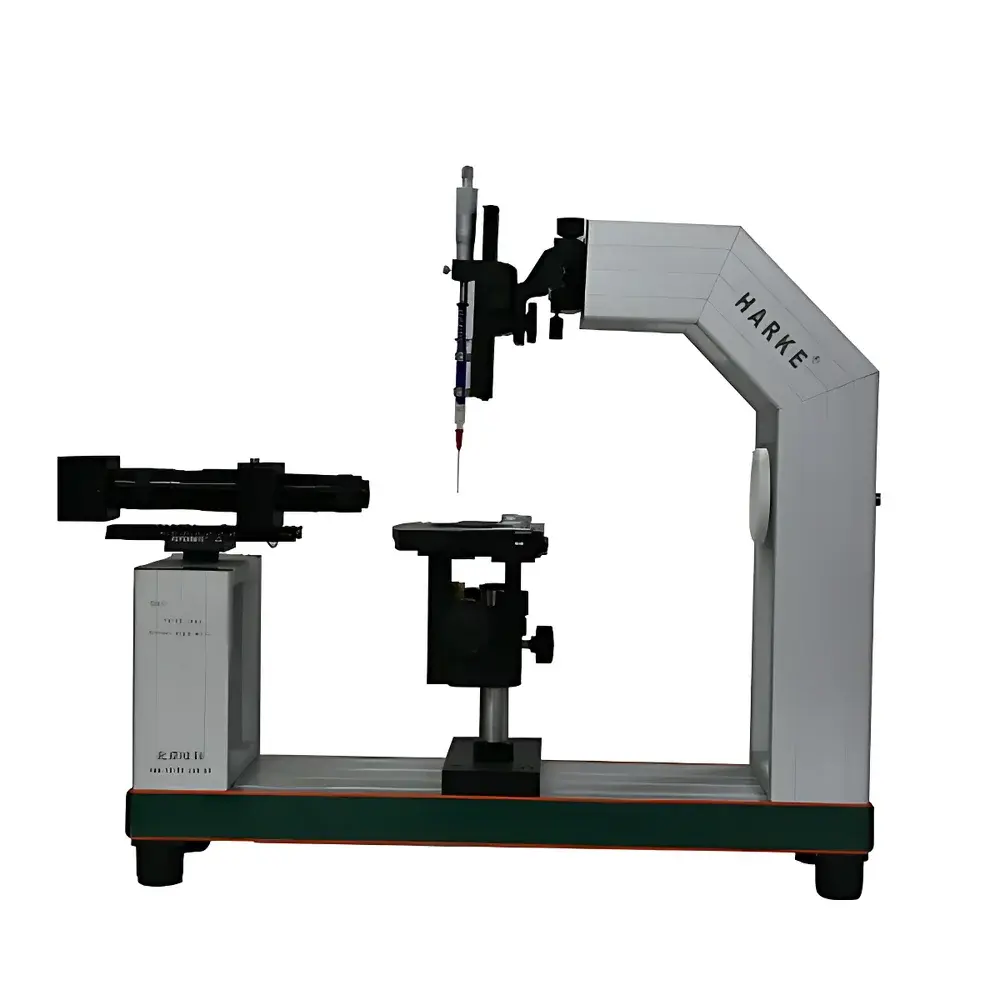
HARKE SPCA Video-Based Optical Contact Angle Analyzer
| Brand | HARKE |
|---|---|
| Model | SPCA |
| Type | Benchtop Video Optical Contact Angle Analyzer |
| Contact Angle Range | 0–180° |
| Contact Angle Accuracy | ±0.1° |
| Sample Stage Dimensions | 120 × 120 mm |
| Optical Magnification | 0.7–4.7× (parfocal zoom) |
| Surface/Interfacial Tension Range | 0–1000 mN/m |
| Surface/Interfacial Tension Accuracy | ±0.01 mN/m |
| Dispensing Volume Range | 0–100 μL (motorized, computer-controlled), manual syringe option (1 mL) |
| Dispensing Precision | ±0.1 μL |
| Stage Travel | Vertical 50 mm, Horizontal (X/Y) 70 mm × 40 mm |
| Extended Stage Translation | 150 mm (Z-axis forward/backward) |
| Syringe Mount Travel | 100 mm × 100 mm (vertical/horizontal) |
| Microscope Translation | 100 mm (Z-axis) |
| Max Sample Height | 80 mm |
| Instrument Footprint | 240 × 640 × 630 mm (W × L × H) |
Overview
The HARKE SPCA is a precision-engineered benchtop video optical contact angle analyzer designed for quantitative characterization of solid-liquid interfacial phenomena. It operates on the principle of high-resolution digital image capture and advanced edge-detection algorithms to determine contact angles from sessile drop, captive bubble, and dynamic tilt configurations. The system integrates a parfocal zoom microscope (0.7–4.7×), a high-frame-rate CMOS camera, and motorized microdispensing with sub-microliter resolution—enabling reproducible measurements across flat, curved, tilted, and topographically complex surfaces. Its architecture supports both static and dynamic contact angle analysis—including advancing/receding angles, hysteresis quantification, and time-resolved wetting kinetics—making it suitable for R&D and quality control in materials science, coatings, biomedical device development, and surface functionalization laboratories.
Key Features
- Full-automation capability for contact angle measurement using seven validated analytical methods: Circle Fit, Ellipse Fit, Tangent (global and local), Height/Width, Young–Laplace curve fitting, and Curve Ruler algorithm—each selectable based on droplet morphology and substrate geometry.
- Parfocal zoom optical path ensures consistent focus across magnification range, eliminating refocusing during multi-scale imaging or sequential droplet deposition.
- Motorized microdispensing unit with programmable volume control (0–100 μL) and ±0.1 μL volumetric accuracy, synchronized with image acquisition for precise temporal correlation.
- Three-axis motorized sample stage (X/Y/Z) plus independent microscope and syringe mount translation enables full geometric flexibility—supporting convex/concave surface correction, inclined-plane measurements, and multi-position mapping.
- Real-time video recording with frame-by-frame playback, timestamped snapshot capture at user-defined intervals, and export of individual frames from recorded sequences for offline validation.
- Integrated surface energy calculation module implementing Zisman, Fowkes, Owens–Wendt–Rabel–Kaelble (OWRK), and Wu harmonic mean models—compatible with multi-liquid protocols per ASTM D7490 and ISO 19403 series standards.
Sample Compatibility & Compliance
The SPCA accommodates samples up to 100 mm wide × 80 mm thick × arbitrary length, mounted on a rigid 120 × 120 mm fixed-stage platform. Its modular mechanical design allows direct integration with environmental chambers (optional) for temperature- and humidity-controlled measurements per ISO 27448. All software operations comply with ALCOA+ principles for data integrity; audit trails, electronic signatures, and user-access controls are configurable to meet FDA 21 CFR Part 11 and EU Annex 11 requirements when deployed in GLP/GMP-regulated environments. Calibration verification procedures align with ISO/IEC 17025 guidelines for testing laboratories.
Software & Data Management
The proprietary SPCA Control Suite provides a deterministic workflow—from hardware initialization and protocol definition to real-time analysis and report generation. Raw images and metadata (timestamp, dispensing volume, stage coordinates, environmental conditions) are stored in vendor-neutral HDF5 format. Batch processing supports statistical evaluation across multiple samples or time points, with export options for CSV, PDF, and XML. Customizable templates enable automated compliance reporting for ISO 14721 (OAIS) archival workflows. Software updates are delivered via secure HTTPS channels with SHA-256 signature verification.
Applications
- Surface energy mapping of polymer films, thin-film coatings, and plasma-treated substrates.
- Wettability assessment of medical device surfaces (e.g., catheters, stents) under simulated physiological conditions.
- Quality assurance of hydrophobic/hydrophilic finishes in textile and paper manufacturing.
- Adhesion prediction via work of adhesion and spreading coefficient calculations in inkjet printing and adhesive formulation.
- Dynamic contact angle profiling during evaporation-driven dewetting in microfluidic channel development.
- Validation of self-cleaning or anti-fouling functionality in functional nanocoatings.
FAQ
What droplet deposition methods does the SPCA support?
Sessile drop, captive bubble, and dynamic tilt configurations are fully supported—including automated sequential deposition for hysteresis studies.
Can the system measure contact angles on non-planar surfaces?
Yes—curvature correction algorithms and adjustable stage geometry enable accurate measurements on convex, concave, and angled substrates.
Is the software compliant with regulatory data integrity standards?
When configured with role-based access control and audit trail logging, the system meets core requirements of FDA 21 CFR Part 11 and EU GMP Annex 11.
What surface tension range can be derived from pendant/sessile drop analysis?
The system calculates interfacial tension values from 0 to 1000 mN/m with an accuracy of ±0.01 mN/m using Young–Laplace curve fitting.
Does the instrument require external calibration standards?
A certified reference goniometer standard (e.g., NIST-traceable glass wedge) is recommended for periodic verification; no routine recalibration of optics or mechanics is required due to parfocal stability and encoder-based motion control.



