
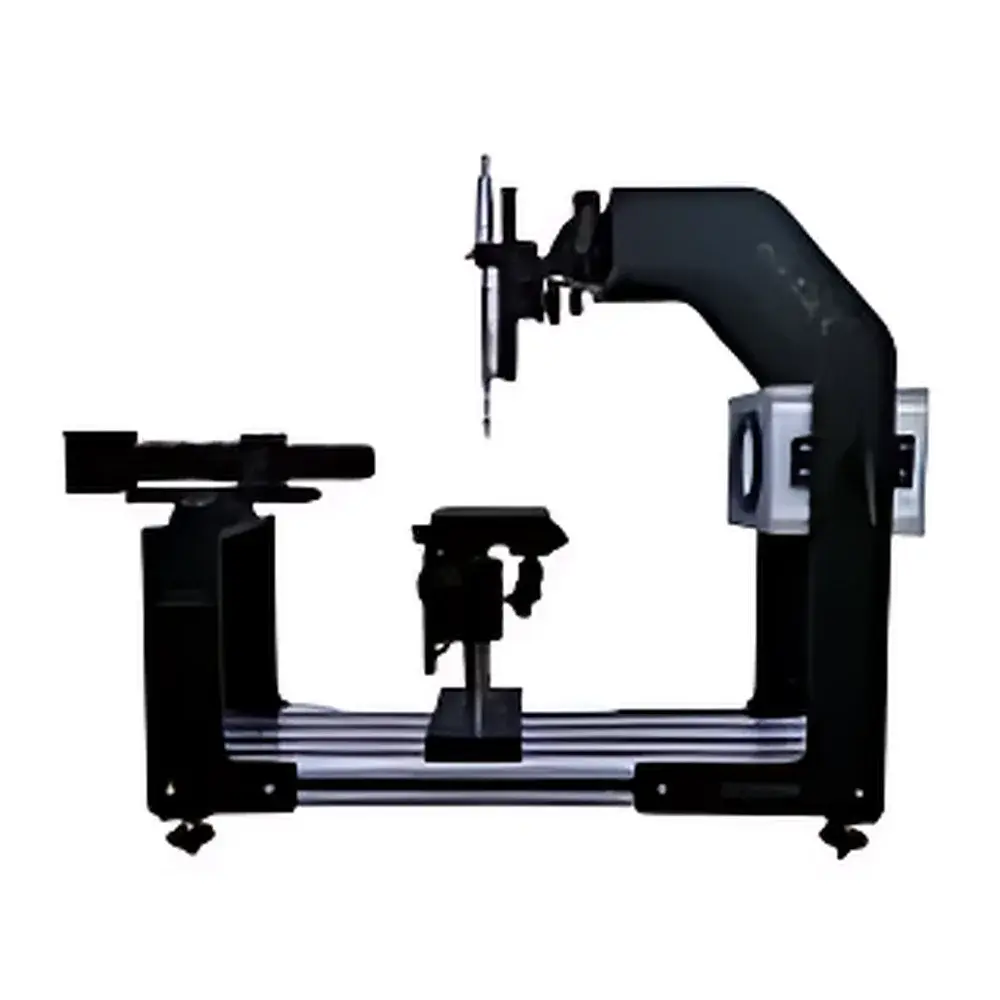
HARKE SPCAX11 Video-Based Contact Angle Goniometer
| Brand | HARKE |
|---|---|
| Origin | Beijing, China |
| Manufacturer Type | Direct Manufacturer |
| Instrument Category | Domestic |
| Model | HARKE-SPCAX11 |
| Instrument Type | Benchtop Optical Contact Angle Analyzer |
| Contact Angle Measurement Range | 0–180° |
| Contact Angle Accuracy | ±0.5° |
| Sample Stage Dimensions | 100 mm × 120 mm |
| Optical Magnification | 0.7×–4.5× |
| Surface/Interfacial Tension Range | 0–1000 mN/m |
| Surface/Interfacial Tension Resolution | 0.01 mN/m |
Overview
The HARKE SPCAX11 Video-Based Contact Angle Goniometer is an optical tensiometer engineered for precise, non-invasive quantification of interfacial interactions at solid–liquid–vapor boundaries. It operates on the principle of sessile drop analysis—capturing high-resolution silhouette images of liquid droplets deposited on solid substrates—and applying advanced edge-detection algorithms to determine the contact angle (θ) via Young’s equation and related interfacial thermodynamic models. The system supports static, dynamic, and time-resolved measurements—including advancing/receding angles, contact angle hysteresis, roll-off angles, and absorption kinetics—enabling rigorous characterization of wettability, surface energy heterogeneity, and interfacial thermodynamics. Its modular architecture integrates a motorized XYZ stage, programmable syringe pump, telecentric zoom lens, and high-speed industrial CMOS camera (60 fps), ensuring reproducible positioning, controlled dosing, and distortion-free imaging under consistent illumination conditions.
Key Features
- Benchtop design with aerospace-grade aluminum frame and modular electronics for long-term mechanical stability and thermal drift minimization
- Telecentric continuous zoom lens (0.7×–4.5×) delivering uniform magnification across field-of-view and eliminating perspective distortion critical for sub-degree angular accuracy
- Adjustable monochromatic blue LED cold-light source (25,000 h lifetime) optimized for high-contrast droplet contour extraction without sample heating
- Motorized Y–Z translation stage (Y: 160 mm travel, 0.01 mm resolution; Z: manual fine adjustment, 20 mm range) enabling repeatable multi-point measurement across heterogeneous surfaces
- Automated syringe dispenser with vertical (60 mm) and lateral (30 mm) positioning for precise droplet deposition and dynamic receding/advancing protocols
- Real-time image acquisition and automated contour fitting using curvature-based and ellipse-fitting algorithms compliant with ISO 19403-2 and ASTM D7334 standards
Sample Compatibility & Compliance
The SPCAX11 accommodates flat, curved, porous, and particulate samples—including wafers, coated glass, polymer films, textiles, powders, and superhydrophobic/superhydrophilic surfaces—via configurable stage fixtures and optional accessories (e.g., immersion cells for captive bubble analysis, tilting stages for roll-off angle determination). All measurement workflows adhere to internationally recognized metrological frameworks: contact angle data traceability aligns with ISO 27448 (characterization of photocatalytic surfaces), while surface energy calculations follow Owens–Wendt–Rabel–Kaelble (OWRK) and Wu harmonic mean methods per ISO 19403-4. The instrument supports GLP-compliant operation through timestamped audit logs, user access controls, and raw image/data archiving—fully compatible with FDA 21 CFR Part 11 requirements when deployed with validated LIMS integration.
Software & Data Management
The proprietary HARKE Analysis Suite provides a calibrated, scriptable environment for real-time droplet tracking, multi-frame sequence analysis, and time-lapse contact angle evolution modeling. It delivers quantitative outputs including contact angle vs. time curves, hysteresis loops, surface free energy decomposition (polar/dispersive components), work of adhesion, and interfacial tension values derived from pendant/sessile/suspended drop profiles. Export formats include CSV, PNG, TIFF, and PDF reports with embedded metadata (camera settings, calibration coefficients, environmental conditions). Software validation documentation, IQ/OQ protocols, and electronic signature support are available upon request for regulated laboratory environments.
Applications
This goniometer serves as a core analytical tool in R&D and QC laboratories across semiconductor fabrication (wafer hydrophobicity screening), display manufacturing (ITO/glass coating uniformity), biomedical device development (polymer scaffold wettability), pharmaceutical formulation (tablet coating integrity), and advanced materials research (nanocomposite surface functionalization). Specific use cases include: evaluating plasma treatment efficacy on polymeric substrates; quantifying cleaning residue impact on solder mask adhesion; assessing inkjet printability via dynamic contact angle mapping; characterizing self-cleaning surface durability under cyclic humidity exposure; and determining surfactant adsorption kinetics at oil–water interfaces using pendant drop analysis.
FAQ
What standard test methods does the SPCAX11 support?
It complies with ISO 19403-1 to -4 (contact angle and surface energy), ASTM D7334 (surface wettability of coatings), and ISO 27448 (photocatalytic activity assessment via water contact angle).
Can it measure contact angles on rough or textured surfaces?
Yes—through multi-point averaging, local curvature correction, and optional topography-integrated analysis modules.
Is interfacial tension measurement limited to pure liquids?
No—the system calculates interfacial tension for binary and ternary liquid systems using pendant drop shape analysis and Neumann’s equation of state.
Does the software support automated batch processing of multiple samples?
Yes—customizable measurement sequences, auto-focus routines, and scheduled image capture enable unattended operation for high-throughput screening.
What calibration procedures are required for routine operation?
A two-point geometric calibration (using certified reference angles) and a surface tension verification (with ultrapure water at 20 °C) are recommended before each daily session.



