
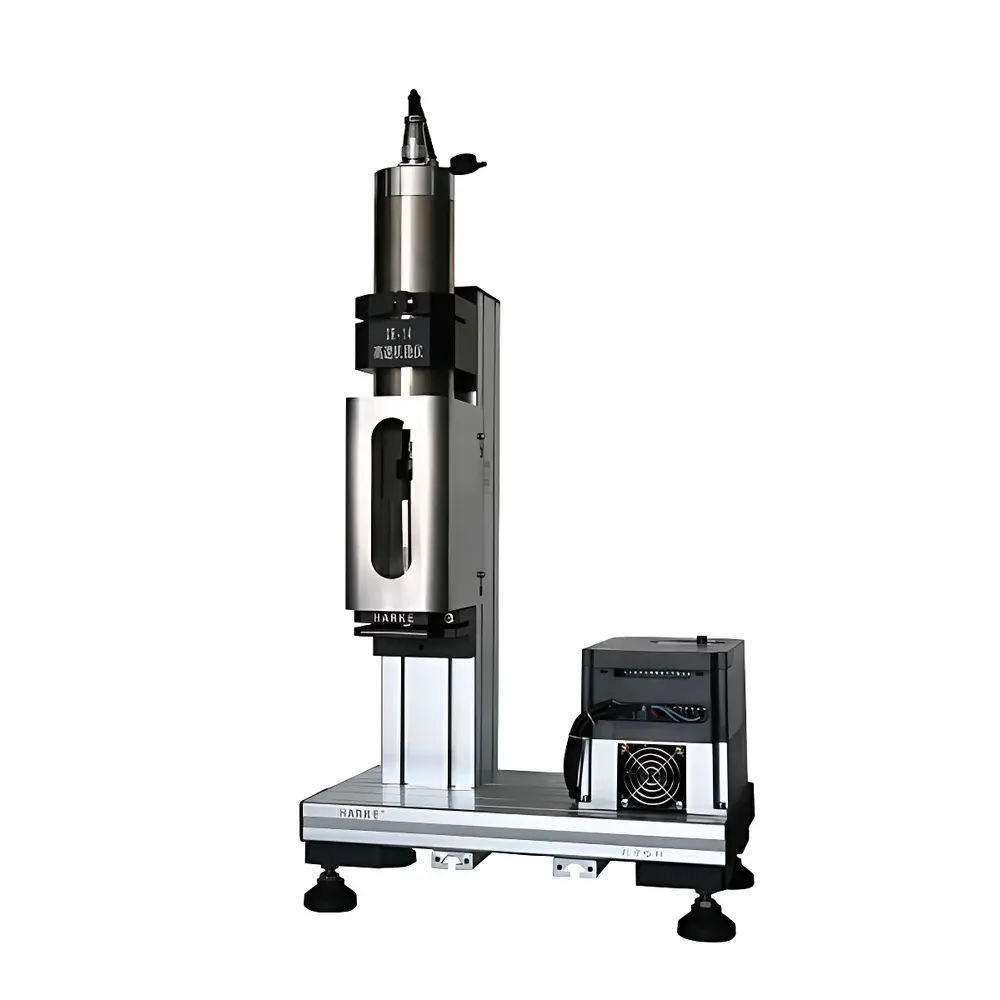
HARKE XR-14G High-Speed Mechanical Stability Tester for Latex
| Brand | HARKE |
|---|---|
| Origin | Beijing, China |
| Manufacturer Type | OEM Manufacturer |
| Product Origin | Domestic (China) |
| Model | XR-14G |
| Pricing | Upon Request |
Overview
The HARKE XR-14G High-Speed Mechanical Stability Tester is a precision-engineered instrument designed specifically for evaluating the mechanical stability of natural and synthetic latex dispersions under standardized high-shear conditions. It operates on the principle of controlled high-speed rotational agitation—employing a calibrated stainless-steel stirring disc rotating at precisely defined angular velocities within a geometrically specified glass container. This method quantifies latex coagulation behavior by measuring the mass or volume of insoluble coagulum formed after a fixed duration of mechanical stress, directly correlating with colloidal stability, surfactant efficacy, and formulation robustness. The instrument complies fully with ISO 2006:2017 “Rubber — Natural rubber — Determination of mechanical stability of centrifuged field latex”, ensuring data traceability and regulatory acceptability in quality control laboratories, R&D centers, and manufacturing facilities serving the rubber, glove, condom, and dipped goods industries.
Key Features
- Wide adjustable speed range from 3,000 to 20,000 rpm, with factory-calibrated default operation at 14,000 ± 200 rpm—meeting the nominal test condition specified in ISO 2006.
- Speed stability maintained within ±100 rpm during continuous operation at 14,000 rpm, achieved via industrial-grade frequency converter-driven synchronous motor with low thermal drift and minimal vibration.
- Dual-disc configuration: interchangeable stirring discs conforming to ISO 2006 dimensional tolerances—20.83 ± 0.03 mm diameter × 1.57 ± 0.05 mm thickness for natural latex; 36.12 ± 0.03 mm diameter × 1.58 ± 0.05 mm thickness for synthetic latex.
- Precision-machined glass container (ID: 58.0 ± 0.25 mm, height: 127 mm, wall thickness: 2.5 mm) with repeatable immersion geometry—stirring disc bottom positioned at 13 ± 1 mm above container base.
- Integrated water-cooling interface (inlet/outlet ports on motor housing) enabling extended operation under thermal load; automatic thermal management activates when localized motor temperature reaches 60 °C.
- EMC-compliant design with 220 V ±10 %, 5 A power supply; operational ambient range: 10–40 °C; compatible with latex dispersions across pH 1–14.
Sample Compatibility & Compliance
The XR-14G is validated for use with both ammoniated and non-ammoniated natural rubber latex (NRL), as well as carboxylated nitrile butadiene rubber (XNBR), styrene-butadiene rubber (SBR), and chloroprene (CR) latices. Its mechanical configuration satisfies all dimensional, rotational, and timing requirements outlined in ISO 2006, including disc geometry, container specifications, immersion depth, and speed tolerance. While not intrinsically compliant with GLP or GMP documentation standards, the instrument supports audit-ready workflows when integrated into laboratory information management systems (LIMS) and operated under documented SOPs—including mandatory calibration verification using optical tachometry prior to each test series. Routine maintenance logs, speed validation records, and container/disc metrology reports are recommended for ISO/IEC 17025-accredited laboratories.
Software & Data Management
The XR-14G operates as a hardware-controlled analog system without embedded firmware or digital data logging. Speed setpoint and real-time frequency display (e.g., “H234.0” indicating ~234 Hz ≈ 14,040 rpm) are managed exclusively through the front-panel variable-frequency drive (VFD). No proprietary software is required or provided. For regulated environments, users must implement external documentation protocols: manual entry of speed confirmation (via calibrated optical tachometer), test duration, sample ID, disc type, and environmental conditions into bound lab notebooks or electronic records compliant with 21 CFR Part 11 where applicable. HARKE supplies full dimensional drawings and ISO 2006 conformance statements to support internal validation and equipment qualification (IQ/OQ).
Applications
- Quality assurance of field latex concentrate prior to compounding or dipping processes.
- Formulation development for stabilizer packages (e.g., fatty acid soaps, surfactants, antioxidants) in synthetic latex systems.
- Batch-to-batch consistency monitoring in glove and medical device manufacturing.
- Accelerated stability screening during polymerization process optimization.
- Root-cause analysis of premature coagulation in storage tanks or pipelines.
- Technical support for ASTM D1076 (Standard Specification for Rubber—Natural—Centrifuged Field Latex) and GB/T 8295 (Chinese national standard equivalent to ISO 2006).
FAQ
What is the purpose of the water-cooling interface?
The dual-port cooling interface allows connection to a recirculating chiller or tap-water line to dissipate heat generated during prolonged operation (>30 min at ≥14,000 rpm); it prevents thermal degradation of motor windings and maintains rotational accuracy.
Can the XR-14G be used for non-latex colloidal dispersions?
While mechanically capable of agitating other aqueous colloids, its validation and dimensional specifications are exclusive to ISO 2006-compliant latex testing; application to non-rubber systems requires independent method verification.
Is speed calibration required before every test?
Yes—optical tachometer verification against the stirring shaft’s reflective tape is mandatory per ISO 2006 Section 6.2; recorded speed must fall within 14,000 ± 200 rpm for valid results.
Why are two different disc sizes specified?
Natural latex exhibits higher inherent stability and lower viscosity than most synthetics; the smaller disc (20.83 mm) applies appropriate shear stress for NRL, while the larger disc (36.12 mm) ensures sufficient energy input for lower-stability synthetic latices.
Does HARKE provide calibration certificates?
HARKE supplies dimensional certification for discs and containers upon request; however, speed calibration must be performed in situ using NIST-traceable tachometry as part of user-defined equipment qualification procedures.






