
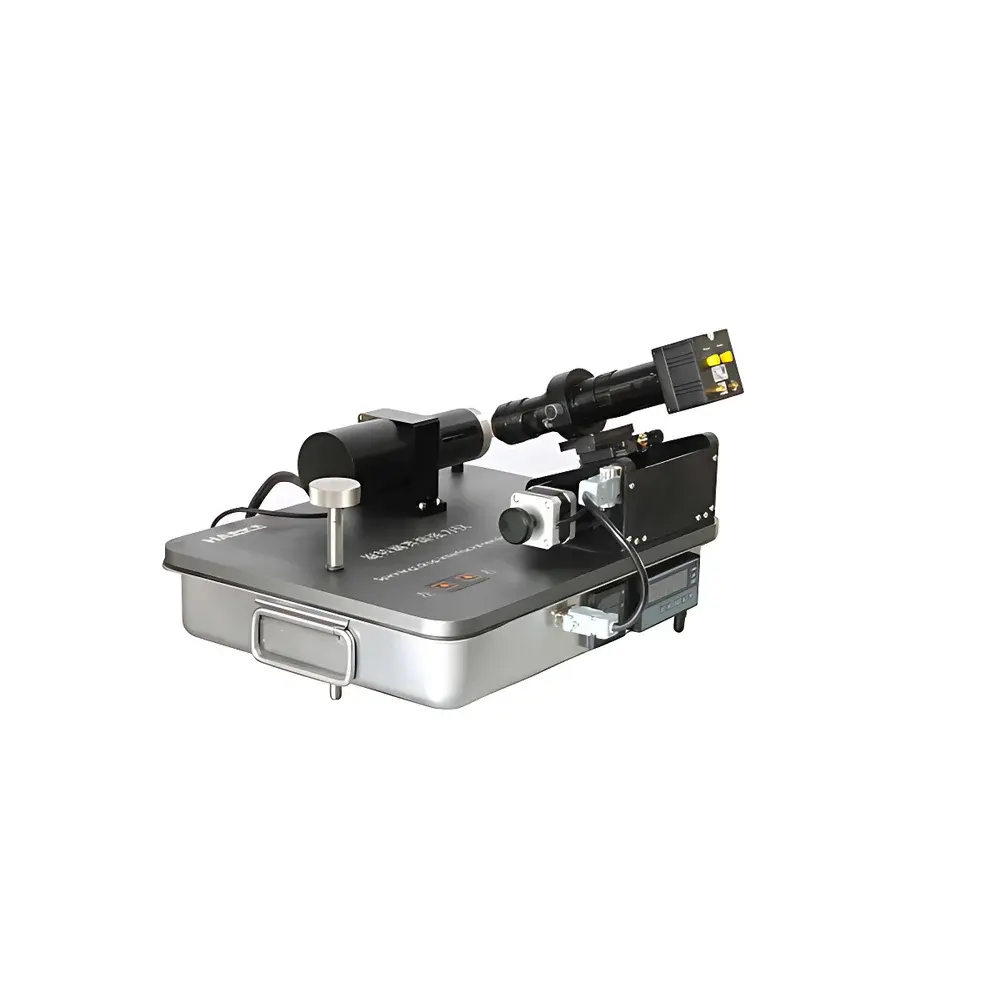
HARKE XZD-SP Video-Based Rotating Drop Ultra-Low Interfacial Tensiometer
| Brand | HARKE |
|---|---|
| Origin | Beijing, China |
| Manufacturer Type | Direct Manufacturer |
| Model | XZD-SP |
| Measurement Accuracy | ±0.01 mN/m |
| Temperature Display Range | 0–100 °C |
| Temperature Display Accuracy | ±0.1 °C |
| Surface/Interfacial Tension Range | 1×10⁻⁷–100 mN/m |
| Rotational Speed Range | 1000–9000 rpm (extendable to 13,000 rpm) |
| Speed Control Accuracy | ±0.1% |
| Radial Readout Range | 0–6 mm |
| Axial Readout Range | 0–50 mm |
| Readout Resolution | 0.01 mm |
| Heating Method | Integrated Peltier + External Circulating Bath |
| Optical Zoom | 4.7× optical + 2× digital |
| Frame Rate | 25 fps |
| Data Interface | RS-232 (temp/speed), USB 2.0 (video) |
| Power Supply | 220 V / 50 Hz ±10%, 3 A |
Overview
The HARKE XZD-SP is a precision-engineered video-based rotating drop ultra-low interfacial tensiometer designed for quantitative characterization of interfacial tension (IFT) and surface tension (ST) in systems where conventional pendant or sessile drop methods lack sufficient sensitivity—particularly in enhanced oil recovery (EOR), microemulsion formulation, polymer-surfactant interactions, and pharmaceutical colloidal dispersions. Operating on the rotating drop principle, the instrument subjects a density-matched liquid droplet (typically oil phase) suspended in a continuous immiscible phase (e.g., brine or solvent) to controlled centrifugal force within a horizontally rotating quartz capillary tube. Under equilibrium, the droplet deforms into a prolate spheroid; its axial and radial dimensions are captured in real time by a high-resolution video optical system and analyzed using Young–Laplace equation-based algorithms to derive interfacial tension with sub-micron resolution. The XZD-SP achieves measurement sensitivity down to 1×10⁻⁷ mN/m—enabling reliable quantification of ultralow IFT regimes critical for surfactant screening and phase behavior mapping.
Key Features
- High-precision rotating drop platform with direct-drive high-speed synchronous servo motor (1000–9000 rpm, extendable to 13,000 rpm), delivering ±0.1% speed control accuracy and eliminating belt-driven maintenance cycles.
- Dual-mode thermal regulation: integrated Peltier heating combined with external circulating bath compatibility for stable temperature control across 0–100 °C at ±0.1 °C display accuracy.
- Dedicated quartz capillary tubes (2 mm and 6 mm inner diameter standard; 4 mm optional) featuring optimized geometry and surface treatment to minimize nucleation-induced bubble formation during sample loading.
- Computer-controlled video tracking system with 4.7× optical zoom and 2× software-assisted digital zoom, enabling dynamic image acquisition at 25 frames per second and data throughput of 150 MB/s via USB 2.0 interface.
- Digitally stabilized stroboscopic LED illumination (flash or continuous mode) with extended lifetime (>10,000 hours) and uniform intensity distribution—critical for consistent edge detection under high-speed rotation.
- Integrated digital readout panel with LED display for real-time monitoring of rotational speed, temperature, and axial/radial dimensions (0.01 mm resolution).
Sample Compatibility & Compliance
The XZD-SP accommodates a broad range of fluid pairs—including hydrocarbon–aqueous, fluorocarbon–polymer, and ionic liquid–supercritical CO₂ systems—provided density matching is achieved within operational rotational limits. Sample volume requirements are minimal (≤50 µL), supporting high-throughput surfactant evaluation. All hardware and firmware comply with CE electromagnetic compatibility (EMC) directives. While not pre-certified for GMP environments, the system supports audit-ready operation when configured with validated software protocols: raw image timestamps, metadata logging (temperature, rpm, exposure settings), and exportable CSV/Excel reports meet basic GLP documentation requirements. Optional traceable calibration using certified reference oils (e.g., n-decane/water at 25 °C, IFT = 42.1 mN/m) enables ISO/IEC 17025-aligned verification.
Software & Data Management
The native Windows XP-compatible acquisition and analysis software provides full instrument control—including automated temperature ramping, rotational speed profiling, and real-time droplet contour fitting. Image processing employs adaptive thresholding and sub-pixel edge detection to extract axial and radial diameters from each frame. Calculated interfacial tension values are updated dynamically and logged with UTC timestamps. Export formats include ASCII, CSV, and XML for integration into LIMS or statistical analysis platforms (e.g., JMP, MATLAB). Raw video sequences (AVI) and processed parameter logs are stored separately to ensure data integrity. RS-232 serial communication enables synchronized logging of temperature and speed telemetry alongside image-derived metrics—supporting multi-variable correlation studies essential for mechanistic modeling.
Applications
- Surfactant screening for EOR: Quantifying ultralow IFT (<10⁻³ mN/m) between reservoir oil and synthetic surfactant solutions under reservoir-relevant temperature and salinity conditions.
- Microemulsion phase diagram construction: Mapping Winsor Type I–IV transitions via systematic IFT minima identification across composition and temperature gradients.
- Nanoparticle-stabilized interfaces: Assessing interfacial rheology proxies through dynamic shape relaxation analysis during step-change rotational protocols.
- Biopharmaceutical formulation: Evaluating protein–surfactant competition at oil–water interfaces in parenteral emulsions and lipid nanoparticle suspensions.
- CO₂–brine–rock wettability assessment: Measuring IFT and contact angle evolution under elevated pressure (when coupled with optional high-pressure cell).
FAQ
What is the minimum measurable interfacial tension value supported by the XZD-SP?
The instrument achieves reliable detection down to 1×10⁻⁷ mN/m under optimal density-matching and low-noise imaging conditions.
Can the XZD-SP operate under elevated pressure?
The base configuration is ambient-pressure only; however, third-party high-pressure rotating drop cells (up to 20 MPa) can be integrated with mechanical and optical alignment adapters.
Is the software compatible with modern Windows operating systems?
The native software runs on Windows XP; for Windows 10/11 compatibility, virtual machine deployment or API-based custom integration (via RS-232/USB command set) is recommended.
How is temperature stability maintained during long-duration measurements?
Dual-path thermal control—integrated Peltier heating plus external recirculating bath coupling—ensures drift <±0.05 °C over 2-hour continuous runs.
Are calibration standards included with the instrument?
A set of reference fluids (e.g., pure water, diiodomethane) is supplied for geometric and thermal validation; certified IFT standards require separate procurement.
Related Products



