
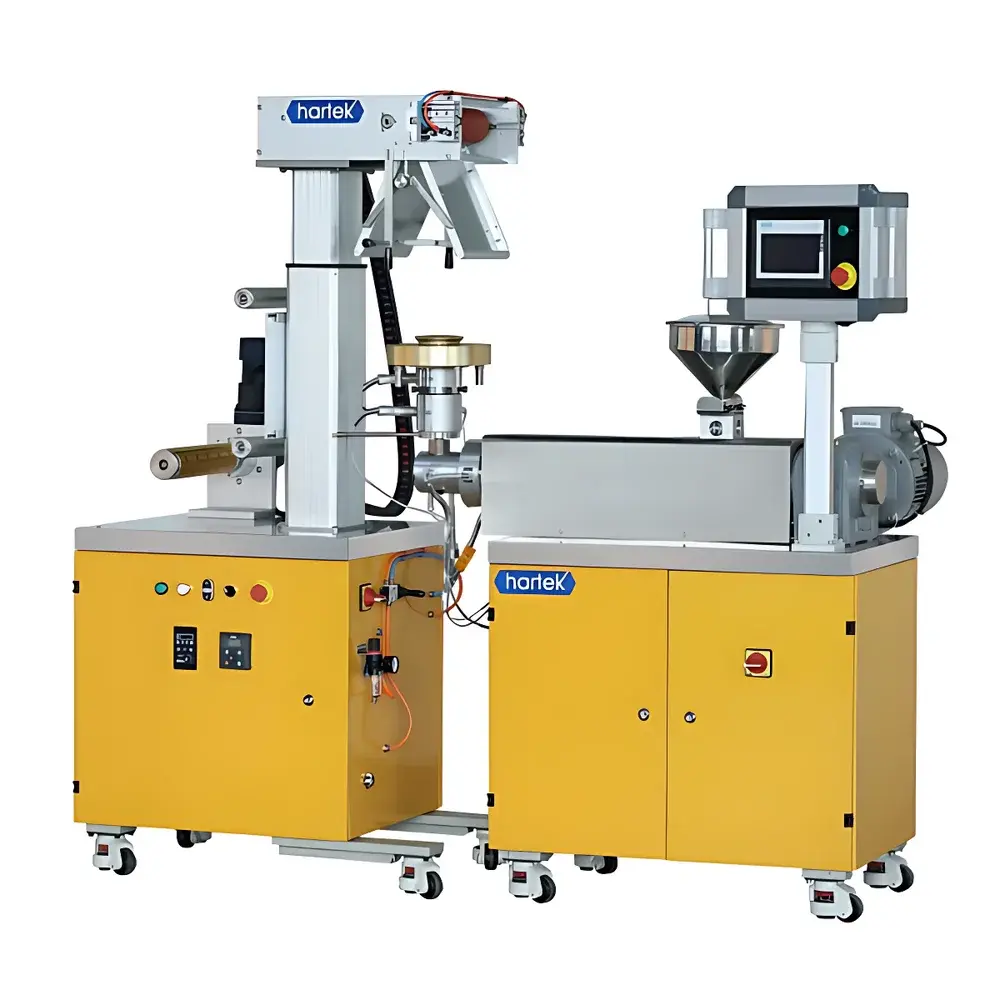
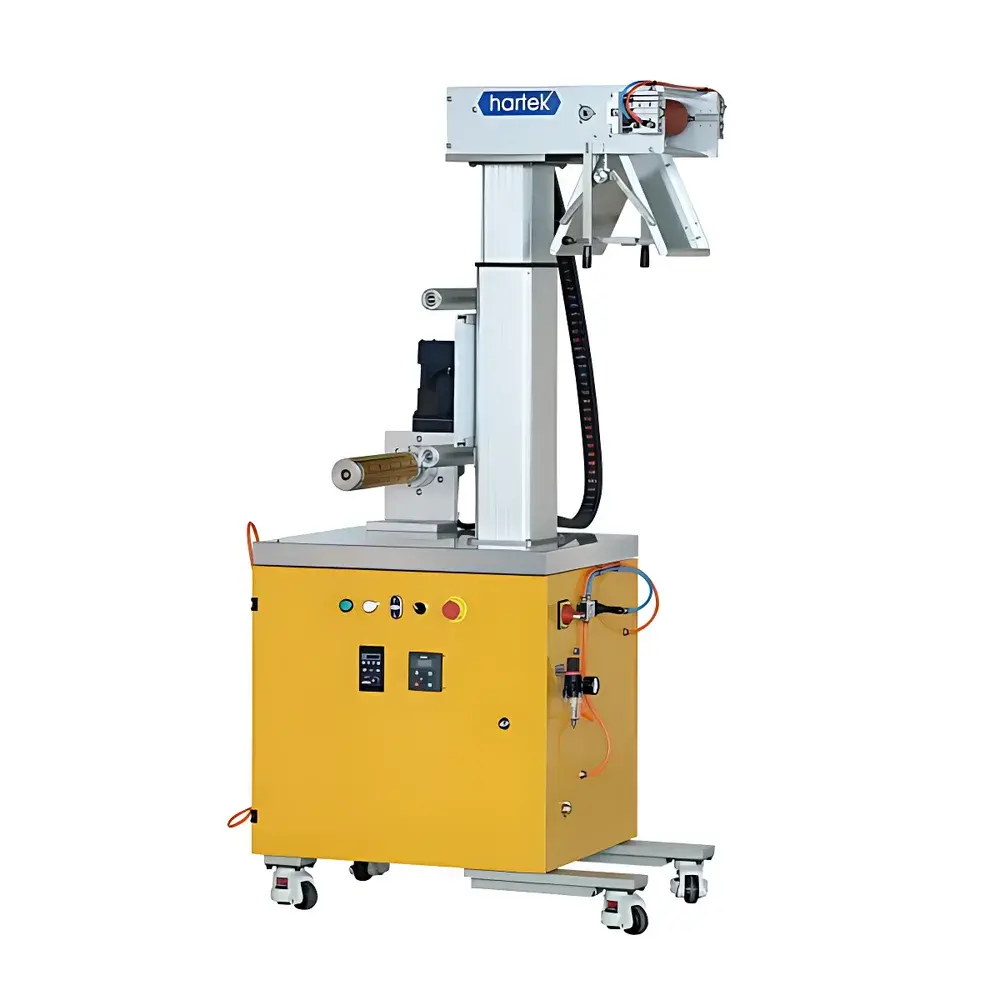
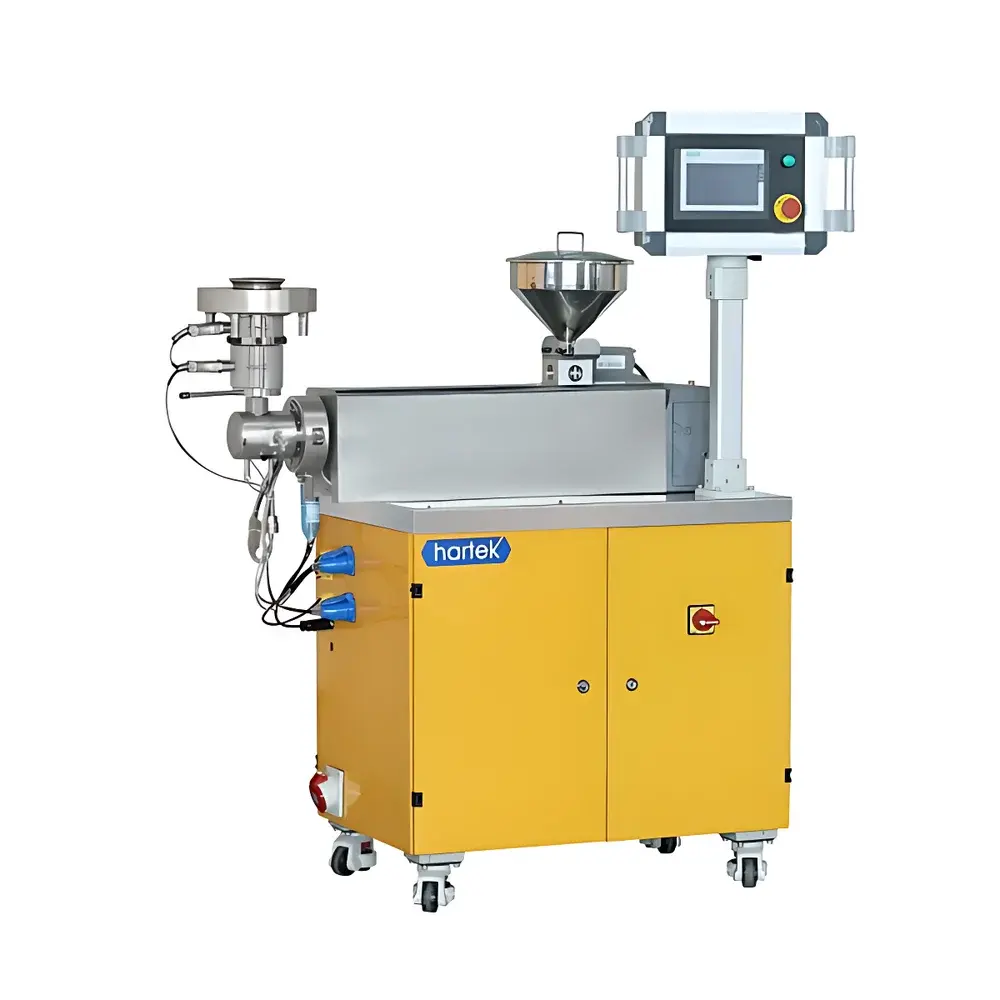
Hartek HTBS-25 Laboratory-Scale Blown Film Extrusion Line
| Brand | Hartek |
|---|---|
| Origin | Guangdong, China |
| Manufacturer Type | Direct Manufacturer |
| Region Category | Domestic (China) |
| Model | HTBS-25 |
| Price Range | USD 14,000 – 28,000 |
| Screw Diameter | 25 mm |
| L/D Ratio | 28:1 |
| Max Screw Speed | 120 rpm |
| Heating/Cooling | Electric Heating / Air Cooling |
| Max Barrel Temperature | 350 °C |
| Temperature Control Accuracy | ±1.0 °C |
| Melt Pressure Range | 0–35 MPa |
| Melt Pressure Accuracy | ±0.2 % F.S. |
| Haul-off Speed | 0–8 m/min (stepless) |
| Bubble Diameter (Folded) | 200 mm |
| Weight | 550 kg |
| Overall Dimensions | 2980 × 944 × 2630 mm |
Overview
The Hartek HTBS-25 is a compact, benchtop-scale blown film extrusion line engineered for controlled polymer processing research and development in academic laboratories, R&D centers, and quality assurance departments of polymer compounders and film manufacturers. It implements classical tubular blown film processing principles—polymer melt extrusion through an annular die, bubble inflation via internal air pressure, radial cooling by dual-ring air rings, and stabilized haul-off with precision tension control—to replicate industrial-scale film formation under highly reproducible, instrumented conditions. Unlike full-scale production lines, the HTBS-25 integrates real-time process monitoring (melt pressure, zone temperatures, screw speed, haul-off velocity) within a footprint suitable for ISO-classified lab environments. Its modular architecture supports method development for polyolefins (LDPE, LLDPE, HDPE), biopolymers (PLA, PBAT), engineering thermoplastics (PA, PET), and filled or pigmented systems—enabling systematic study of melt rheology–film morphology–mechanical property relationships.
Key Features
- Siemens S7-1200 PLC integrated with 10.1-inch high-resolution resistive touchscreen HMI for centralized parameter setting, real-time trend visualization, and recipe-based operation.
- Single-screw extruder with 25 mm diameter, 28:1 L/D ratio, and hardened nitrided steel barrel—optimized for low-shear, high-melt-stability extrusion of sensitive or viscous resins.
- Independent servo-motor-driven haul-off system with closed-loop feedback; traction rollers surface-hardened (≥60 HRC) and mirror-polished to minimize film slippage and surface marking.
- Constant-tension winder with pneumatic brake and torque-controlled payout—ensuring uniform winding density and eliminating edge deformation during short-run trials.
- Modular die assembly with interchangeable mandrel/die ring sets (standard 200 mm folded bubble diameter); optional configurations available for multi-layer coextrusion or inline thickness gauging integration.
- Full-zone electric heating with PID-controlled SSR outputs and forced-air cooling channels—achieving ±1.0 °C thermal stability across all six barrel zones and adapter/die sections.
Sample Compatibility & Compliance
The HTBS-25 accommodates granular, pelletized, and powder-form thermoplastic feedstocks—including virgin polymers, recycled content blends, masterbatches, nanocomposites, and additive-loaded compounds—without pre-drying requirements for most standard grades. It complies with CE machinery safety directives (2006/42/EC) and conforms to IEC 61800-5-1 for adjustable speed drive safety. All temperature and pressure transducers meet EN 61326-1 EMC immunity standards. For regulated environments, the PLC firmware supports audit trail logging (with timestamped operator actions and parameter changes), aligning with GLP documentation requirements per OECD Series on Principles of Good Laboratory Practice. While not FDA 21 CFR Part 11–validated out-of-the-box, the system architecture permits third-party validation packages for pharmaceutical-grade film excipient development.
Software & Data Management
Process data—including screw RPM, zone temperatures (6 channels), melt pressure (1 channel), haul-off speed, and air ring flow rates (if equipped)—are logged at 1 Hz resolution to internal SD card storage. The embedded HMI provides export functionality in CSV format for post-processing in MATLAB, Python (pandas), or JMP. Optional Ethernet/IP or Modbus TCP connectivity enables integration into existing MES or LIMS platforms for automated report generation. No proprietary software license is required; configuration files are editable via standard .CSV templates. All firmware updates are delivered as signed binary packages with SHA-256 checksum verification.
Applications
- Quantitative evaluation of melt strength, bubble stability, and frost line height across resin families and molecular weight distributions.
- Dispersion efficiency assessment of colorants, UV stabilizers, and functional additives using optical microscopy or SEM of quenched film cross-sections.
- Empirical optimization of blow-up ratio (BUR), draw-down ratio (DDR), and chill line height (CLH) to maximize tensile isotropy and haze reduction.
- Accelerated screening of compatibilizers in immiscible polymer blends (e.g., PP/PA, PE/EVOH) via film clarity, delamination onset, and peel strength testing.
- Validation of rheological models (e.g., Wagner I, Giesekus) against actual extrudate swell and bubble neck-in behavior under varying shear histories.
- Training platform for polymer processing engineers on DOE-based film property mapping (e.g., impact of melt temperature on dart drop impact resistance).
FAQ
What is the minimum sample quantity required for a single test run?
Typically 300–500 g of dry polymer granules, depending on target film thickness and throughput settings.
Can the HTBS-25 produce multilayer films?
Yes—via optional coextrusion adapter kits supporting up to three-layer asymmetric structures (e.g., sealant/core/tie layers).
Is nitrogen purge capability available for oxygen-sensitive resins?
Standard configuration includes optional inert gas inlet ports at hopper and die adapter; custom purging manifolds can be integrated upon request.
Does the system support ASTM D2610 or ISO 1183 film property correlation studies?
Yes—the consistent film geometry and process repeatability enable direct correlation to standard test specimens for density, tensile, and optical measurements.
What maintenance intervals are recommended for the extruder screw and barrel?
Inspection every 500 operational hours; routine cleaning with purging compound; full refurbishment (re-nitriding, re-boring) advised after 5,000 hours of continuous use.





