
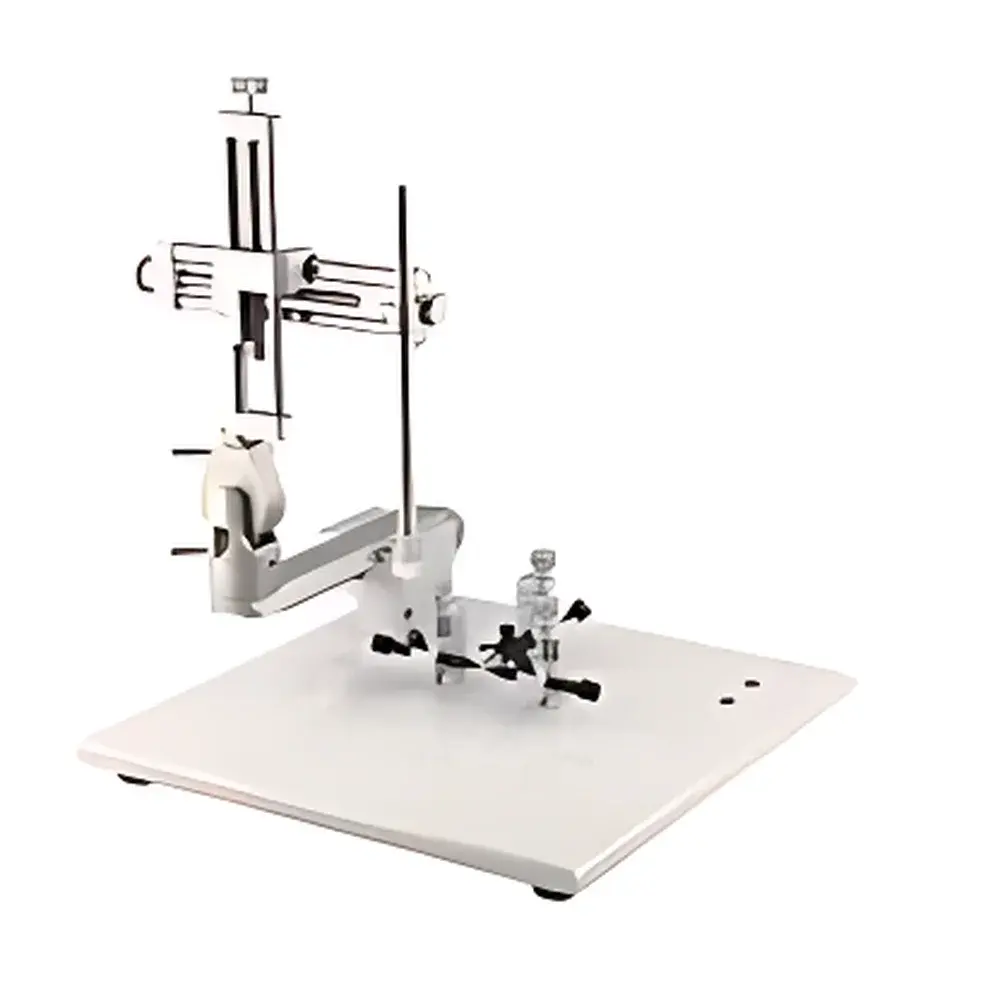
Harvard Apparatus Model 51700 Mouse-Specific Stereotaxic Instrument
| Brand | Harvard Apparatus |
|---|---|
| Origin | USA |
| Model | 51700 |
| Animal Weight Range | 10–75 g |
| Base Dimensions | 25 × 25 cm |
| Type | Mouse-Specific, Manual Precision Frame |
| Zeroing Function | Yes |
| Compatibility | Standard Stoelting Accessories (e.g., electrodes, cannulae, microinjection systems) |
Overview
The Harvard Apparatus Model 51700 Mouse-Specific Stereotaxic Instrument is a rigorously engineered mechanical positioning system designed exclusively for precise intracranial interventions in laboratory mice. It operates on the foundational principle of stereotaxic neurosurgery—using bregma and lambda as anatomical reference points to define a three-dimensional Cartesian coordinate system relative to the mouse brain’s standardized atlas (e.g., Franklin & Paxinos). This enables reproducible targeting of subcortical nuclei—including the hippocampus (CA1, DG), striatum, ventral tegmental area (VTA), substantia nigra pars compacta (SNc), and prefrontal cortex—with micron-level repeatability across subjects. Unlike universal or large-animal frames, the Model 51700 integrates a compact, low-profile architecture optimized for murine cranial dimensions and surgical workflow ergonomics. Its robust aluminum alloy construction, hardened stainless-steel manipulators, and backlash-free micrometer drives ensure long-term dimensional stability under repeated sterilization cycles and daily laboratory use. The instrument is not motorized or digitally encoded; rather, it relies on calibrated manual translation along orthogonal X (anterior–posterior), Y (medial–lateral), and Z (dorsal–ventral) axes—each with 10-µm resolution graduation and positive mechanical stop limits—to deliver high reproducibility in electrophysiology, microinjection, optogenetic fiber implantation, and chronic electrode array placement.
Key Features
- Mouse-optimized frame geometry: 25 × 25 cm low-center-of-gravity base ensures stability during micro-manipulation and compatibility with standard stereotaxic surgery rigs and heating pads.
- Precision micrometer-driven manipulators: Each axis features dual-scale vernier calibrations (mm and 0.1 mm) and fine-adjustment knobs enabling sub-millimeter positioning accuracy.
- Dedicated zeroing mechanism: Independent axis homing allows rapid re-establishment of bregma-referenced origin prior to each procedure—critical for longitudinal studies requiring repeated injections or implants.
- Full compatibility with Stoelting-standard accessories: Accepts all widely adopted rodent-specific components including ear bars, incisor hooks, hydraulic microdrives (e.g., Model 64000), and stereotaxic adapters for Nanoject II, UltraMicroPump, and LED/optical fiber carriers.
- Modular expandability: Designed to integrate seamlessly with third-party digital imaging systems (e.g., fluorescence-guided targeting), electrophysiology recording rigs, and environmental control units without structural modification.
Sample Compatibility & Compliance
The Model 51700 is validated for use with Mus musculus strains weighing 10–75 g, encompassing C57BL/6, BALB/c, FVB/N, and immunocompromised models (e.g., NSG, NOG). Its clamping system accommodates both flat and angled skull orientations while maintaining consistent inter-ear bar distance and incisor bar pressure (adjustable 0–150 g force range). All materials comply with ISO 10993-5 (biological evaluation of medical devices) for non-cytotoxicity and USP Class VI plastic certification where applicable. The instrument meets general laboratory safety standards per ANSI Z535.4 and supports GLP-compliant experimental documentation when used in conjunction with traceable calibration logs and SOP-defined setup protocols.
Software & Data Management
As a purely mechanical stereotaxic frame, the Model 51700 does not incorporate embedded firmware, onboard displays, or native software connectivity. However, it is fully interoperable with industry-standard neuroscience data acquisition and analysis platforms—including Spike2 (CED), OpenEphys, MATLAB-based custom pipelines, and commercial stereotaxic planning suites (e.g., Stereotaxic Atlas Tools for MATLAB, QuickNII). Users routinely pair the device with digital calipers or external optical encoders (e.g., Renishaw RESOLUTE) for post-hoc position logging. For regulated environments (e.g., preclinical contract research organizations), the frame supports 21 CFR Part 11–compliant audit trails when integrated into validated electronic lab notebook (ELN) workflows documenting coordinate entries, animal IDs, and procedural timestamps.
Applications
- Construction of neurodegenerative disease models: Unilateral 6-OHDA infusion into the medial forebrain bundle for Parkinson’s disease modeling; Aβ1–42 or tau fibril injection into hippocampal CA1 for Alzheimer’s-related synaptic dysfunction studies.
- Targeted viral vector delivery: AAV-mediated Cre/loxP or DREADD expression in genetically defined neuronal populations (e.g., DAT-Cre, CaMKIIα-tTA lines).
- Chronic electrophysiological recording: Stable implantation of tetrodes, silicon probes (Neuropixels), or EEG screw electrodes with <50 µm targeting variance across cohorts.
- Stem cell transplantation: Image-guided delivery of neural progenitor cells into subventricular zone or striatal parenchyma with controlled infusion rates and dwell times.
- Behavioral circuit interrogation: Optogenetic stimulation/inhibition via implanted optical fibers coupled with real-time behavioral tracking (e.g., ANY-maze, EthoVision XT).
FAQ
Is the Model 51700 compatible with rat or larger animal preparations?
No—it is mechanically constrained for murine anatomy only. Rats require ≥30 cm base width and higher Z-axis travel; use Stoelting Model 51720 or Harvard Apparatus Model 51710 for rats.
Does this instrument include digital readouts or motorized positioning?
No. The Model 51700 is a manual precision frame. Digital display (Model 51730D) and motorized variants (Model 51730M) are available as separate configurations.
Can I perform stereotaxic surgery under MRI or two-photon guidance?
Yes—the non-ferromagnetic aluminum frame is MRI-compatible at ≤3T and optically transparent to near-infrared wavelengths, enabling intraoperative imaging integration with appropriate non-magnetic accessories.
What calibration documentation is provided?
Each unit ships with NIST-traceable dimensional verification report covering base flatness (±2 µm), axis orthogonality (±0.05°), and micrometer linearity (±0.02 mm over full travel).
How often should mechanical recalibration be performed?
Annual verification is recommended for GLP/GCP compliance; more frequent checks (quarterly) are advised in high-throughput core facilities performing >500 procedures/year.
Related Products




