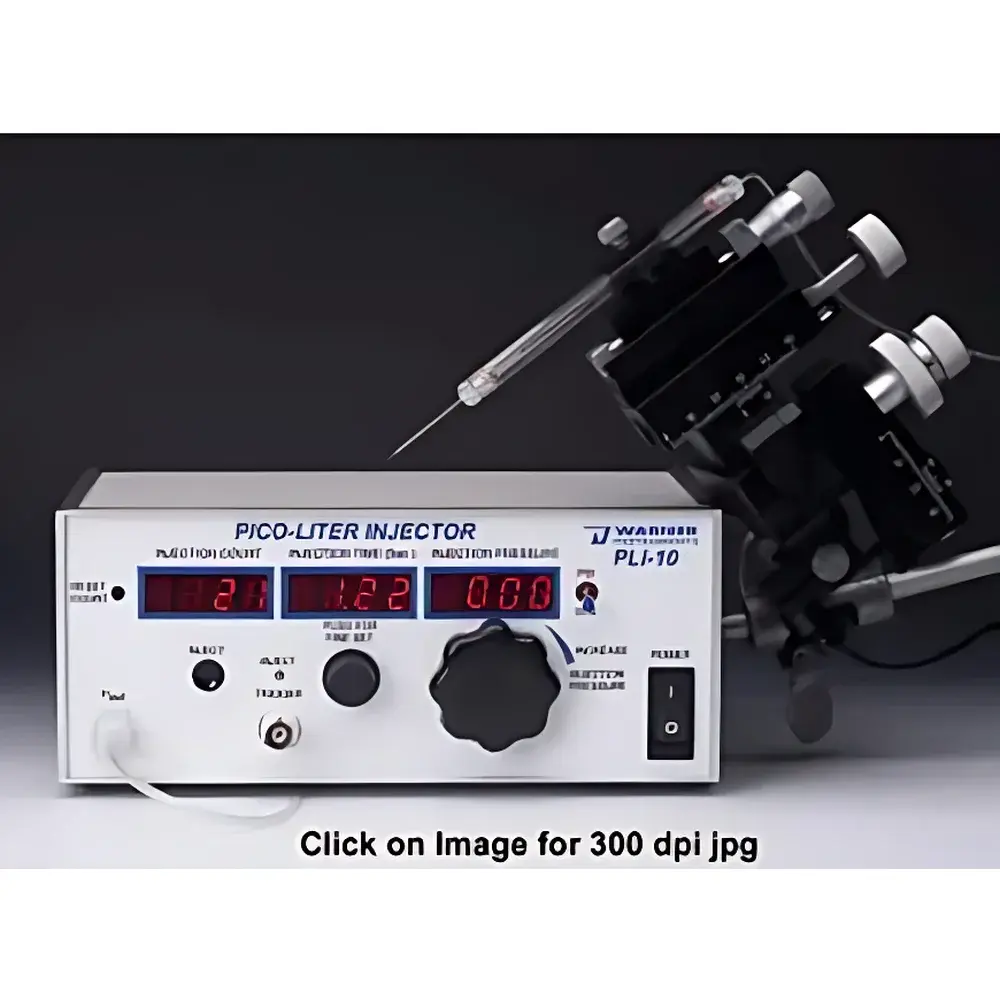
Harvard Apparatus PLI-10 Picoliter Injector
| Brand | Harvard Apparatus |
|---|---|
| Origin | USA |
| Model | PLI-10 |
| Input Pressure Range | 480–720 kPa (70–105 psi) |
| Output Pressure Range | 2.8–413 kPa (0.2–60 psi), continuously adjustable |
| Pulse Width Resolution | 10 ms (0.01–0.99 s) |
| Injection Count Display | 0–9999 (digital LED) |
| Trigger Modes | Front-panel knob, foot switch, external TTL pulse via BNC input |
| Operating Mode | Timed pulse or continuous gate-controlled duration |
| Pressure Release | Multi-turn manual regulator with bidirectional control |
| Compliance | Designed for GLP-compliant electrophysiology and microinjection workflows |
Overview
The Harvard Apparatus PLI-10 Picoliter Injector is a precision pneumatic microinjection system engineered for reproducible, low-volume fluid delivery in demanding physiological, pharmacological, and neurobiological applications. Based on regulated gas pressure displacement—rather than mechanical piston actuation—the PLI-10 delivers picoliter-scale volumes with high temporal fidelity and minimal mechanical drift. Its core architecture employs a high-stability, multi-turn coil pressure regulator to translate input gas pressure (480–720 kPa) into finely tunable output pressure (2.8–413 kPa), enabling consistent delivery across diverse viscosities and capillary geometries. Unlike motor-driven syringe pumps, the PLI-10 avoids step-resolution limitations and back-pressure hysteresis, making it especially suited for intracellular and subcellular injection protocols where volume accuracy, timing repeatability, and rapid pressure decay are critical—such as oocyte microinjection, blastomere targeting, and extracellular neurotransmitter uncaging.
Key Features
- Precision pneumatic actuation with analog pressure regulation via calibrated multi-turn coil valve, ensuring stable output over extended operation
- Digital LED display showing real-time pressure (kPa/psi), elapsed time, and cumulative injection count (0–9999)
- Three independent trigger modalities: front-panel rotary timer knob, foot-switch interface, and TTL-compatible BNC input for synchronization with electrophysiology rigs or imaging systems
- Programmable pulse width resolution of 10 ms (0.01–0.99 s range) and 1 s (1–99 s range), supporting both transient and sustained delivery profiles
- Bidirectional manual pressure release mechanism for immediate, operator-controlled venting without system reset
- Robust metal housing and sealed pneumatic pathways designed for long-term reliability in humidified incubator environments and laminar flow hoods
Sample Compatibility & Compliance
The PLI-10 interfaces seamlessly with standard borosilicate or quartz micropipettes (tip diameters 0.5–5 µm) and supports both positive-pressure injection and gentle backfill priming. It is routinely deployed in protocols requiring adherence to Good Laboratory Practice (GLP) frameworks, particularly in academic and contract research settings performing preclinical developmental biology or neuropharmacology studies. While not certified under FDA 21 CFR Part 11, its deterministic timing logic, non-volatile event logging (via external data acquisition), and hardware-based trigger isolation support audit-ready experimental documentation when integrated with compliant DAQ platforms. The device meets IEC 61010-1 safety requirements for laboratory electrical equipment and operates within Class II biosafety cabinet airflow specifications when properly vented.
Software & Data Management
The PLI-10 operates as a standalone hardware controller with no embedded firmware or proprietary software dependency. All operational parameters—including pressure setpoint, pulse duration, and trigger source—are configured directly via front-panel controls. For traceable data capture, users integrate the BNC TTL output and analog pressure monitor signal (0–10 V) into third-party acquisition systems (e.g., Axon pCLAMP, National Instruments DAQmx, or Spike2). This architecture ensures full compatibility with timestamp-synchronized multimodal recording—critical for correlating injection onset with patch-clamp current transients or calcium imaging frames. Audit trails are maintained externally through acquisition software’s built-in metadata tagging and HDF5 or ABF file logging.
Applications
- Oocyte and embryo microinjection for CRISPR/Cas9 editing, mRNA transfection, and morpholino delivery
- Intracellular dye loading and iontophoretic tracer injection in acute brain slices
- Targeted neurotransmitter or drug application in single-neuron pharmacology assays
- Pressure-assisted cell loading in microfluidic organ-on-chip platforms
- Calibration and validation of high-speed volumetric imaging systems requiring known bolus inputs
FAQ
What is the minimum resolvable injection volume using the PLI-10?
Volume resolution depends on pipette geometry and fluid viscosity; with a 1-µm tip and aqueous buffer, typical minimum pulses deliver ~5–20 pL. Calibration against fluorescent dextran standards is recommended for quantitative work.
Can the PLI-10 be used with corrosive or organic solvents?
No. The internal seals and regulator materials are rated for aqueous and saline solutions only. Exposure to ethanol, DMSO, or acids will degrade elastomeric components and void warranty.
Is the BNC trigger input optically isolated?
No. The BNC input is electrically referenced to the unit’s chassis ground. For galvanic isolation in sensitive electrophysiology setups, a commercially available TTL isolator module must be inserted inline.
Does the PLI-10 support variable pressure ramping during a single pulse?
No. It delivers constant pressure throughout each defined pulse interval. Dynamic pressure modulation requires external pressure controllers or custom waveform generators synchronized via the BNC port.
What maintenance is required for long-term accuracy?
Annual verification of pressure transducer linearity using NIST-traceable deadweight tester is advised. Regular cleaning of the pressure regulator seat with lint-free swabs and isopropanol prevents particulate-induced drift.