
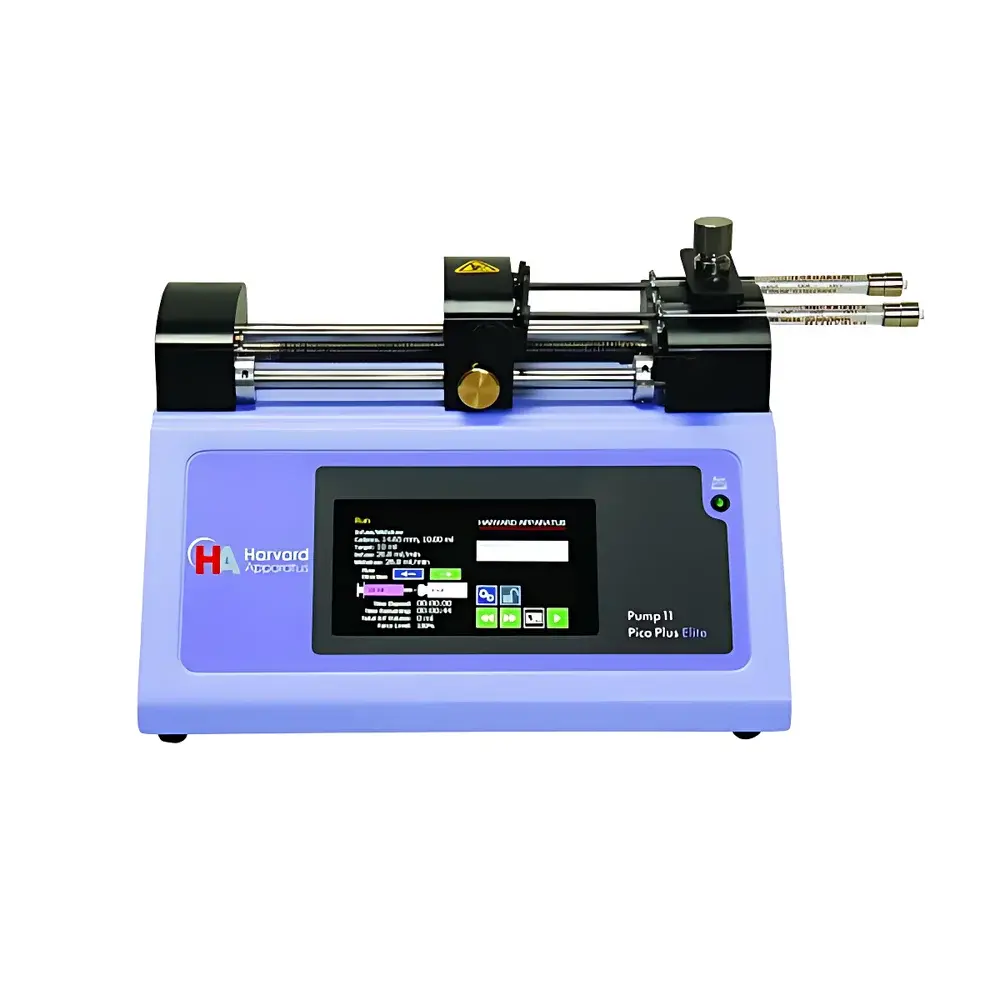
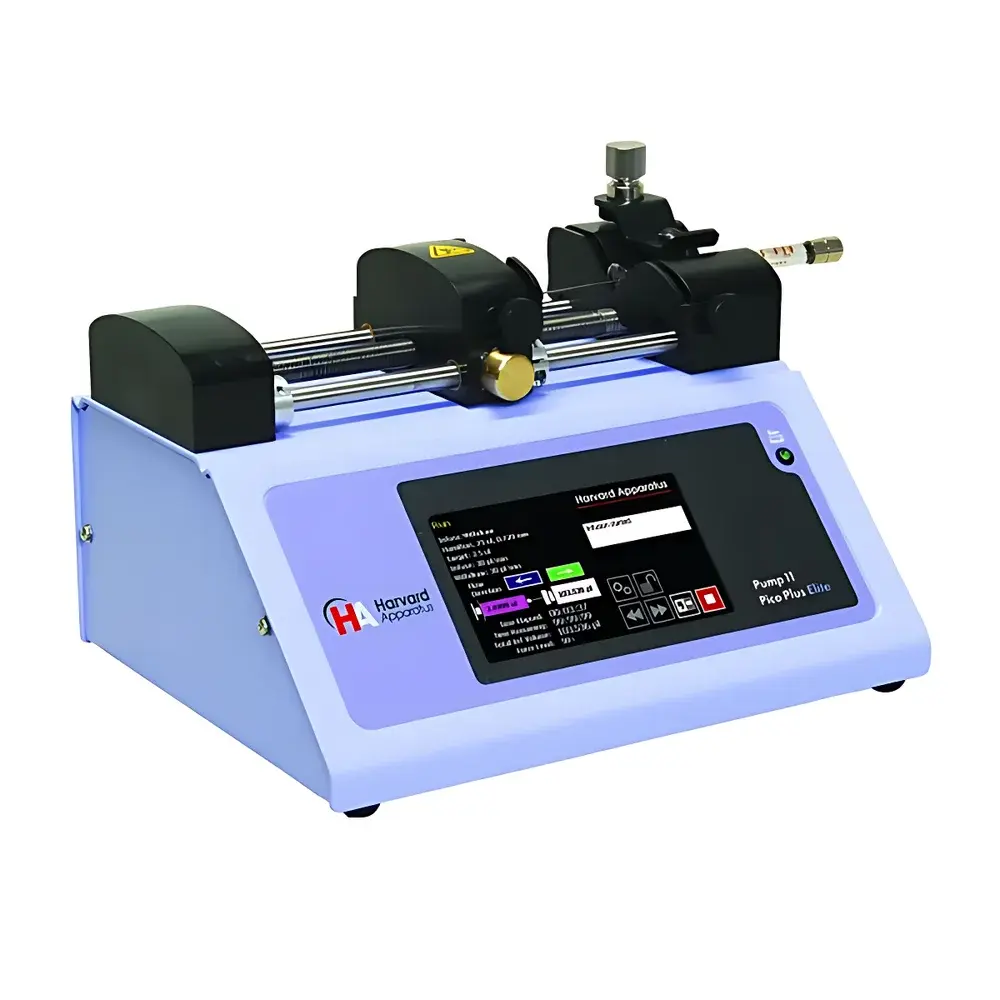
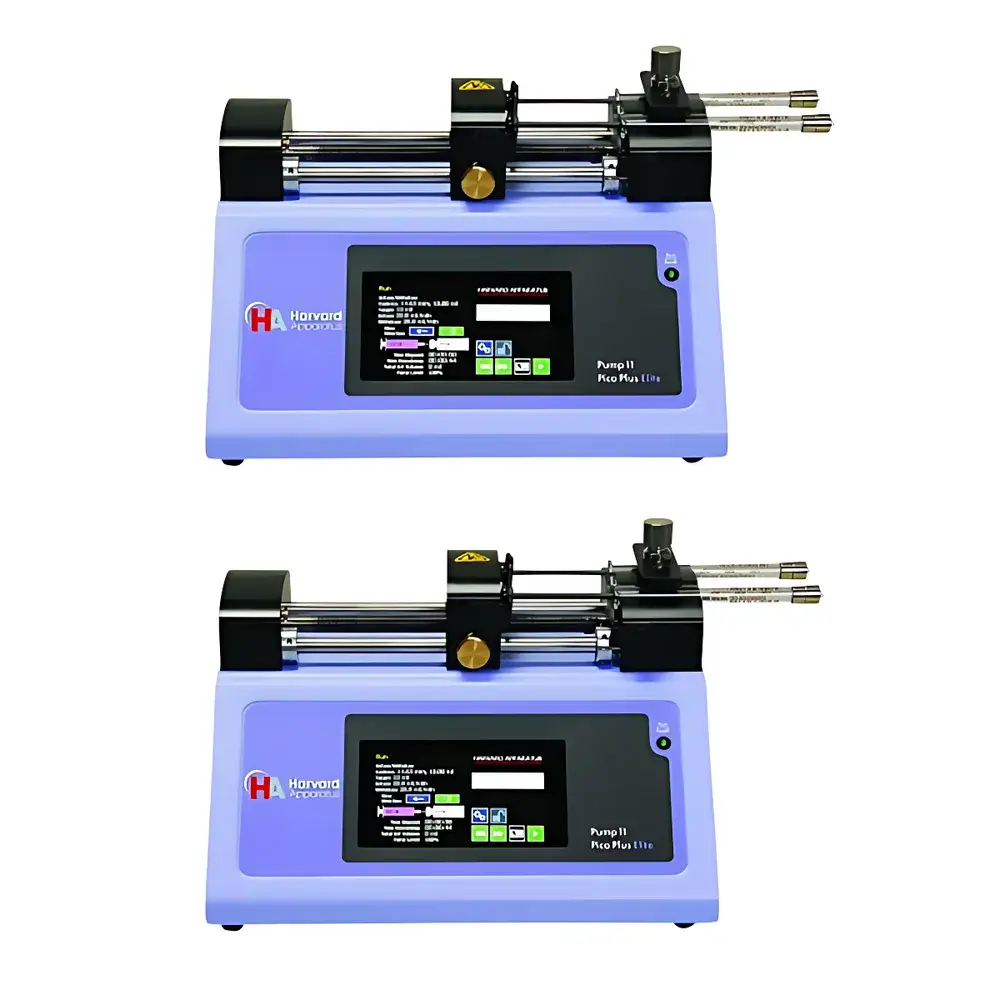
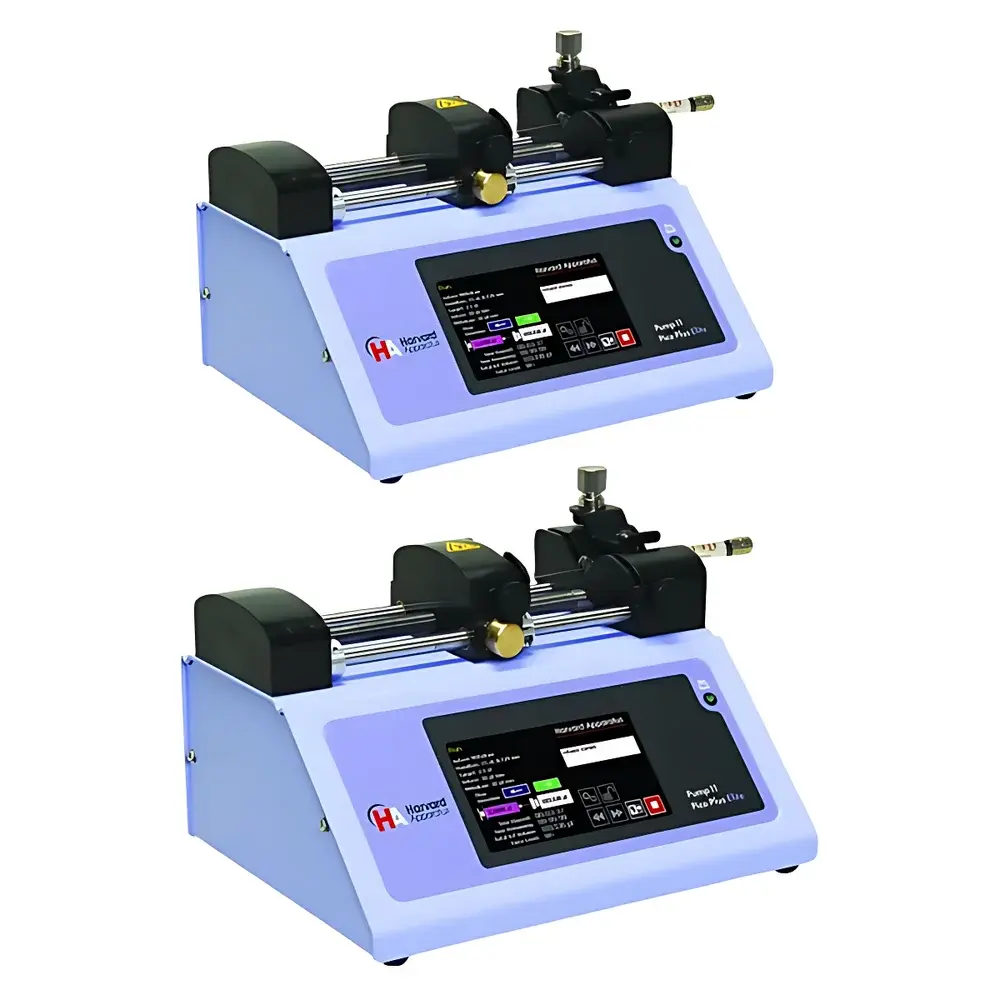
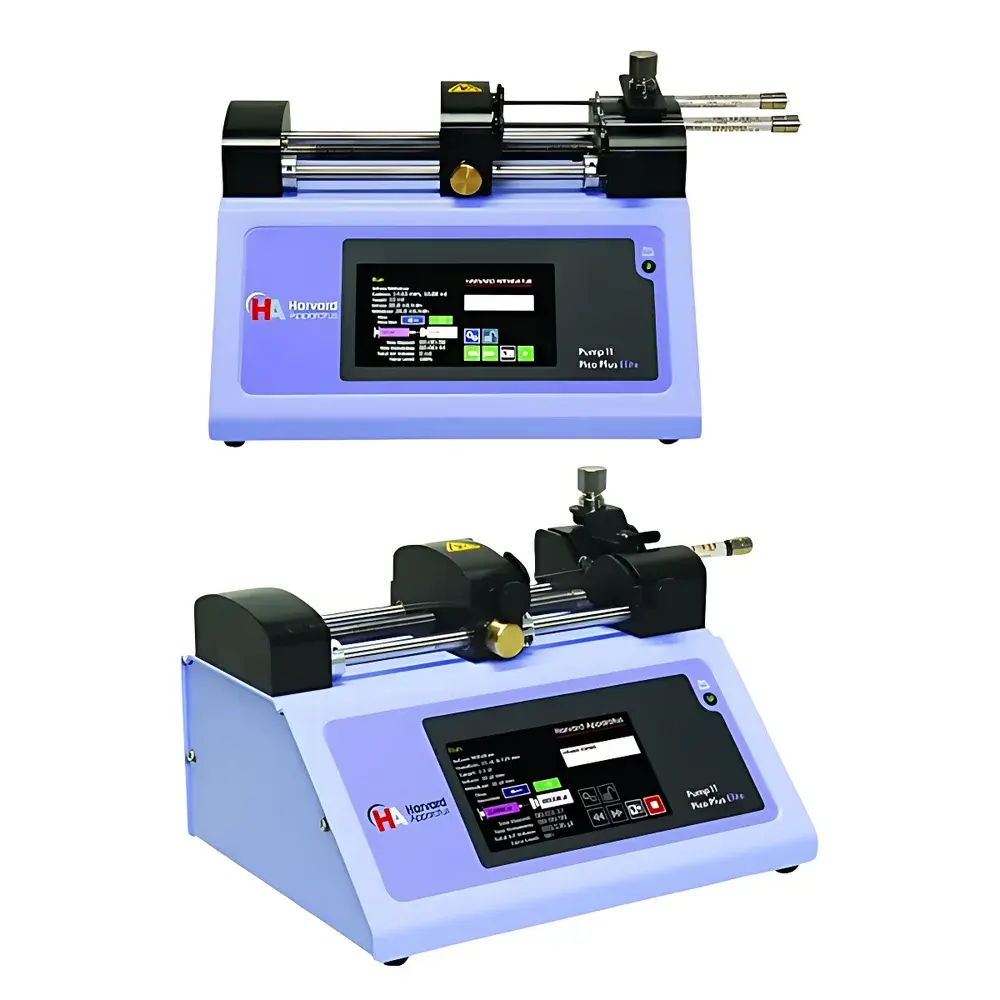
Harvard Apparatus Pump 11 Pico Plus Elite Syringe Pump
| Brand | Harvard Apparatus |
|---|---|
| Origin | USA |
| Model | Pump 11 Pico Plus Elite |
| Type | Programmable dual-channel infusion/withdrawal syringe pump |
| Accuracy | ±0.35% |
| Flow Rate Range (single-channel) | 0.54 pL/min to 39.77 mL/min |
| Flow Rate Range (dual-channel) | 0.54 pL/min to 11.70 mL/min |
| Syringe Capacity (single) | 0.5 µL – 60 mL |
| Syringe Capacity (dual) | 0.5 µL – 10 mL |
| Max Linear Force | 16 kg (35 lb) |
| Display | 4.3" WQVGA TFT color touchscreen |
| Interfaces | RS-485, USB Type B, 15-pin D-Sub I/O & TTL, footswitch input, optional RS-232 (RJ-11) |
| Power Input | 12–30 VDC |
| AC adapter | 100–240 VAC, 50/60 Hz, 18 W |
| Dimensions (H×L×W) | 22.6 × 17.78 × 15 cm |
| Weight | 2.1 kg |
| Certifications | CE, ETL (UL/CSA), WEEE, EU RoHS, CB Scheme |
Overview
The Harvard Apparatus Pump 11 Pico Plus Elite is a high-precision, microprocessor-controlled syringe pump engineered for ultra-low-flow and high-reproducibility fluid delivery in demanding research environments. Operating on the principle of linear motor-driven plunger displacement, it delivers exceptional volumetric accuracy across an exceptionally wide dynamic range—from sub-picoliter-per-minute rates critical for single-cell microinjection and microfluidic chip actuation, up to milliliter-per-minute flows suitable for HPLC solvent delivery or perfusion systems. Its dual-channel configuration supports independent or synchronized infusion/withdrawal protocols, enabling precise bidirectional control essential for applications such as push-pull microdialysis, closed-loop feedback infusion, and multi-reagent sequential dosing. Designed and manufactured in the United States, the Pump 11 Pico Plus Elite meets stringent engineering standards for mechanical stability, thermal drift resistance, and long-term force consistency—ensuring repeatable performance under continuous operation in regulated laboratory settings.
Key Features
- High-resolution 4.3″ WQVGA color touchscreen with intuitive icon-based interface—enabling full standalone operation without external computer dependency
- Programmable dual-channel architecture supporting both infusion-only and bidirectional (infusion/withdrawal) modes with independent parameter control per channel
- Ultra-broad flow range: 0.54 pL/min to 39.77 mL/min (single-channel); 0.54 pL/min to 11.70 mL/min (dual-channel), calibrated across all standard glass and plastic syringes (0.5 µL – 60 mL capacity)
- ±0.35% volumetric accuracy verified per ISO 8536-4 and ASTM D3418 guidelines, traceable to NIST-certified reference standards
- Adjustable linear force output up to 16 kg (35 lb) with fine-grained step resolution of 0.031 µm/µstep, ensuring compatibility with high-viscosity media and narrow-bore tubing
- Integrated digital I/O (15-pin D-Sub) and TTL-compatible triggers for synchronization with electrophysiology rigs, imaging systems, or custom DAQ platforms
- Expandable connectivity via RS-485 daisy-chaining (up to 31 pumps), optional RS-232 (RJ-11), IEEE-1394, and USB Type B serial communication
- Footswitch input for hands-free start/stop/pause control during time-sensitive procedures such as intracellular injection or live-tissue perfusion
Sample Compatibility & Compliance
The Pump 11 Pico Plus Elite accommodates a broad spectrum of syringe materials—including borosilicate glass, polypropylene, and Luer-lock compatible polymer variants—across volumes from 0.5 µL microsyringes to 60 mL reservoirs. Its low-inertia linear drive mechanism minimizes pulsation and backflow artifacts, making it suitable for shear-sensitive biological samples (e.g., primary neurons, exosomes, liposomal formulations). The system complies with key international regulatory frameworks: CE marking under Directive 2014/30/EU (EMC) and 2014/35/EU (LVD); ETL certification to UL 61010-1 and CSA C22.2 No. 61010-1 for laboratory safety; WEEE and RoHS 2011/65/EU for environmental compliance; and CB Scheme recognition for global market access. While not inherently 21 CFR Part 11 compliant out-of-the-box, audit-ready operation is achievable when integrated with validated third-party software platforms that enforce electronic signature, change control, and secure audit trails.
Software & Data Management
The pump operates autonomously via its embedded firmware, allowing users to create, store, and execute multi-step protocols—including ramped flow profiles, conditional branching, and timed pauses—directly on-device using the alphanumeric keypad and touchscreen. Harvard Apparatus’ proprietary Pump Software (v5.0+) provides advanced remote configuration, real-time flow monitoring, and export of timestamped CSV data logs compatible with MATLAB, Python (Pandas), and LabChart. Firmware updates are delivered via USB or network-connected host PC, supporting version-controlled deployment in GLP/GMP-aligned workflows. All internal memory retains program history and calibration metadata, facilitating traceability during internal audits or FDA pre-submission reviews.
Applications
- Microfluidics and organ-on-a-chip platforms requiring stable picoliter-scale reagent delivery
- In vivo and in vitro microdialysis (push-pull mode) for neurotransmitter sampling in awake-behaving rodent models
- HPLC and UHPLC gradient elution with programmable solvent mixing and pulseless flow
- Single-cell manipulation: cytoplasmic/nuclear injection, CRISPR RNP delivery, and oocyte microinjection
- Mass spectrometry sample introduction, including nano-ESI and MALDI spotting automation
- Nutritional pharmacokinetics studies involving controlled enteral or intravenous nutrient infusion in preclinical models
- Electrophysiology experiments integrating fluid delivery with patch-clamp or calcium imaging acquisition
FAQ
What syringe sizes and materials are supported?
The Pump 11 Pico Plus Elite accepts standard Luer-lock and Luer-slip syringes ranging from 0.5 µL microsyringes to 60 mL reservoirs, including glass, polypropylene, and fluoropolymer-coated variants.
Can the pump operate without a computer connection?
Yes—full protocol creation, storage, and execution are possible via the onboard touchscreen and keypad; no external PC is required for routine operation.
Is the ±0.35% accuracy specification valid across the entire flow range?
Yes—the stated accuracy reflects worst-case deviation across all calibrated syringe sizes and flow rates, verified per ISO 8536-4 Annex B using gravimetric validation methods.
How is synchronization achieved with external instruments?
Via TTL-level trigger inputs/outputs, RS-485 daisy-chaining, or USB-hosted command protocols (SCPI-compliant), enabling tight temporal alignment with electrophysiology amplifiers, cameras, or chromatography data systems.
Does the pump support GMP/GLP documentation requirements?
While the hardware includes audit-ready features (e.g., firmware version logging, program timestamping), full 21 CFR Part 11 compliance requires integration with validated third-party software providing electronic signatures, role-based access, and immutable audit trails.



