
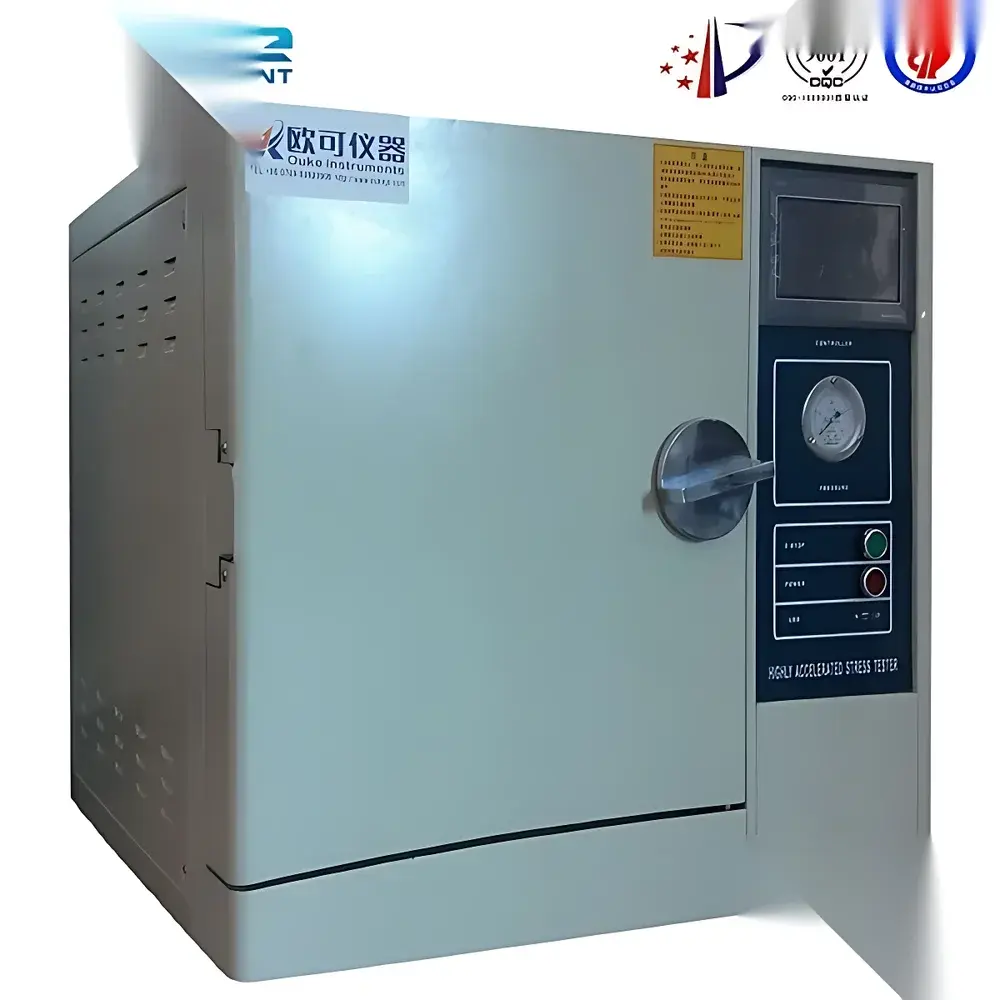
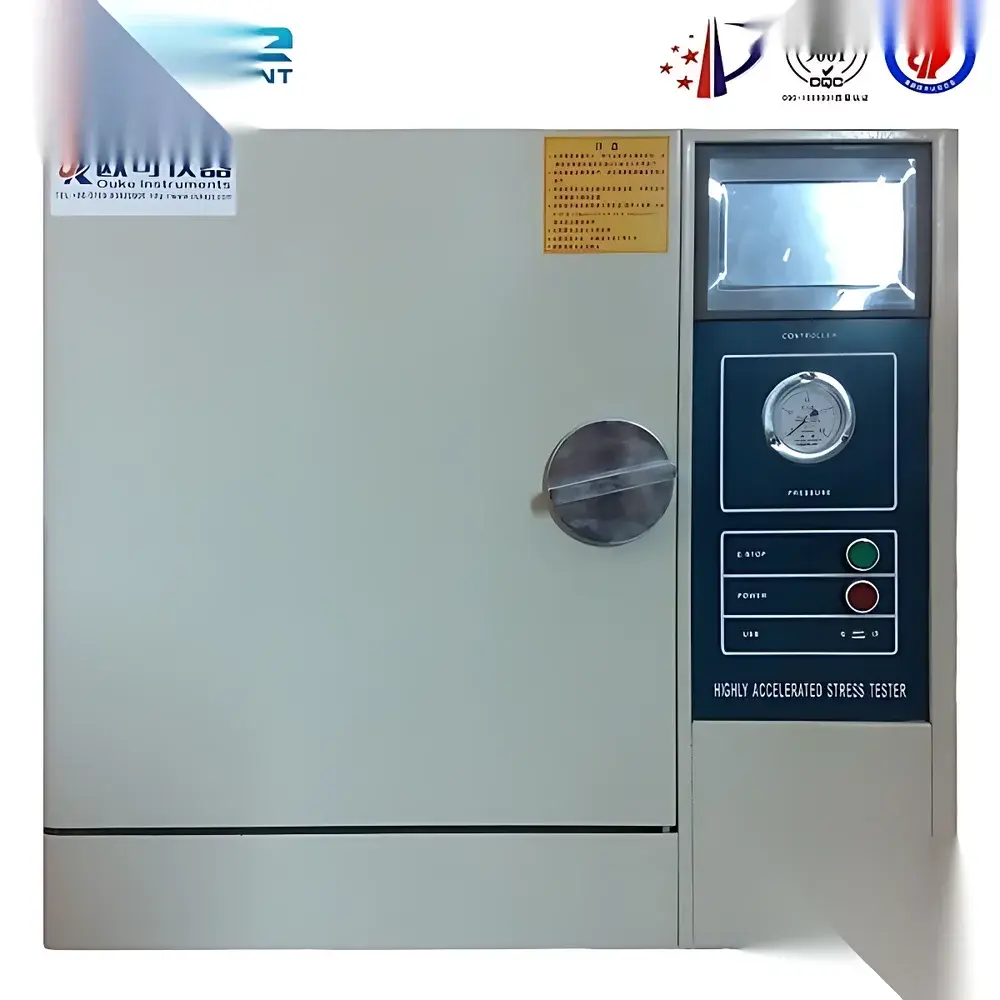
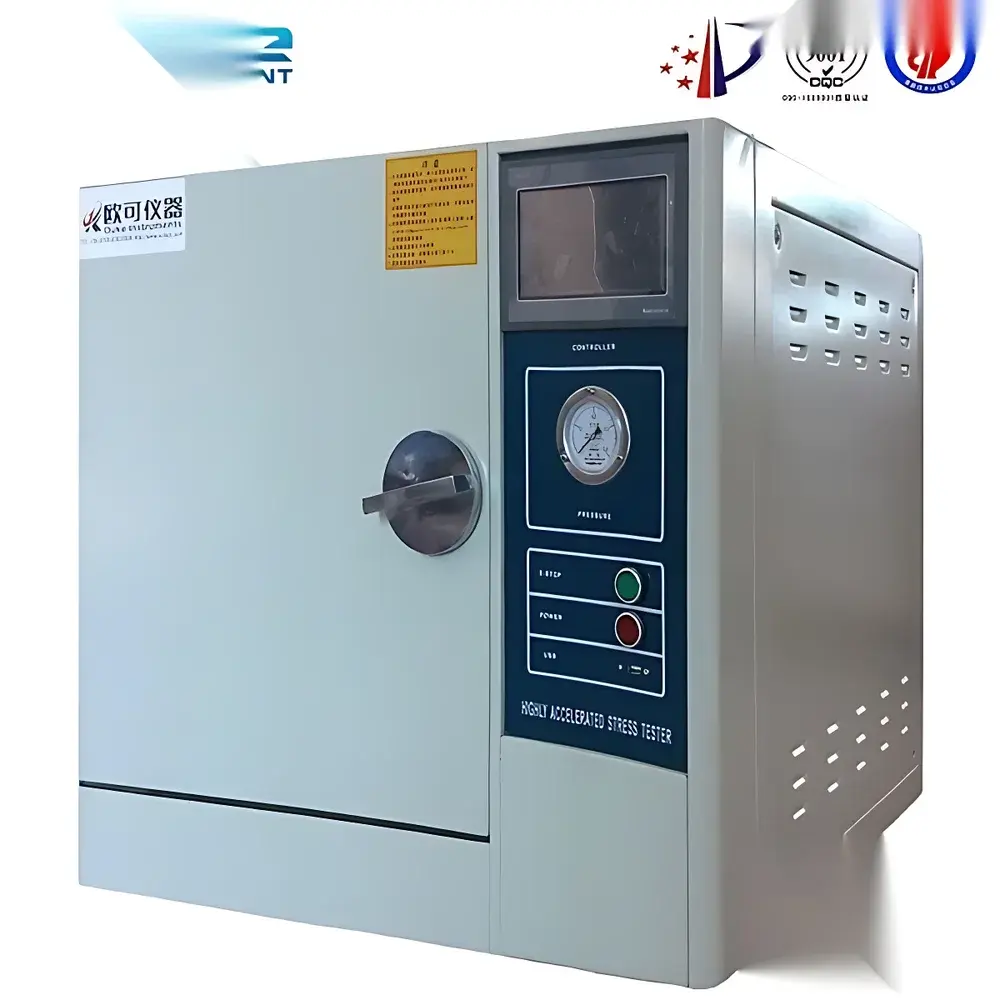
HAST High-Accelerated Stress Test Chamber
| Brand | Other Brands |
|---|---|
| Origin | Imported |
| Manufacturer Type | Authorized Distributor |
| Price | USD 13,500 (FOB) |
| Internal Dimensions | Ø250 × 400 mm |
| External Dimensions | W560 × H1000 × D650 mm |
| Temperature Range | +100°C to +132°C |
| Relative Humidity | 100% RH (saturated steam) |
| Control System | Microprocessor-based PID controller with LED display, SSR output |
| Temperature Sensor | Pt100 platinum resistance thermometer |
| Heating | Stainless steel finned heater |
| Humidification | Electric surface-evaporation type with drain port |
| Inner Chamber Material | SUS#304 mirror-finish stainless steel |
| Outer Cabinet | SUS#304 stainless steel with electrostatic powder coating |
| Safety Protections | Fuseless overcurrent protection, compressor overload protection, overtemperature cut-off, low-water level alarm, dry-heater burnout prevention, fast-acting thermal fuse |
| Power Supply | 1Φ 220 V, 8 A, 50 Hz ±10% |
| Water Requirement | RO-purified or distilled water |
Overview
The HAST High-Accelerated Stress Test Chamber is an engineered environmental stress screening system designed for reliability validation of electronic components, printed circuit boards (PCBs), semiconductor packages, and hermetic seals under elevated temperature and saturated steam pressure conditions. Operating on the principle of accelerated moisture diffusion via high-pressure saturated steam—typically at temperatures between +100°C and +132°C and relative humidity maintained at 100% RH—the chamber replicates years of field-level moisture ingress in hours or days. Unlike standard damp heat testing (e.g., 85°C/85% RH), HAST leverages increased partial pressure of water vapor to drive rapid hydrolytic degradation mechanisms, including wire bond corrosion, intermetallic growth, mold compound delamination, and solder joint fatigue. This makes it indispensable for qualification per JEDEC JESD22-A110, JESD22-A118, and AEC-Q200, as well as for failure analysis labs conducting root-cause investigations of latent moisture-related defects.
Key Features
- Microprocessor-based PID temperature controller with LED digital display and membrane keypad interface, supporting single-point setpoint control and multi-parameter PID tuning for stable thermal regulation.
- Pt100 platinum resistance temperature sensor (±0.3°C accuracy) integrated into the chamber core for precise real-time feedback and closed-loop control.
- Stainless steel (SUS#304) finned heating elements with insulated high-voltage ceramic terminals ensure uniform thermal distribution and long-term operational safety.
- Surface-evaporation humidification system generates saturated steam without external steam generators; includes dedicated drain port for routine maintenance and mineral residue removal.
- Magnetic-coupled fan assembly enables gentle, non-turbulent natural convection of saturated vapor—minimizing localized condensation and ensuring spatial uniformity of temperature and humidity (±0.8°C, ±2% RH across working volume).
- Double-walled construction with SUS#304 mirror-finish interior and electrostatically coated exterior provides corrosion resistance, cleanroom compatibility, and mechanical robustness for continuous industrial use.
- Comprehensive safety architecture includes fuseless overcurrent protection, compressor overload relay, independent overtemperature cutoff (mechanical backup), low-water level detection, dry-heater interlock, and fast-acting thermal fuses compliant with IEC 61000-4-5 surge immunity requirements.
Sample Compatibility & Compliance
The chamber accommodates test samples up to Ø250 mm diameter × 400 mm height—including QFP, BGA, CSP, MEMS sensors, automotive ECUs, and encapsulated optoelectronic modules. Its internal geometry and airflow design prevent shadowing effects and support standardized sample rack configurations per MIL-STD-883 Method 1030.4 and JEDEC JESD22-A110. All electrical and thermal subsystems conform to CE marking directives (EMC Directive 2014/30/EU, LVD Directive 2014/35/EU), and mechanical design meets ISO 13849-1 PLc functional safety requirements for guarded access zones. The system supports audit-ready documentation packages aligned with GLP and GMP environments, including calibration traceability to NIST standards and optional 21 CFR Part 11-compliant electronic log generation when paired with certified data acquisition software.
Software & Data Management
While the base configuration features standalone microcontroller operation, optional Ethernet-enabled data logging modules provide real-time streaming of temperature, pressure, and runtime status to local networks. Logged data exports in CSV and PDF formats with time-stamped metadata, supporting integration into LIMS platforms such as LabWare or Thermo Fisher SampleManager. Firmware supports configurable alarm thresholds, event-triggered snapshot capture, and password-protected parameter locking—essential for regulated manufacturing sites requiring change control and revision history. Calibration certificates include uncertainty budgets per ISO/IEC 17025:2017 Annex A.3, and firmware updates are delivered via signed USB firmware images to prevent unauthorized modification.
Applications
- Qualification testing of plastic-encapsulated microcircuits (PEMs) per JEDEC JESD22-A118 (Unbiased HAST) and JESD22-A110 (Biased HAST).
- Accelerated life testing of automotive electronics subjected to under-hood thermal cycling and humidity exposure.
- Failure mode analysis of moisture-sensitive devices (MSL-rated components) during pre-reflow and post-solder reliability assessment.
- Validation of conformal coating integrity and adhesive bond stability in aerospace-grade assemblies.
- Process capability studies for wafer-level packaging lines involving copper pillar bumping and underfill dispensing.
- Reliability benchmarking of new dielectric materials and low-k interlayer dielectrics under hygrothermal stress.
FAQ
What water purity is required for reliable HAST operation?
RO-purified water (resistivity ≥1 MΩ·cm) or ASTM Type II distilled water is mandatory to prevent scaling, heater fouling, and inaccurate humidity generation. Deionized water alone is insufficient due to residual ionic contaminants.
Can this chamber perform unbiased HAST per JEDEC JESD22-A118?
Yes—when operated without applied bias voltage to test samples, the chamber meets all thermal and humidity uniformity criteria specified in JESD22-A118 for unbiased stress profiles (e.g., 130°C/85% RH equivalent at 110°C/100% RH).
Is pressure monitoring included in the standard configuration?
The chamber integrates a calibrated analog pressure gauge with dual-range scale (0–300 kPa and 0–200 kPa) referenced to atmospheric pressure; digital pressure readout is available as an optional upgrade with RS-485 Modbus RTU interface.
How is temperature uniformity validated across the working volume?
Uniformity is verified using a 9-point thermocouple mapping procedure per IEC 60068-3-5, performed annually or after major maintenance; typical deviation is ≤±0.8°C at 121°C steady state.
Does the system support automated test sequencing for multi-step stress profiles?
Standard firmware supports single-setpoint soak cycles only; programmable ramp-soak sequences require the optional Advanced Test Manager module with embedded scripting engine and external trigger I/O ports.
Related Products



