
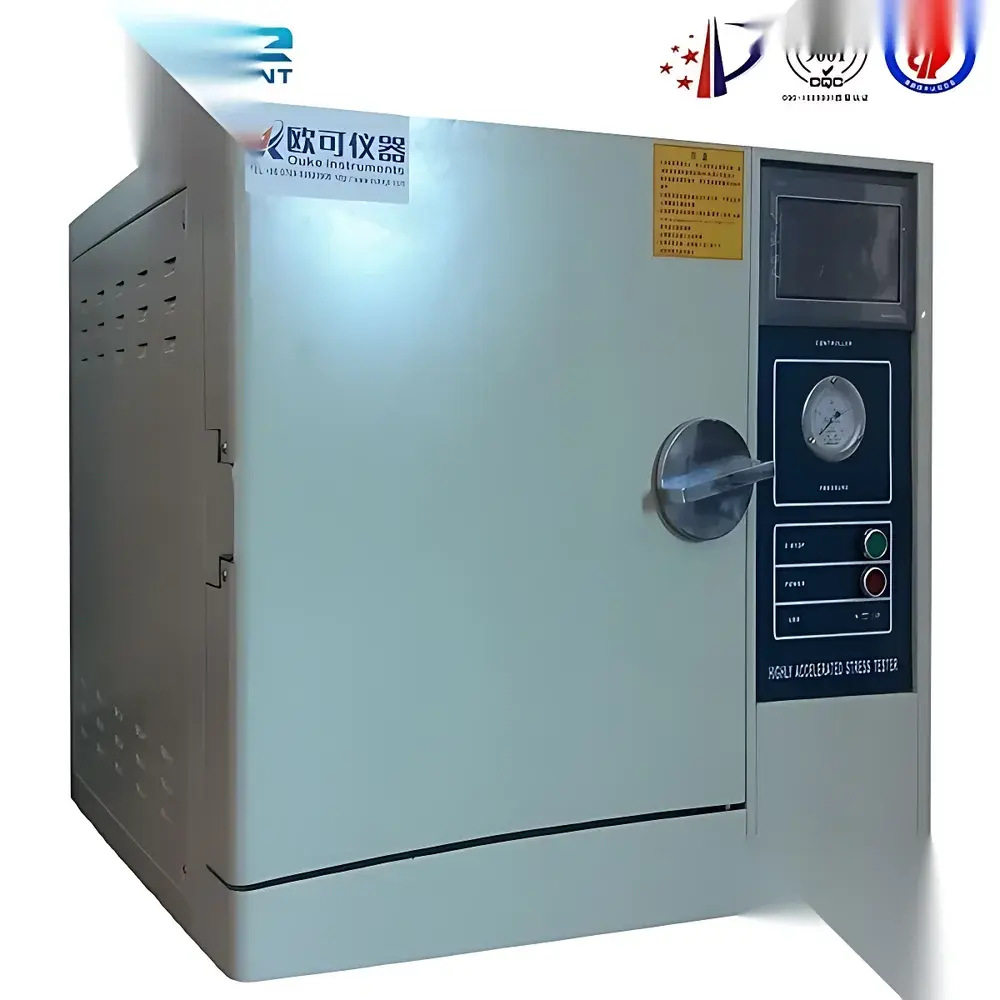
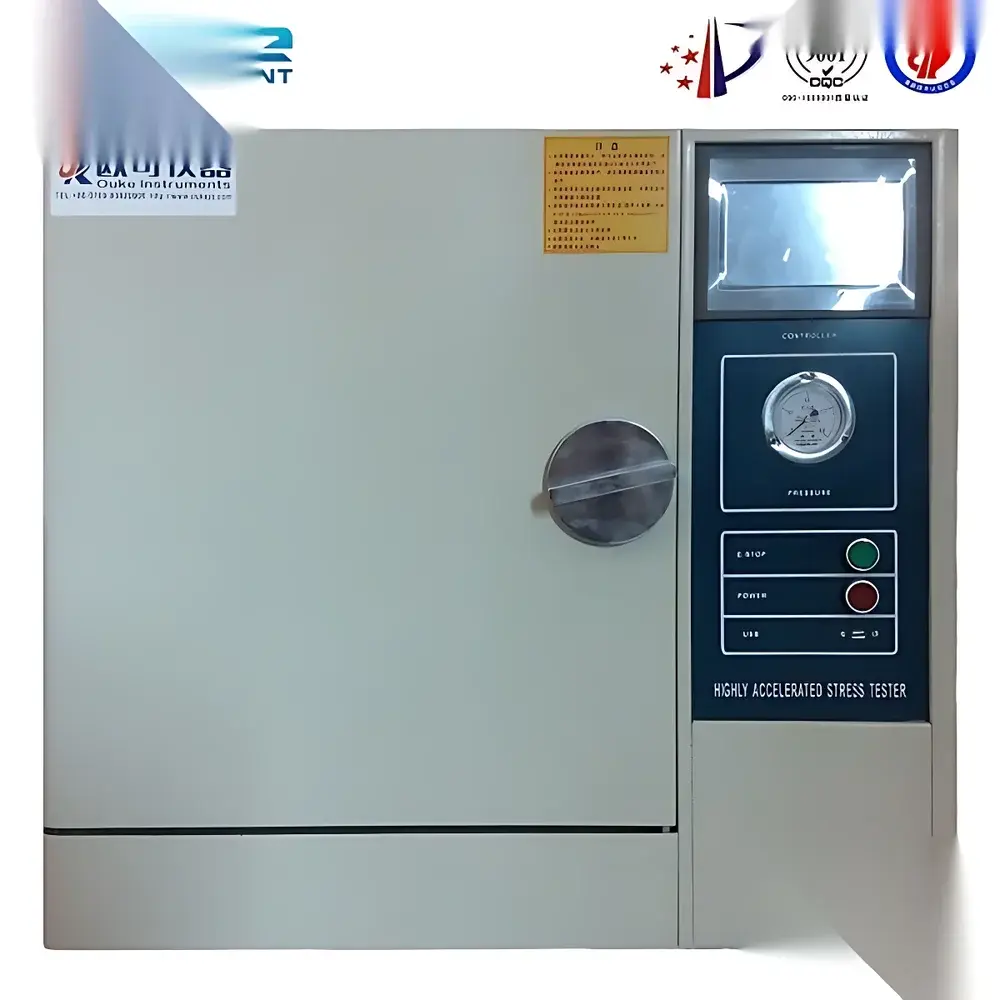
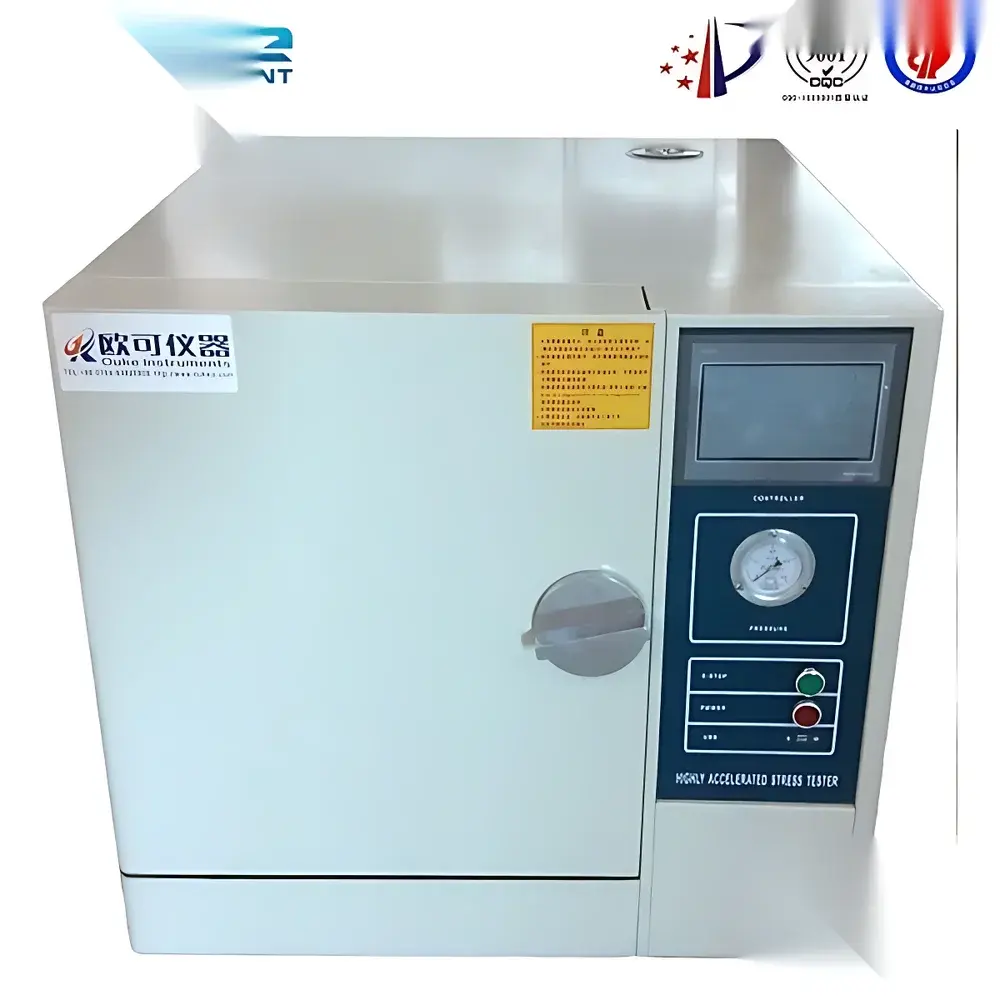
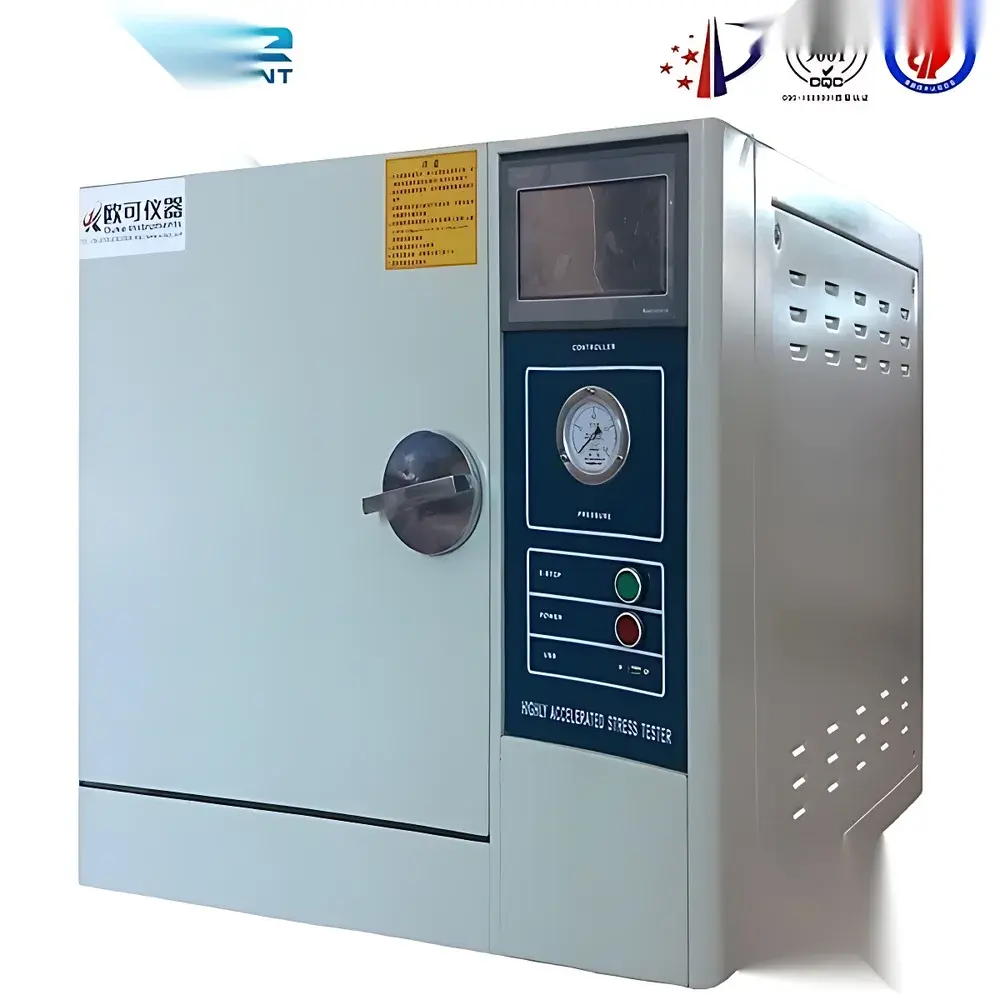
HAST High-Accelerated Stress Test Chamber
| Brand | Generic |
|---|---|
| Origin | Imported |
| Manufacturer Type | Authorized Distributor |
| Price | USD 14,000 (FOB) |
| Internal Dimensions (HAST-25) | Ø250 × 450 mm |
| Internal Dimensions (HAST-35) | Ø350 × 500 mm |
| Temperature Range | RT to 132°C |
| Humidity Range | 75–100% RH |
| Pressure Range | 0.0–2.8 kg/cm² (gauge), max safe capacity 4.0 kg/cm² |
| Temperature Uniformity | ±1.5°C |
| Temperature Control Accuracy | ±0.5°C |
| Temperature Resolution | 0.1°C |
| Pressurization Time (0 → 2.0 kg/cm²) | ~30 min |
| Inner Chamber Material | SUS304 stainless steel |
| Outer Casing | SECC steel with electrostatic powder coating |
Overview
The HAST High-Accelerated Stress Test Chamber is an engineered environmental stress screening system designed for accelerated reliability validation of electronic components, printed circuit boards (PCBs), semiconductor packages, and hermetically sealed devices. It operates on the principle of high-pressure saturated steam exposure—elevating temperature, humidity, and pressure simultaneously beyond standard autoclave conditions—to induce latent failure mechanisms (e.g., corrosion, intermetallic diffusion, dielectric degradation, and package delamination) in significantly reduced test durations. Unlike conventional Temperature-Humidity-Bias (THB) testing, HAST introduces elevated partial pressure of water vapor (up to 2.8 kg/cm² gauge), effectively accelerating moisture ingress through packaging interfaces and passivation layers. This enables qualification-level stress testing compliant with JEDEC JESD22-A110, JESD22-A118, and IEC 60068-2-66 standards—commonly required for AEC-Q200, MIL-STD-750, and automotive-grade component certification.
Key Features
- Automated water replenishment system maintains consistent saturation levels throughout extended test cycles; low-water detection triggers immediate refill without interrupting operation.
- Dual-sensor real-time monitoring of chamber pressure and corresponding saturation temperature ensures thermodynamic consistency per IAPWS-IF97 steam tables.
- LED digital PID temperature controller with 0.1°C resolution and ±0.5°C stability over full operating range (RT–132°C).
- Integrated digital timer initiates countdown only after chamber reaches target temperature—eliminating premature timing errors due to thermal lag.
- Condensate purge mechanism continuously removes non-saturated vapor fractions during pressurization, maintaining >99.5% steam quality per ASME PTC 19.10 guidelines.
- Seamless silicone door gasket with compression-molded geometry achieves leak rate <1.0 × 10⁻⁵ mbar·L/s under 3.0 kg/cm² pressure—validated per ISO 10648-2.
- Electropolished SUS304 inner chamber surface minimizes nucleation sites for condensate pooling and resists chloride-induced pitting corrosion.
- Robust structural design includes dual safety interlocks, burst disc (rated at 4.0 kg/cm²), and redundant pressure relief valves meeting PED 2014/68/EU requirements.
Sample Compatibility & Compliance
The chamber accommodates a broad range of sample configurations—including trays, carriers, and bare dies—within two standard internal volumes (Ø250 × 450 mm and Ø350 × 500 mm). Its uniform thermal distribution (±1.5°C across working volume) and precise pressure regulation ensure reproducible stress profiles essential for comparative failure analysis. The system supports compliance-driven test protocols aligned with JEDEC JESD22-A110 (Unbiased HAST), JESD22-A118 (Biased HAST), and IEC 60068-2-66 (damp heat, cyclic, high pressure). Full traceability is enabled via optional RS-485/Modbus RTU interface for integration into GLP/GMP audit environments requiring 21 CFR Part 11–compliant electronic records.
Software & Data Management
While the base configuration features standalone LED controllers, optional PC-based data acquisition software provides continuous logging of temperature, pressure, humidity (derived), elapsed time, and alarm status at user-defined intervals (1–60 sec). All datasets are timestamped, digitally signed, and exportable in CSV or XML format for statistical process control (SPC) analysis. Audit trails record operator ID, parameter changes, and system events—supporting FDA-regulated validation workflows. Calibration certificates for integrated PT100 sensors and pressure transducers are supplied with NIST-traceable documentation.
Applications
- Qualification testing of plastic-encapsulated microcircuits (PEMs) per MIL-STD-883 Method 1008.
- Failure mode acceleration for solder joint fatigue, wire bond lift-off, and mold compound cracking.
- Reliability screening of MEMS sensors, RF modules, and power discrete devices prior to AEC-Q100/Q200 release.
- Process validation of conformal coating integrity and underfill adhesion strength.
- Root cause analysis of field returns involving moisture-related parametric drift or catastrophic short circuits.
FAQ
What is the maximum allowable test duration for continuous HAST operation?
Standard duty cycle supports up to 96 hours uninterrupted; extended runs require pre-approval and verification of cooling water flow stability.
Does the chamber support biased testing (voltage applied during stress)?
Yes—optional feedthrough terminals (up to 10 channels, 100 VDC/1 A rating) enable real-time electrical monitoring during HAST exposure.
How is pressure calibrated and verified?
Factory calibration uses deadweight testers traceable to NPL standards; annual recalibration is recommended per ISO/IEC 17025.
Can the system be integrated into an automated test line?
Yes—digital I/O ports support start/stop commands, E-stop interlocking, and pass/fail signal output compatible with PLC-based MES systems.
Is steam purity monitored in real time?
While direct conductivity measurement is not included, steam quality is inferred from pressure-temperature correlation deviation; deviations >±0.3°C trigger automatic purge and reconditioning sequence.
Related Products



