
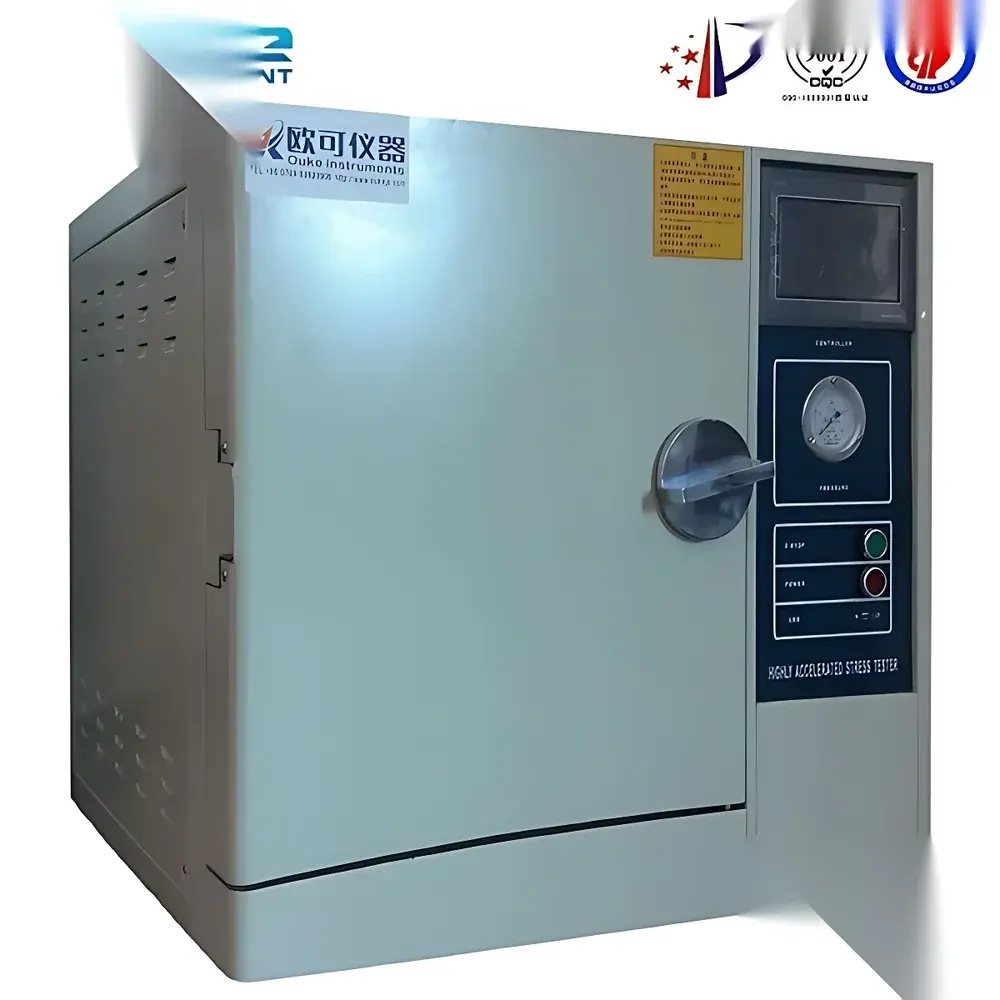
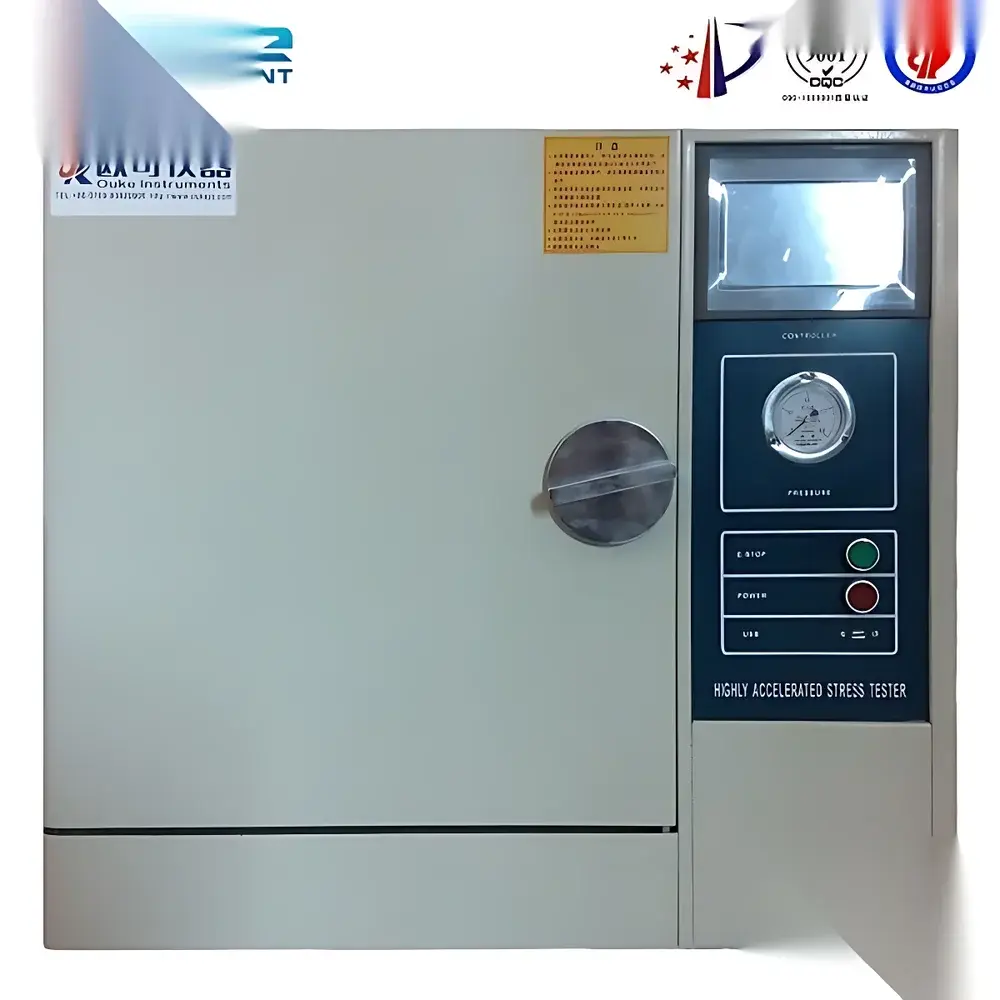
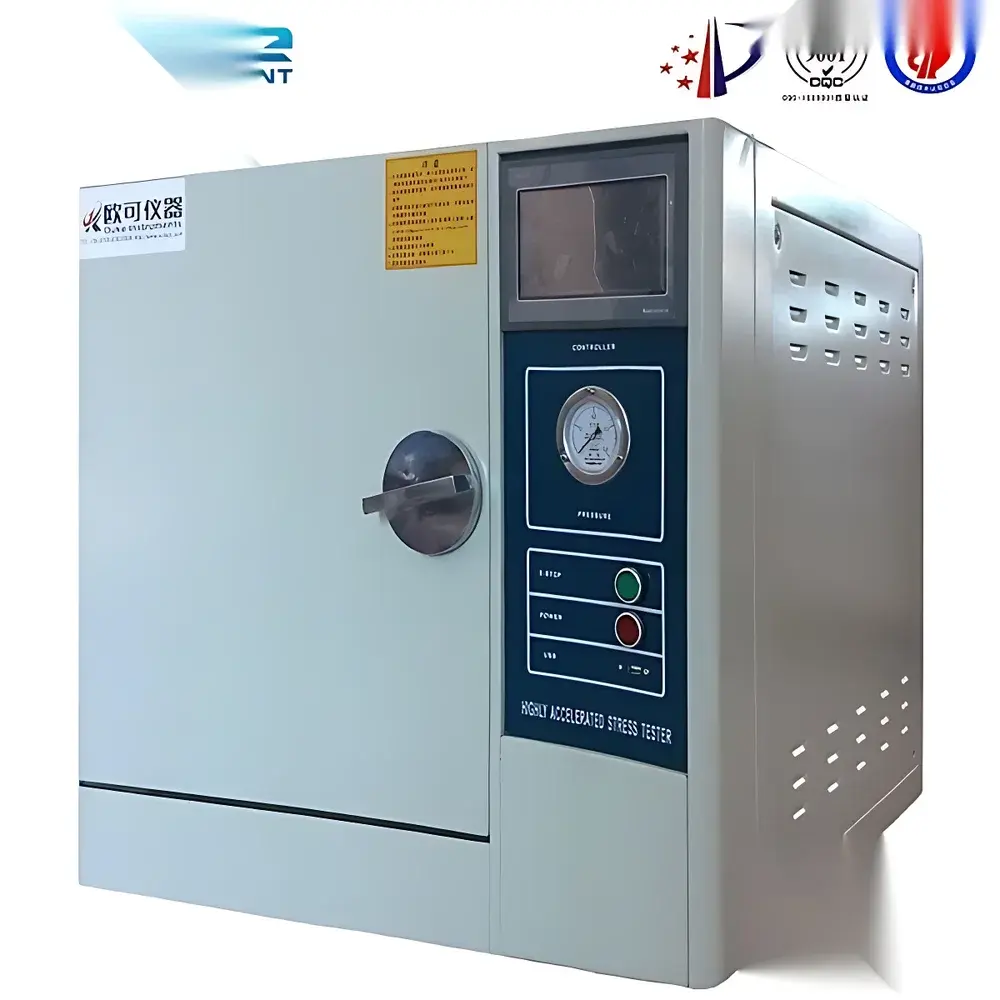
HAST High-Pressure Steam Aging Chamber
| Brand | Other Brands |
|---|---|
| Origin | Imported |
| Manufacturer Type | General Distributor |
| Price | USD 14,000 (approx.) |
| Internal Chamber Dimensions | Φ25×35 cm, Φ30×45 cm, Φ40×55 cm, Φ50×60 cm |
| Temperature Range | 105–132°C, 105–142.9°C, 105–155°C |
| Pressure Range | 0.2–2.0 kg/cm² (gauge), 0.2–3.0 kg/cm² (gauge), 0.2–3.5 kg/cm² (gauge) |
| Humidity Range | 65–100% RH (adjustable) |
| Controller | Dual-language (English/Chinese), USB & RS-232C interfaces, real-time data logging and curve export |
| Resolution | Temperature: 0.1°C, Humidity: 0.1% RH, Pressure: 0.1 kg/cm² |
| Temperature/Humidity Stability (Unsaturated Mode) | ±0.5°C / ±2.5% RH |
| Temperature/Humidity Stability (Saturated Mode) | ±0.5°C / 100% RH |
| Uniformity | ±0.5°C / ±5% RH |
| Bias Terminals | Standard: 8 channels (optional: 8–55 channels), AC/DC 125 V / 1 A |
| Pressurization Time | ~45–55 min depending on configuration |
Overview
The HAST High-Pressure Steam Aging Chamber is an accelerated reliability testing system engineered for stress-based evaluation of electronic components, PCB assemblies, encapsulated semiconductors, and hermetic packaging under elevated temperature, humidity, and pressure conditions. Unlike conventional THB (Temperature-Humidity-Bias) chambers, this chamber operates above atmospheric saturation—leveraging the principles of Highly Accelerated Stress Testing (HAST) as defined in JESD22-A110 and JEDEC standards. By maintaining controlled supersaturated steam environments at pressures up to 3.5 kg/cm² (gauge), it achieves acceleration factors of 10× to 100× compared to standard 85°C/85% RH tests. The system directly measures temperature, relative humidity, and gauge pressure via calibrated industrial-grade sensors—eliminating reliance on indirect saturation calculations—and ensures traceable, reproducible aging profiles essential for qualification per AEC-Q200, IEC 60749, and MIL-STD-883 methods.
Key Features
- True multi-parameter real-time sensing: Independent high-accuracy Pt100 RTD (temperature), capacitive polymer RH sensor (humidity), and piezoresistive pressure transducer (gauge pressure) deliver synchronized, uncorrected readings—enabling ISO/IEC 17025-compliant validation.
- Dual-mode humidity control: Supports both unsaturated (non-condensing) and saturated (condensing) operation, with dynamic dew-point tracking for precise moisture activity regulation.
- Integrated bias terminal interface: Standard 8-channel isolated DC/AC bias capability (125 V / 1 A per channel), expandable to 55 channels, compliant with JEDEC JESD22-A118 test requirements for powered device stress.
- Thermally optimized chamber architecture: Patented localized dry-air purge design prevents condensation on test specimens during ramp-down phases, preserving sample surface integrity and measurement repeatability.
- Robust mechanical construction: Reinforced stainless-steel inner chamber with welded seams; no bolted flanges in critical pressure zones—designed to withstand cyclic pressurization without fatigue-induced leakage or dimensional drift.
- Comprehensive data governance: Embedded controller supports timestamped CSV export via USB or RS-232C, with configurable sampling intervals (1 s to 60 s) and built-in audit trail for GLP/GMP-aligned workflows.
Sample Compatibility & Compliance
The chamber accommodates a wide range of sample configurations—from bare die and QFN packages to populated automotive ECUs and medical-grade PCBAs—within four standard internal volume options (0.17 L to 1.18 L). All models comply with safety and electromagnetic compatibility requirements per IEC 61000-4 series and EN 61010-1. Test protocols executed in this system satisfy qualification criteria outlined in JESD22-A101 (THB), JESD22-A110 (HAST), JESD22-A118 (HAST with bias), and IPC-9701A. Optional third-party calibration certificates (NIST-traceable) are available for temperature, humidity, and pressure sensors—supporting FDA 21 CFR Part 11 compliance when paired with validated software extensions.
Software & Data Management
The embedded controller firmware provides dual-language UI (English/Chinese), intuitive profile programming (up to 99 segments), and real-time graphical display of all monitored parameters. Data export functions generate time-stamped .CSV files containing full-resolution sensor logs—including pressure ramp rate, dwell stability, and humidity overshoot metrics—for post-test statistical analysis. For enterprise integration, optional PC-based software enables remote monitoring, automated report generation (PDF/Excel), and alignment with LIMS platforms via OPC UA or Modbus TCP. All data storage and transmission adhere to AES-256 encryption standards, and user access levels support role-based permissions (Operator, Engineer, Administrator) with mandatory login audit trails.
Applications
This chamber is routinely deployed in semiconductor foundry qualification labs, automotive Tier-1 supplier R&D centers, and aerospace component manufacturers for: accelerated moisture diffusion assessment in mold compounds; early detection of corrosion at bond wires and solder joints; validation of conformal coating barrier performance; screening of MEMS package hermeticity; and reliability benchmarking of GaN/SiC power modules under combined thermal-hygro-mechanical stress. Its ability to replicate field-relevant failure mechanisms—including electrochemical migration (ECM), intermetallic growth, and delamination—makes it indispensable for AEC-Q100 Grade 0/1 qualification and ISO 26262 ASIL-D hardware verification.
FAQ
What is the difference between HAST and traditional THB testing?
HAST applies elevated pressure to increase water vapor partial pressure beyond atmospheric saturation, accelerating moisture ingress without requiring extended test durations. THB relies solely on ambient-pressure 85°C/85% RH exposure, resulting in significantly lower acceleration factors.
Is external compressed air required for operation?
Yes—a clean, oil-free, dry air supply (minimum 6 bar) must be connected to the dedicated inlet port to drive the pneumatic pressure booster system.
Can the chamber perform unbiased (open-circuit) tests?
Absolutely. Bias terminals are optional and electrically isolated; tests may be conducted with or without applied voltage/current.
How is temperature uniformity verified across the working volume?
Per IEC 60068-3-5, uniformity is validated using a 9-point thermocouple mapping procedure at steady-state conditions, with results documented in the factory acceptance test (FAT) report.
Does the system support automated pass/fail evaluation against predefined thresholds?
Not natively—the controller logs raw sensor data only. Threshold-based analysis requires post-processing in external tools (e.g., Python, MATLAB, or custom QA dashboards).



