
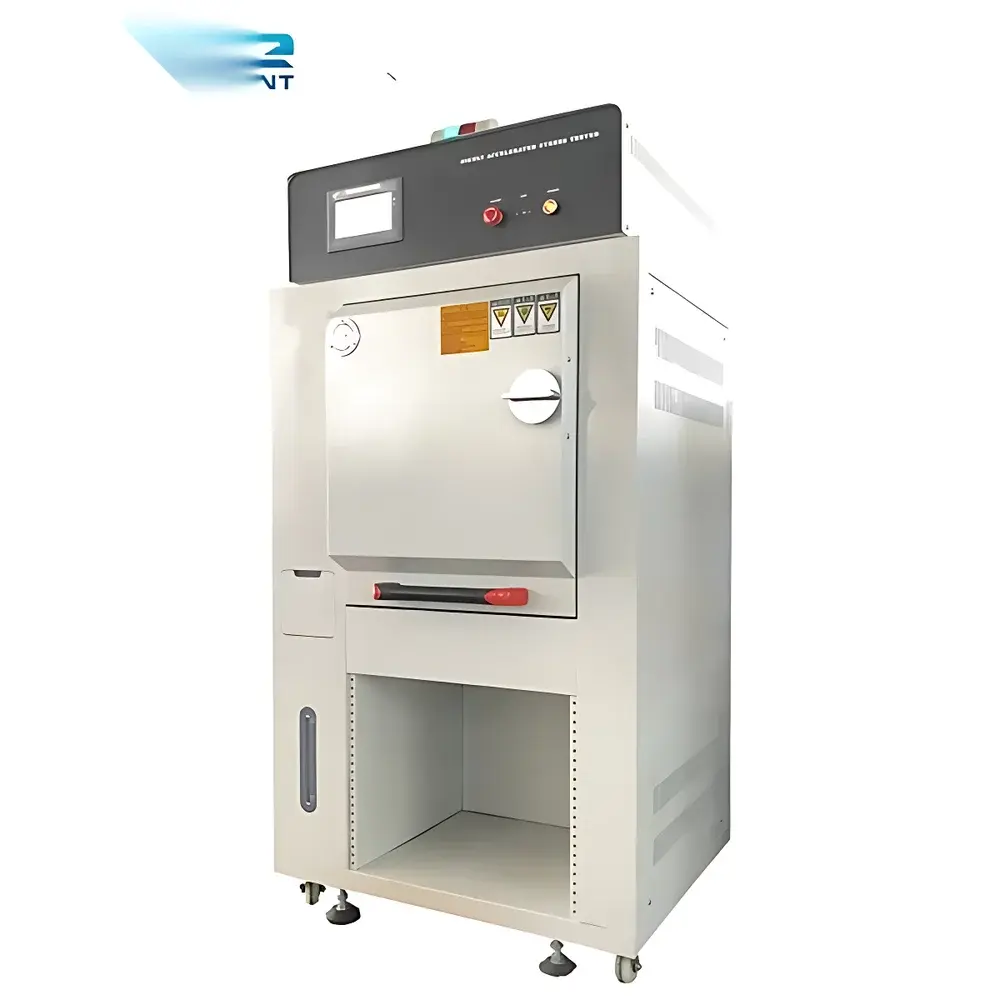
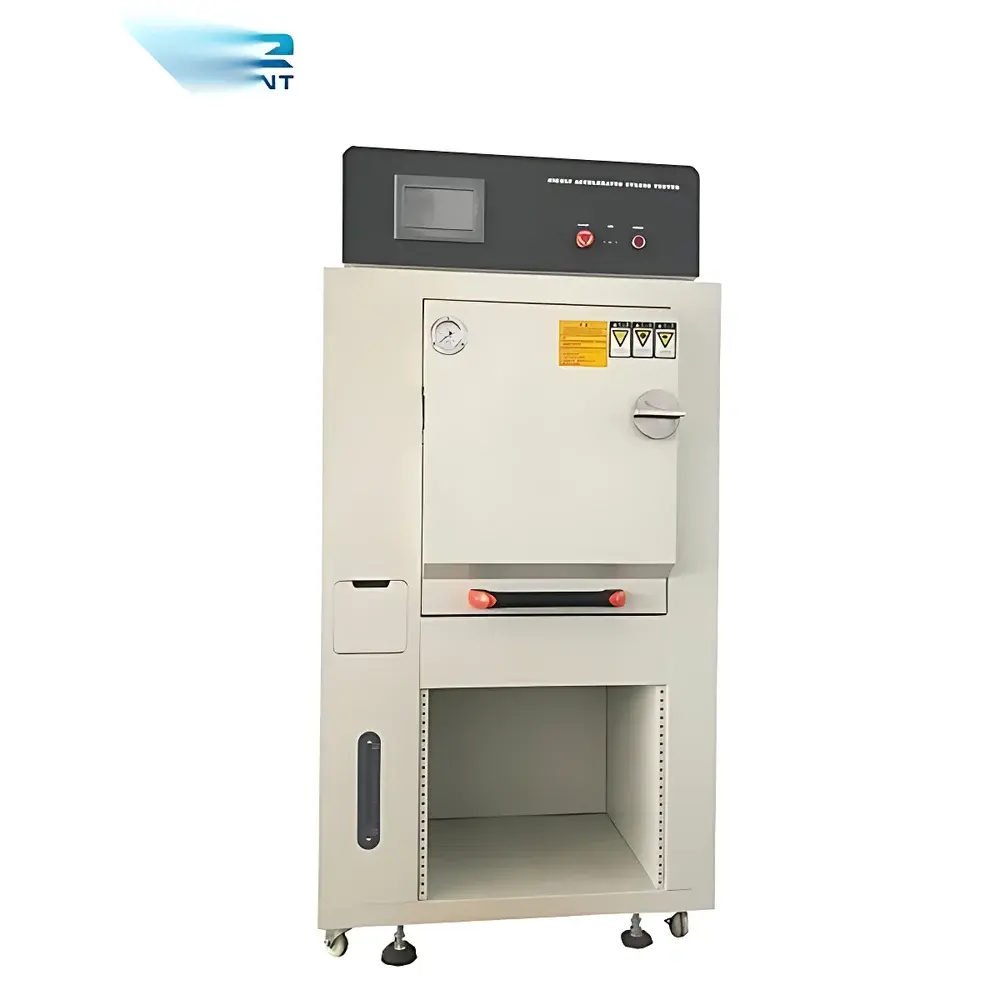
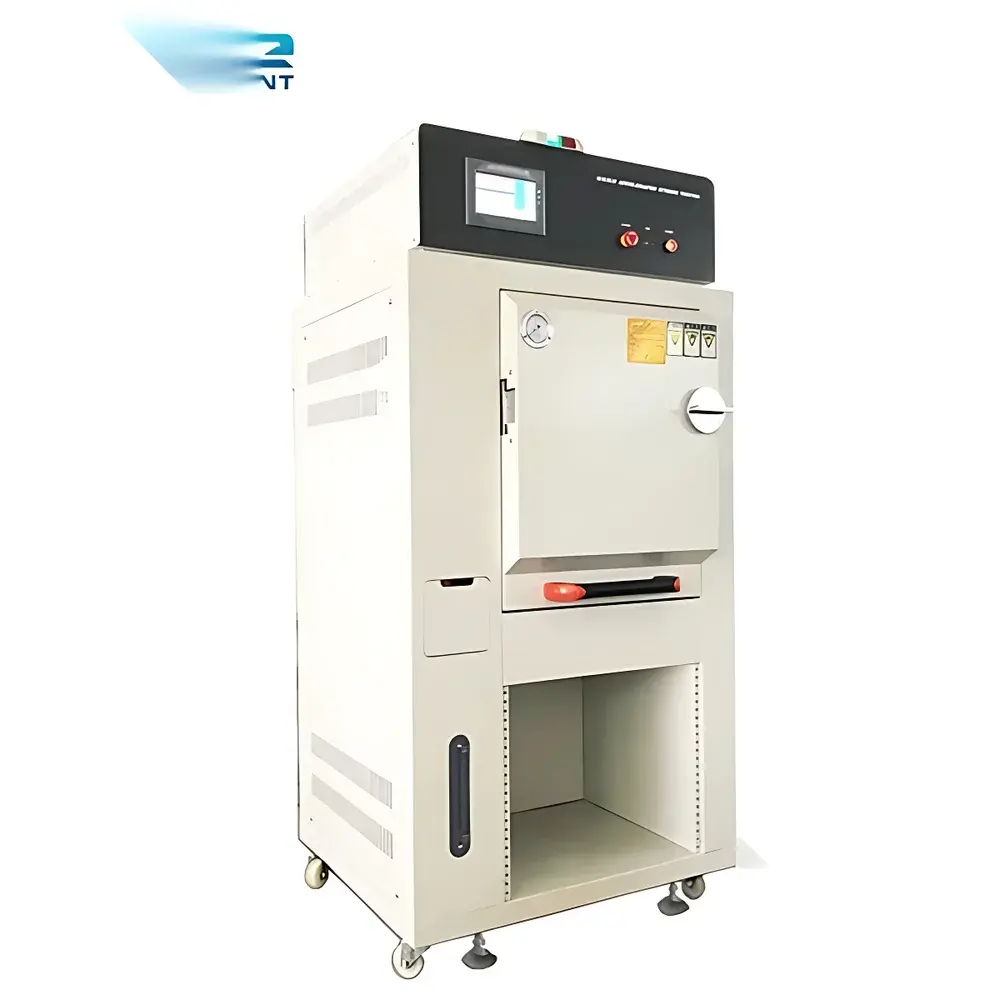
HAST Highly Accelerated Stress Test Chamber
| Brand | Other Brands |
|---|---|
| Origin | Imported |
| Manufacturer Type | General Distributor |
| Price | USD 14,000 (approx.) |
| Temperature Range | 105–132 °C |
| Temperature Uniformity | ±2.0 °C |
| Temperature Stability | ±0.5 °C |
| Humidity Range | 75–100 % RH |
| Humidity Stability | ±2.5 % RH |
| Humidity Uniformity | ±5.0 % RH |
| Pressure Range | 0.05–0.196 MPa (0.5–2.0 kgf/cm²) |
| Ramp Time (Temp) | ≤35 min (25→132 °C) |
| Ramp Time (Pressure) | ≤40 min (0→0.196 MPa) |
| Safety | Overpressure, overtemperature, and vacuum-failure interlocks |
| Compliance | Designed per JESD22-A110, JEDEC Standard, MIL-STD-883 Method 1030, and IEC 60068-2-66 |
Overview
The HAST Highly Accelerated Stress Test Chamber is an engineered environmental reliability testing system designed to evaluate the long-term hermeticity, moisture resistance, and structural integrity of electronic components and sealed assemblies under extreme combined stress conditions—elevated temperature, high relative humidity, and elevated partial pressure of water vapor. Unlike conventional Temperature-Humidity-Bias (THB) or 85/85 tests, HAST applies saturated or near-saturated steam at pressures above atmospheric (typically 0.05–0.196 MPa), significantly accelerating moisture diffusion through polymer encapsulants, die attach interfaces, and mold compound–leadframe boundaries. This enables detection of latent failure mechanisms—including corrosion of bond wires and metallization layers, intermetallic growth, delamination, and conductive anodic filament (CAF) formation—in days rather than weeks or months. The chamber operates on a controlled saturated steam environment, where pressure elevation directly increases the chemical potential of water, thereby intensifying hydrolytic degradation kinetics in semiconductor packages (e.g., QFP, BGA, CSP, LED modules) and multilayer PCBs.
Key Features
- Triple-stress control architecture: Independent regulation of temperature (105–132 °C), relative humidity (75–100 % RH), and absolute vapor pressure (0.05–0.196 MPa) with real-time feedback loops.
- Precision stainless-steel test chamber with electropolished interior surface finish—resistant to condensate adhesion, corrosion, and particulate retention.
- Integrated vacuum pre-conditioning cycle: Automatic evacuation and filtered air purge prior to pressurization ensures removal of ambient oxygen and non-condensable gases, eliminating false pass/fail due to trapped air pockets.
- Digital LED timer with start-trigger logic: Initiation synchronized to attainment of both target temperature and pressure thresholds—ensuring test validity per JEDEC JESD22-A110 compliance requirements.
- Dynamic saturation management: Condensate drainage system continuously removes unsaturated vapor during ramp-up, maintaining thermodynamic equilibrium and preventing uncontrolled condensation on test specimens.
- Multi-level safety interlocks: Hardware-based overpressure relief valve, dual redundant temperature limit sensors, vacuum-failure shutdown, and audible/visual fault indicators for LIMIT condition activation.
Sample Compatibility & Compliance
This HAST chamber accommodates standard JEDEC trays (JEDEC STD-20), 300 mm wafer carriers, and custom fixtures for IC packages, discrete semiconductors, optoelectronic modules (LED/Laser diodes), flexible printed circuits (FPC), and hermetically sealed medical device housings. It excludes flammable, explosive, volatile organic compounds (VOCs), corrosive chemicals (e.g., halogenated solvents, strong acids/bases), and high-EMI emitters—consistent with IEC 61000-4-3 immunity constraints and laboratory safety protocols. All operational parameters align with industry-standard qualification methodologies: JEDEC JESD22-A110 (Unbiased HAST), JESD22-A118 (Biased HAST), MIL-STD-883 Method 1030.10, and IEC 60068-2-66. Data logging supports GLP/GMP traceability when integrated with compliant software platforms.
Software & Data Management
The chamber integrates with optional PC-based control software supporting ISO/IEC 17025-compliant calibration tracking, audit-ready test log export (CSV/Excel), and configurable alarm thresholds. Raw sensor data—including chamber temperature, humidity, pressure, vacuum level, and elapsed test time—is timestamped with millisecond resolution and stored locally on embedded SD card (optional). The system supports FDA 21 CFR Part 11–compliant user access control, electronic signatures, and immutable audit trails when deployed in regulated pharmaceutical or medical device manufacturing environments. Remote monitoring via Ethernet (Modbus TCP or proprietary API) enables integration into centralized MES or LIMS infrastructure.
Applications
- Qualification of plastic-encapsulated microcircuits (PEMs) per MIL-PRF-38535 and AEC-Q200.
- Failure analysis root cause isolation for moisture-induced corrosion, wire bond lift-off, and mold compound cracking.
- Design validation of conformal coatings, underfill materials, and wafer-level packaging (WLP) barrier performance.
- Reliability screening of automotive ADAS sensors, power modules, and EV battery management ICs exposed to humid under-hood environments.
- Accelerated life modeling for consumer electronics (smartphones, wearables) targeting IP67/IP68 ingress protection certification.
- Process capability assessment of reflow soldering, molding, and hermetic sealing operations in high-mix semiconductor fabs.
FAQ
What standards does this HAST chamber comply with?
It is engineered to support test execution per JEDEC JESD22-A110, JESD22-A118, MIL-STD-883 Method 1030.10, and IEC 60068-2-66—with hardware-level parameter tolerances meeting or exceeding those specifications.
Can the chamber perform biased HAST testing?
Yes—when used with external DC bias supplies and compatible test fixtures, it supports voltage-biased operation per JESD22-A118; electrical feedthroughs and isolation ratings must be verified per application.
Is vacuum pre-purge mandatory before each test cycle?
Yes—vacuum evacuation to ≤10 kPa absolute followed by filtered dry air backfill is required to eliminate non-condensable gases that inhibit true saturated steam conditions and compromise test reproducibility.
What maintenance is required for long-term accuracy?
Quarterly verification of PT100 temperature sensors and capacitive RH transducers against NIST-traceable references; annual recalibration of pressure transducers and safety relief valve setpoints.
Does the system support automated pass/fail evaluation?
No—the chamber provides raw environmental data only; pass/fail determination requires post-test electrical functional testing (e.g., leakage current, parametric shift) performed externally per JEDEC-defined acceptance criteria.



