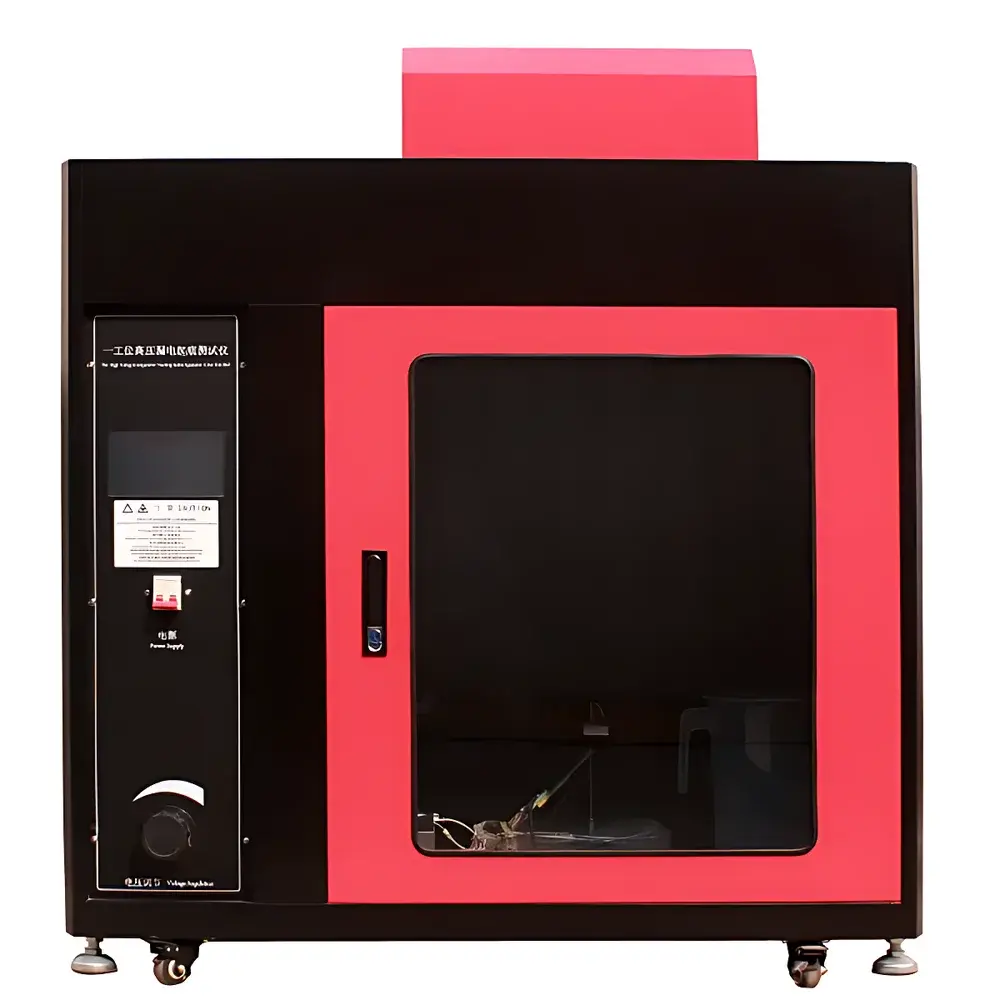
HCTI-2 High-Voltage Tracking Resistance Tester
| Brand | Aerospace Zongheng |
|---|---|
| Origin | Beijing, China |
| Manufacturer Type | Authorized Distributor |
| Country of Origin | China |
| Model | HCTI-2 |
| Price Range | USD 11,200 – 16,800 |
Overview
The HCTI-2 High-Voltage Tracking Resistance Tester is an engineered test system designed to evaluate the comparative resistance of insulating materials—particularly polymers, laminates, and composite dielectrics—to electrical tracking and erosion under severe environmental conditions. It operates in accordance with the core principles defined in IEC 60112 (Equivalently GB/T 6553–2014), simulating real-world degradation mechanisms where conductive contaminants (e.g., salt-laden moisture) bridge electrode gaps on inclined surfaces under sustained AC voltage stress. The instrument applies a controlled 45–65 Hz sinusoidal high voltage across two platinum-tipped electrodes spaced 50.0 ± 0.5 mm apart on a 45° ± 2° inclined specimen. Simultaneously, a standardized ammonium chloride–based contaminant solution is delivered at precisely regulated flow rates onto the specimen surface via gravity-fed drip nozzles and eight-layer filter paper pads. Under these conditions, localized surface discharges initiate carbonized conductive paths—termed “tracking”—whose formation time, propagation behavior, and associated material loss (erosion depth) are quantified to assign standardized tracking index (CTI) or proof tracking index (PTI) ratings. This method is essential for validating insulation integrity in low-voltage apparatus, household appliances, terminal blocks, PCB substrates, and outdoor polymer enclosures exposed to industrial or coastal atmospheres.
Key Features
- Compliant dual-test methodology: Supports both Constant Voltage Method (IEC 60112 Method A) and Stepped Voltage Method (IEC 60112 Method B) per user-selectable protocol
- Integrated precision fluid delivery: Dual independent peristaltic pump system with real-time flow calibration interface; default nominal output: 5.0 mL/min ± 0.1 mL/min (adjustable per Table 1 voltage/flow matrix)
- Touchscreen HMI with embedded parameter validation: On-screen calibration wizard, voltage ramp control, automatic current monitoring (60 mA trip threshold), and timed endpoint logic (1 h or 6 h)
- Standardized electrode assembly: Fixed 50 mm spacing, 45° specimen inclination, Pt/Ir alloy electrodes with defined geometry per IEC 60112 Annex A
- Dedicated contamination management: Pre-calibrated NH₄Cl + nonionic surfactant solution delivery system; resistivity verification port (target: 3.95 ± 0.05 Ω·m at 23 ± 1 °C)
- Fail-safe interlocks: Overvoltage warning (audible + visual alert), automatic circuit interruption upon ≥60 mA sustained current (>2 s), and manual emergency stop
Sample Compatibility & Compliance
The HCTI-2 accommodates rigid flat specimens measuring minimum 50 mm × 120 mm, with recommended thickness of 6.0 mm (other thicknesses permitted with full reporting per GB/T 6553–2014 Clause 7.2). Specimens must be cleaned with isopropanol followed by deionized water, and optionally abraded with 400-grit SiC paper if insufficient wettability is observed. The tester supports evaluation of thermoplastics (e.g., PBT, PA66, PC), thermosets (e.g., epoxy resins, phenolics), filled composites, and elastomeric insulators. All operational parameters—including voltage range (1.0–6.0 kV AC), contamination flow rate (0.075–0.90 mL/min), and series resistor values (10–33 kΩ)—are traceable to IEC 60112:2020, GB/T 6553–2014, and ASTM D3638. The system meets CE marking requirements for electrical safety (EN 61010-1) and electromagnetic compatibility (EN 61326-1). Test records comply with GLP audit trails when exported via USB; metadata includes timestamp, operator ID, voltage setpoint, flow rate, and pass/fail status per specimen.
Software & Data Management
The embedded Linux-based controller features a 7-inch capacitive touchscreen with intuitive navigation across three primary modules: Calibration, Test Setup, and Data Acquisition. During calibration, users perform volumetric verification using a supplied 10 mL graduated cylinder and adjust displayed flow rate values directly—ensuring metrological traceability without external instrumentation. In Test Setup mode, operators select voltage level, test duration (1 h or 6 h), termination criterion (60 mA current or 25 mm tracking distance), and initiate automated sequence. Real-time data logging captures voltage, current waveform snapshots (sampled at 1 kHz), elapsed time, and pump status. Upon completion, results are saved as CSV files containing per-specimen failure time, final current reading, and qualitative notes (e.g., “burning observed”, “no tracking after 6 h”). Exported datasets support post-processing in MATLAB, Excel, or LIMS platforms. No cloud connectivity or remote access is implemented—data sovereignty is maintained locally per ISO/IEC 27001-aligned lab policies.
Applications
This tester serves critical qualification functions across multiple sectors requiring validated insulation performance. In the electrical equipment industry, it verifies CTI ratings for terminal blocks, relay housings, and motor starters per UL 746A and IEC 60695-2-10. Automotive suppliers use it to assess under-hood connector materials exposed to road-salt aerosols. Appliance OEMs apply it to validate housing plastics for washing machines, HVAC units, and kitchen electronics operating in humid environments. Cable manufacturers employ it to benchmark jacket compounds against IEEE 1531 standards for buried distribution systems. Academic research groups utilize its reproducible discharge initiation platform for studying plasma-surface interaction kinetics and carbonization thresholds in novel biopolymer dielectrics. Regulatory submissions to notified bodies (e.g., TÜV Rheinland, SGS) routinely require HCTI-2-generated PTI/CTI reports as evidence of compliance with IEC 60664-1 insulation coordination requirements.
FAQ
What standards does the HCTI-2 conform to?
It fully implements IEC 60112:2020, GB/T 6553–2014, and ASTM D3638, with hardware and software architecture validated against their procedural and dimensional requirements.
Can the HCTI-2 test curved or irregular specimens?
No—it is designed exclusively for flat, rigid plates mounted at 45°. Non-planar geometries require custom fixturing not covered under standard compliance.
Is the contamination solution provided with the instrument?
No—the HCTI-2 ships with empty reagent bottles; users prepare NH₄Cl/surfactant solution per Clause 4.2 of GB/T 6553–2014 using analytical-grade chemicals and certified deionized water.
How is traceability ensured for flow rate calibration?
Each calibration cycle logs date, operator ID, measured volume, and adjusted value into internal memory; calibration certificates can be printed or exported via USB.
Does the system support FDA 21 CFR Part 11 compliance?
While the HCTI-2 does not include electronic signatures or audit trail encryption, its local CSV export format and immutable timestamped logs meet baseline ALCOA+ principles for regulated QC labs operating under GLP/GMP frameworks.