
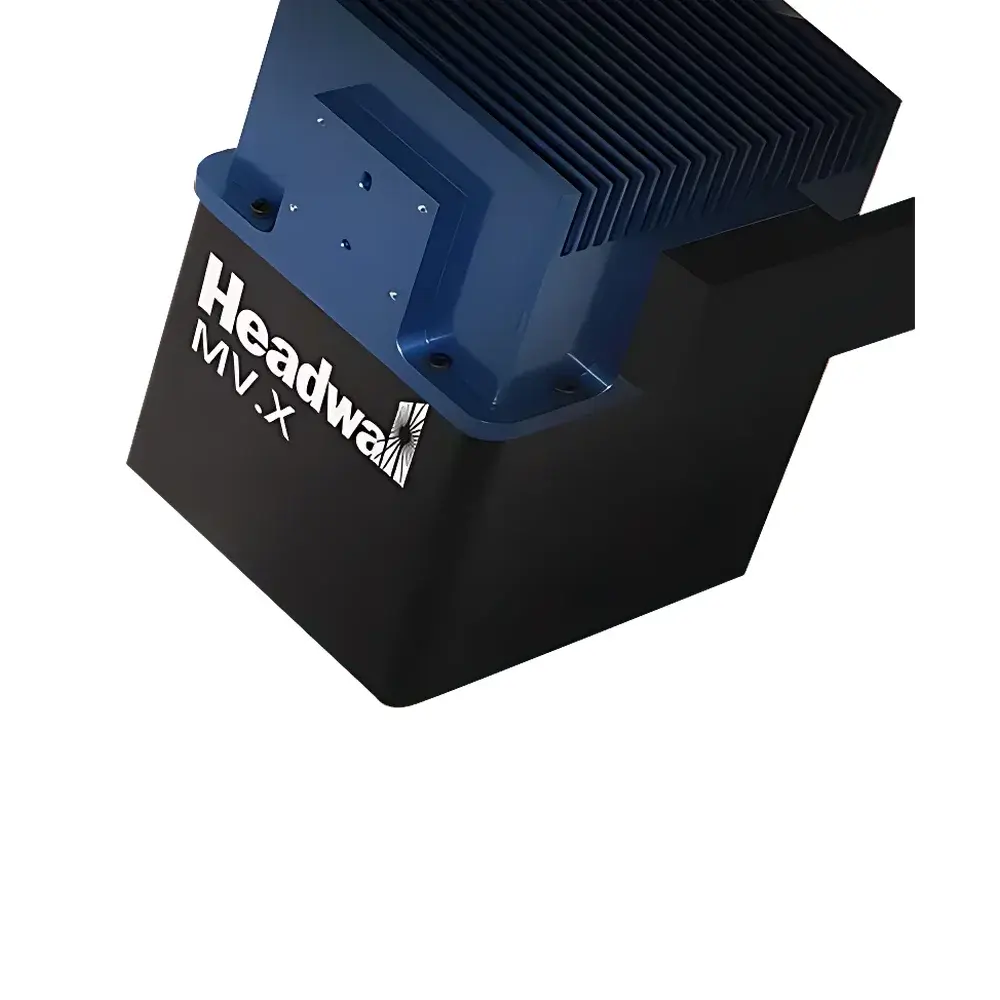
HeadWall Hyperspec MV.X Machine Vision Hyperspectral Imaging Spectrometer
| Brand | HeadWall |
|---|---|
| Origin | USA |
| Manufacturer Status | Authorized Distributor |
| Import Category | Imported |
| Model | Hyperspec MV.X |
| Price Range | USD 68,000 – 136,000 (estimated) |
| Operating Principle | Push-broom |
| Deployment Mode | Ground-based |
| Spectral Range | 400–1000 nm |
| Spectral Resolution (FWHM) | 6 nm |
| Spectral Bands | 342 |
| Spatial Pixels | 1024 |
| Weight | 4 kg |
| Memory/Storage | 8 GB RAM / 128 GB SSD |
| Ingress Protection Rating | IP67 |
Overview
The HeadWall Hyperspec MV.X is a ruggedized, push-broom hyperspectral imaging spectrometer engineered for machine vision integration in industrial and laboratory environments. It operates on the principle of spatial-spectral scanning—capturing contiguous spectral bands across a linear field of view while the sensor or sample moves orthogonally—enabling high-fidelity, frame-aligned spectral data cubes (x, y, λ). With a spectral range spanning 400–1000 nm and a nominal full-width-at-half-maximum (FWHM) resolution of 6 nm, the MV.X resolves 342 discrete spectral channels at 1024 spatial pixels per line. Its compact, sealed optical architecture—certified to IP67—ensures stable performance under vibration, dust, humidity, and temperature fluctuations common in production-floor or field-deployed settings. Unlike scanning-based or tunable-filter systems, the push-broom design delivers inherent radiometric consistency and eliminates temporal misregistration between spectral bands, making it suitable for real-time process monitoring where pixel-level spectral fidelity is critical.
Key Features
- Integrated onboard processing unit with 8 GB RAM and 128 GB SSD for real-time calibration, spectral cube generation, and edge-based analytics—no external PC required for basic operation.
- IP67-rated aluminum housing with thermal management optimized for continuous operation in ambient temperatures from −10 °C to +50 °C.
- Factory-calibrated radiometric response traceable to NIST standards; includes dark current, flat-field, and wavelength calibration coefficients embedded in metadata.
- Native GigE Vision and GenICam compliance for seamless integration into existing machine vision frameworks (e.g., HALCON, OpenCV, Common Vision Blox).
- Modular optical interface supporting interchangeable fore-optics (f/2.0 C-mount lenses) and optional integrated LED illumination modules (450 nm, 530 nm, 660 nm, or broadband white) synchronized via hardware trigger.
- Onboard FPGA enables real-time region-of-interest (ROI) extraction, band math, and threshold-based classification—reducing downstream bandwidth and latency.
Sample Compatibility & Compliance
The Hyperspec MV.X is designed for non-contact, reflectance-mode analysis of solid and semi-solid samples moving on conveyor belts, rotating trays, or stationary stages. It supports dynamic acquisition rates up to 300 lines per second (configurable), enabling inspection of objects traveling at speeds up to 2 m/s with sub-millimeter spatial sampling. The system complies with IEC 61000-6-2 (immunity) and IEC 61000-6-4 (emissions) for industrial electromagnetic environments. Data output adheres to standard HDF5 and ENVI-compatible BIL formats, ensuring interoperability with third-party chemometric platforms (e.g., MATLAB Statistics and Machine Learning Toolbox, Unscrambler X, Pirouette). While not a regulated medical device, its measurement stability and audit-ready metadata logging support GLP-aligned workflows in pharmaceutical quality control and food safety applications.
Software & Data Management
HeadWall’s SpectralView™ software suite provides full instrument control, spectral library management, and supervised/unsupervised classification tools (e.g., SAM, SID, K-Means, PLS-DA). All raw and processed data include embedded EXIF-style metadata: acquisition timestamp, GPS coordinates (when GNSS module is attached), exposure time, lens F-number, and calibration file version. For regulated environments, optional software add-ons enable 21 CFR Part 11-compliant user access controls, electronic signatures, and immutable audit trails. Raw spectral cubes are stored with lossless compression; processed classification masks export as binary TIFF or JSON-annotated GeoJSON for integration into MES or SCADA systems.
Applications
- Food processing: Detection of surface bruising, mold contamination, foreign material (e.g., plastic, rubber), and compositional grading (e.g., sugar content in fruits, fat marbling in meat).
- Pharmaceutical manufacturing: Verification of tablet coating uniformity, active pharmaceutical ingredient (API) distribution, and counterfeit detection via spectral fingerprint matching against reference libraries.
- Recycling sorting: Discrimination of polymer types (PET, HDPE, PVC) and identification of flame-retardant additives based on characteristic absorption features in the visible–NIR range.
- Agricultural product inspection: Assessment of grain viability, detection of mycotoxin-producing fungal infection, and estimation of chlorophyll and moisture content in leaves or harvested crops.
- Industrial quality assurance: Identification of paint mismatches, corrosion onset, or thermal degradation in composite materials using spectral slope analysis and derivative spectroscopy.
FAQ
Is the Hyperspec MV.X compatible with existing PLC-controlled production lines?
Yes—it supports hardware-triggered acquisition via opto-isolated TTL inputs and outputs, and exposes register-level control over Ethernet/IP and Modbus TCP for direct integration with Allen-Bradley, Siemens, and Beckhoff PLCs.
Can spectral libraries be updated in the field without software reinstallation?
Yes—SpectralView™ allows import/export of .sli library files; new classes can be trained on-site using acquired reference spectra and deployed to the onboard classifier via secure SFTP.
Does the system require periodic recalibration in factory environments?
No—factory-applied radiometric and spectral calibrations remain stable for ≥24 months under normal operating conditions; optional annual NIST-traceable recalibration services are available through HeadWall-certified labs.
What is the minimum detectable feature size on a moving conveyor?
At 30 cm working distance and f/2.0 optics, spatial sampling is ~0.3 mm/pixel; effective detection limit depends on contrast and spectral separability but typically resolves features ≥1.5 mm under standard illumination.
Is GPU acceleration supported for real-time classification?
Onboard processing uses FPGA-based logic; for GPU-accelerated deep learning inference (e.g., CNN models), the MV.X streams calibrated spectral data via GigE to an external workstation running NVIDIA CUDA-enabled frameworks.



