
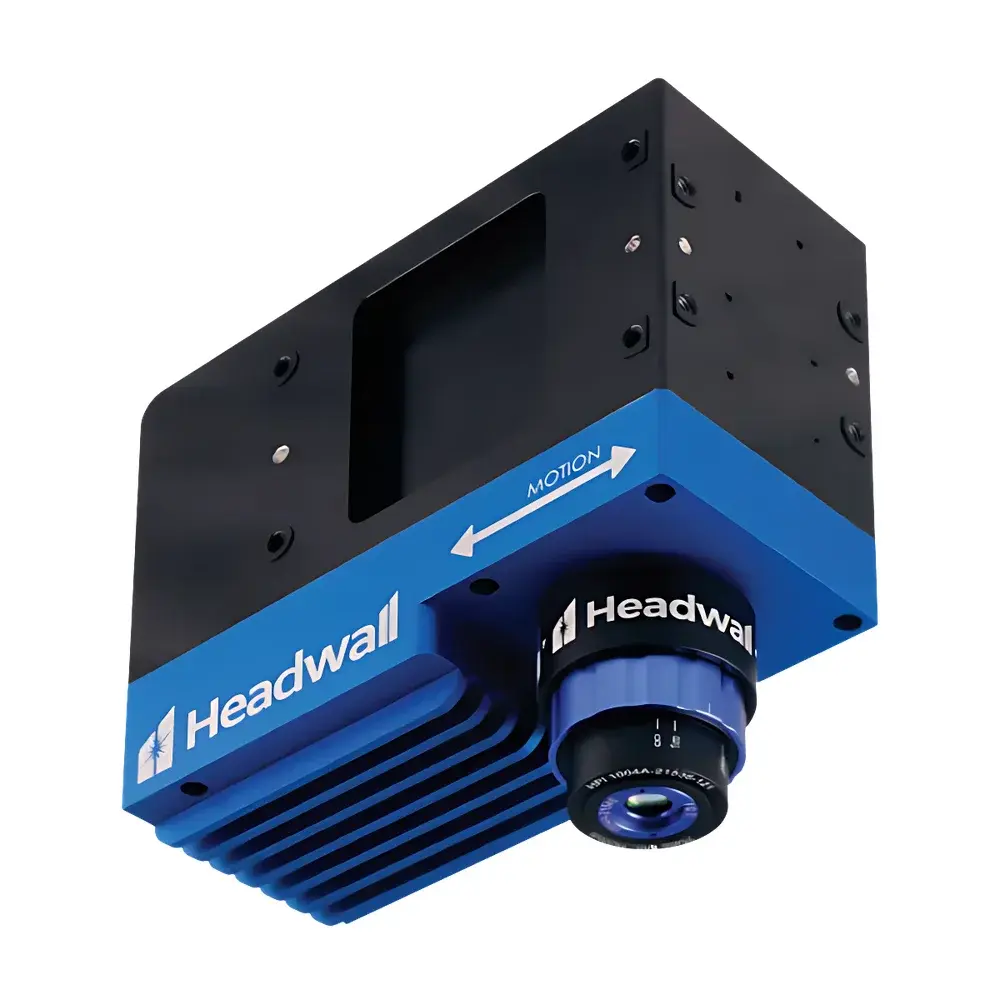
HeadWall MV.C NIR Compact OEM Hyperspectral Imaging Spectrometer
| Brand | HeadWall |
|---|---|
| Origin | USA |
| Manufacturer Type | Authorized Distributor |
| Import Status | Imported |
| Model | MV.C NIR |
| Pricing | USD $65,000–$105,000 (FOB USA) |
| Operating Principle | Push-broom |
| Imaging Method | Dispersive |
| Deployment Environment | Ground-based |
| Spectral Range | 900–1700 nm |
| Spectral Resolution | 7.5 nm (FWHM) |
| Spatial Resolution | 640 pixels × variable line length |
| Total Field of View (TFOV) | 25° |
| Frame Rate | 547 Hz |
| Spectral Channels | 213 |
| Sampling Interval / Dispersion | 3.75 nm/pixel |
| Optical Design | All-reflective, concentric aberration-corrected |
| Dimensions (w/o lens) | 130 × 170 × 70 mm |
| Weight (w/o lens) | 2.2 kg |
| IP Rating | IP54 |
| Software Compatibility | perClass® Mira® Suite, perClass API, eBUS SDK |
Overview
The HeadWall MV.C NIR is a compact, OEM-grade push-broom hyperspectral imaging spectrometer engineered for robust integration into industrial machine vision and inline quality control systems. Based on dispersive all-reflective optics with concentric aberration correction, it delivers high-fidelity spectral data without chromatic distortion across the near-infrared (NIR) band (900–1700 nm). Unlike refractive or hybrid optical architectures, its monolithic reflective design eliminates thermal drift and ensures long-term radiometric stability—critical for unattended operation in factory environments subject to vibration, temperature fluctuation, and dust exposure. The instrument acquires full hyperspectral cubes at 547 lines per second, supporting real-time material classification and quantitative analysis at production-line speeds. Its native 640-pixel spatial resolution and 213 spectral channels (3.75 nm/pixel sampling interval) provide sufficient spectral fidelity for detecting subtle chemical signatures—such as C–H, O–H, and N–H overtone and combination bands—enabling non-contact, label-free assessment of composition, moisture content, fat distribution, and contaminant presence.
Key Features
- All-reflective concentric optical design: Eliminates chromatic aberration and thermal sensitivity; enables stable calibration over extended operational cycles.
- Compact form factor (130 × 170 × 70 mm) and low mass (2.2 kg w/o lens): Facilitates mounting on robotic arms, conveyor-integrated gantries, and space-constrained inspection stations.
- IP54-rated enclosure: Protects internal optics and detector against dust ingress and water splashing—certified for deployment in food processing, chemical manufacturing, and agricultural sorting facilities.
- Native push-broom architecture with 547 Hz line rate: Synchronizes seamlessly with encoder-triggered motion systems for precise spatial registration in continuous-web or moving-belt applications.
- OEM-ready interface support: Fully compatible with eBUS SDK (GenICam-compliant) and perClass API, enabling direct integration into custom PLC-controlled vision platforms and Industry 4.0 data pipelines.
- Calibration traceability: Factory-calibrated with NIST-traceable reference sources; supports user-performed radiometric and spectral recalibration using certified reflectance standards (e.g., Spectralon®).
Sample Compatibility & Compliance
The MV.C NIR is optimized for ground-based, macro-scale analysis of heterogeneous solid and semi-solid samples—including raw and processed meats, polymer granules, pharmaceutical tablets, baked goods, and bulk agricultural commodities. It requires no sample preparation beyond standard conveyor-based presentation and operates under ambient lighting or controlled LED illumination (940 nm, 1050 nm, and 1550 nm bands recommended for optimal SNR). The system complies with IEC 61000-6-2 (immunity) and IEC 61000-6-4 (emissions) for industrial environments. Data acquisition workflows align with GLP and GMP documentation requirements when paired with validated perClass Mira® software; audit trails, user access controls, and electronic signatures satisfy FDA 21 CFR Part 11 readiness criteria when deployed in regulated food safety or pharma QA/QC settings.
Software & Data Management
The MV.C NIR interfaces natively with HeadWall’s perClass Mira® software suite—a modular platform designed for hyperspectral data preprocessing, multivariate modeling (PCA, PLS-DA, SVM), and deployment of classification/regression models to edge hardware. Raw data is output in standard ENVI .hdr/.bin format and HDF5, ensuring interoperability with MATLAB, Python (scikit-learn, hylite), and commercial chemometrics packages. The perClass API provides RESTful endpoints and C++/C# bindings for embedding spectral analytics directly into SCADA or MES systems. All firmware updates, spectral library management, and ROI-based region-of-interest extraction are performed via encrypted HTTPS sessions. Metadata—including timestamp, GPS (when externally synchronized), exposure settings, and environmental sensor inputs—is embedded in every acquired cube per ISO 12234-2 (TIFF/EP) conventions.
Applications
- Meat grading and adulteration detection: Quantification of intramuscular fat (marbling), moisture content, and myoglobin oxidation state via 970 nm, 1210 nm, and 1450 nm absorption features.
- Pharmaceutical tablet coating uniformity: Thickness and compositional homogeneity assessment using 1100–1300 nm spectral windows sensitive to polymer binder distribution.
- Polymer sorting and recycling: Discrimination of PET, HDPE, PP, and PVC based on unique C–H stretching harmonics between 1650–1700 nm.
- Food moisture mapping: Spatially resolved water content estimation in cereal grains, nuts, and dried fruits using 1450 nm and 1940 nm absorption bands.
- Chemical spill identification: Rapid field classification of hydrocarbon residues, solvents, and cleaning agents on stainless-steel or concrete surfaces.
FAQ
Is the MV.C NIR suitable for outdoor or airborne deployment?
No—it is rated for ground-based, fixed-mount industrial use only. Its IP54 rating and thermal design do not support UAV integration or direct solar exposure; for aerial applications, HeadWall recommends the Nano-Hyperspec® series.
Can spectral calibration be performed onsite by the end user?
Yes. The instrument supports user-executed wavelength and radiometric recalibration using optional NIST-traceable tungsten-halogen and diffuse reflectance standards, with procedures documented in the OEM Integration Manual Rev. 3.2.
What frame grabber hardware is required for full-speed operation?
A CoaXPress 2.0 (CXP-6) frame grabber with ≥2-lane interface and PCIe Gen3 x8 host bandwidth is required to sustain 547 Hz line rate with full 640 × 213 data throughput.
Does the system include factory spectral response characterization?
Yes. Each unit ships with a unique spectral response function (SRF) matrix measured at 1 nm intervals across 900–1700 nm, provided in CSV and HDF5 formats for radiometric correction in downstream analysis.
How is geometric distortion corrected in acquired data?
The concentric optical design inherently minimizes keystone and smile distortion; residual spatial nonlinearity is corrected via per-pixel lookup tables (LUTs) generated during factory calibration and applied in real time by the eBUS driver stack.
Related Products





