
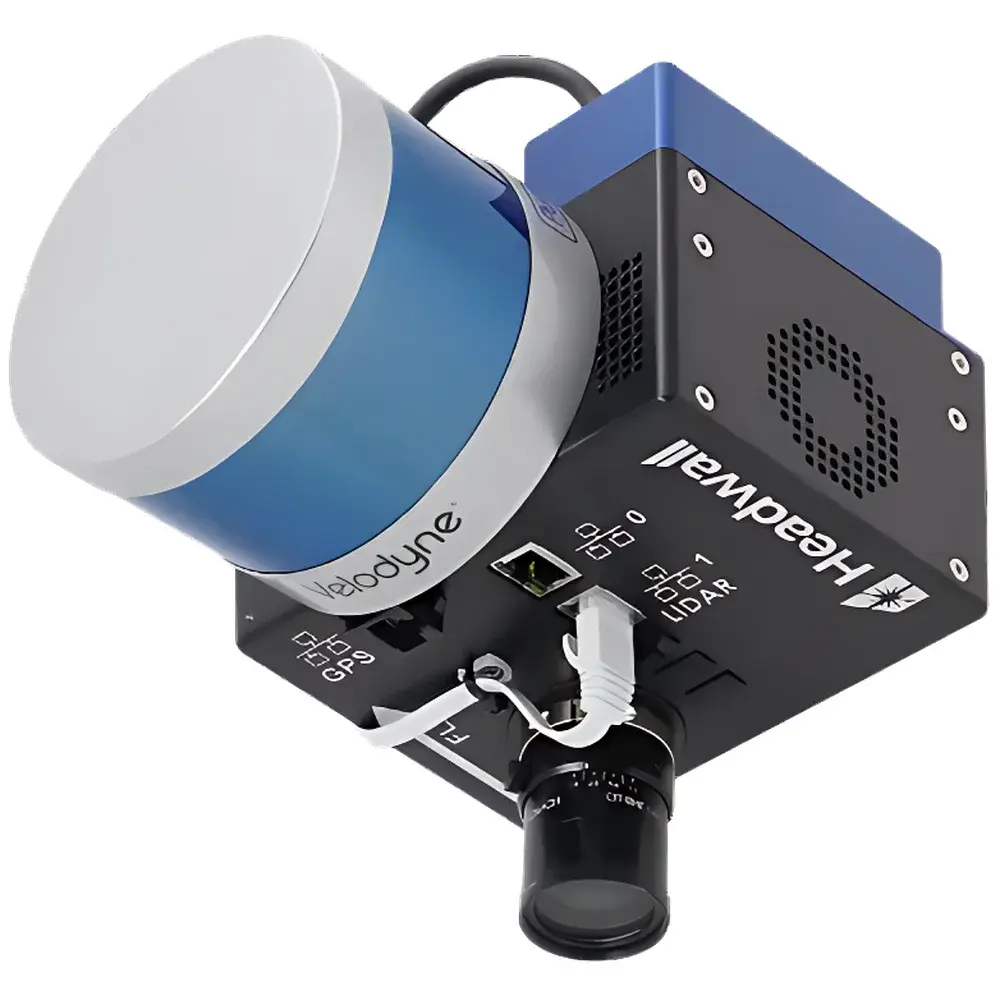
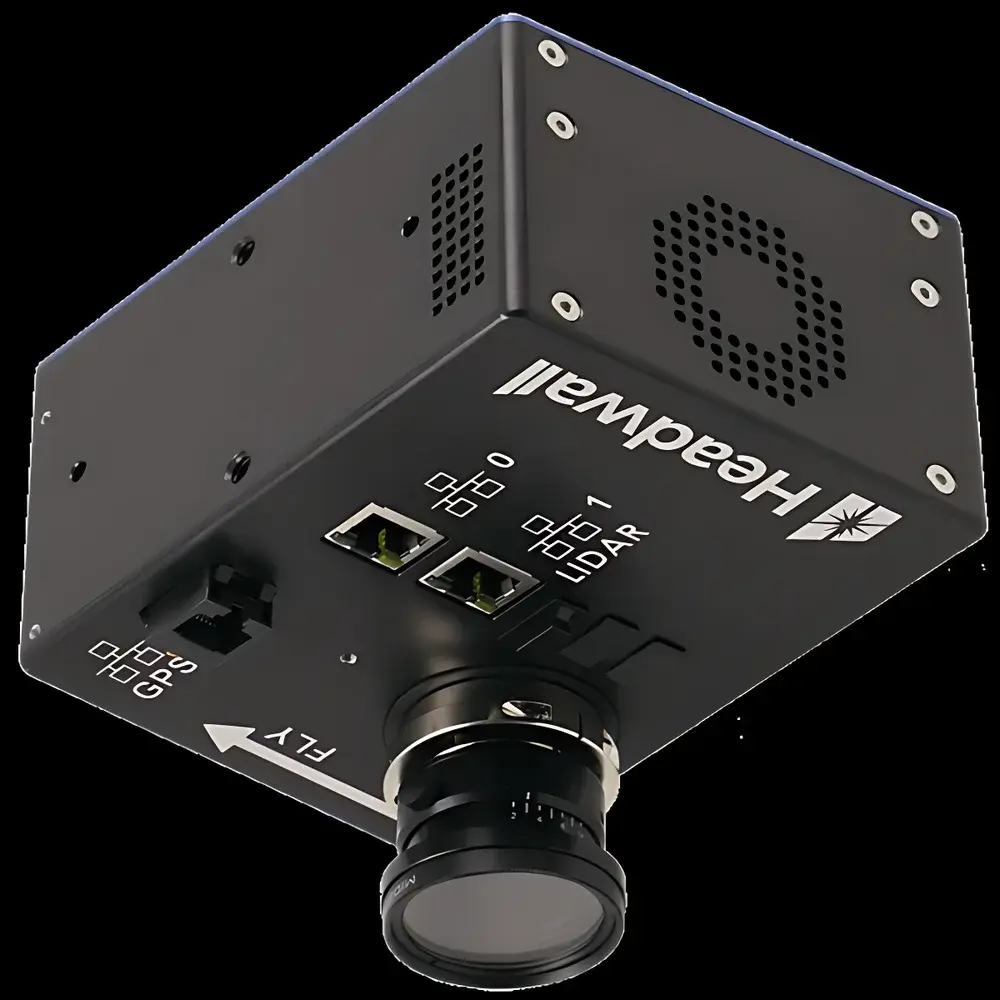
HeadWall Nano HP Ultra-Compact Airborne Hyperspectral Imaging Spectrometer
| Brand | HeadWall |
|---|---|
| Origin | USA |
| Model | Nano HP |
| Imaging Principle | Push-broom |
| Operational Modes | Airborne & Ground-based |
| Spectral Range | 400–1000 nm |
| Spectral Resolution (FWHM) | 6 nm |
| Spatial Pixels | 1020 |
| Spectral Bands | 342 |
| Onboard Storage | 480 GB |
| Weight (without LiDAR) | 1.0 kg |
| Weight (with 16-line LiDAR) | 1.7 kg |
| Optical Design | All-reflective concentric optics with holographic grating |
| Optional Accessories | Integrated 16-line LiDAR, Motorized Rotation Mount |
Overview
The HeadWall Nano HP Ultra-Compact Airborne Hyperspectral Imaging Spectrometer is a rigorously engineered push-broom hyperspectral imager designed for high-fidelity spectral data acquisition in resource-constrained platforms—particularly small UAVs, light aircraft, and ground-based mobile or tripod-mounted survey systems. Operating across the visible to near-infrared (VNIR) spectrum (400–1000 nm), the Nano HP captures contiguous spectral bands at a nominal full-width-at-half-maximum (FWHM) resolution of 6 nm, enabling discrimination of subtle spectral signatures associated with vegetation biochemistry, mineral composition, water quality constituents (e.g., chlorophyll-a, suspended solids, CDOM), and surface material properties. Its all-reflective concentric optical architecture eliminates chromatic aberration and ensures diffraction-limited performance across the entire spectral range—critical for radiometric consistency and inter-scene comparability. The system employs a high-stability, thermally compensated holographic grating and precision-aligned off-axis parabolic mirrors to maintain spectral fidelity under dynamic flight conditions. Unlike snapshot or tunable-filter systems, the push-broom geometry provides per-pixel spectral sampling directly from raw detector output—preserving native signal-to-noise ratio and eliminating interpolation artifacts.
Key Features
- Ultra-compact form factor: 1.0 kg mass (excluding LiDAR), optimized for Class I/II UAV integration without payload compromise
- Onboard 480 GB solid-state storage with real-time data buffering—enables >90 minutes of continuous hyperspectral video capture at full spatial-spectral resolution
- Thermally stabilized optical bench with passive athermalization—ensures spectral calibration stability across −10 °C to +50 °C ambient operating range
- Native synchronization interface (TTL + PPS) for precise time-tagging with GNSS/IMU units and optional LiDAR systems
- Modular accessory support: seamless integration with 16-line scanning LiDAR for co-registered 3D point cloud + hyperspectral cube fusion; motorized rotation mount enables rapid reconfiguration between airborne nadir imaging and ground-based oblique or panoramic scanning
- Firmware-upgradable architecture supporting future spectral binning modes, region-of-interest (ROI) readout, and onboard radiometric correction algorithms
Sample Compatibility & Compliance
The Nano HP is not sample-contacting; it acquires reflected or emitted electromagnetic radiation from external targets at standoff distances ranging from 1 m (ground mode) to 500 m (low-altitude UAV operation). It complies with IEC 61000-6-3 (EMC emission limits) and MIL-STD-810G environmental ruggedness standards for vibration, shock, and thermal cycling. Data outputs conform to ENVI-compatible BIL/BIP formats with embedded GeoTIFF georeferencing metadata (via integrated GNSS/IMU or post-processed bundle adjustment). The system supports traceable calibration workflows aligned with ASTM E2795 (Standard Practice for Calibration of Hyperspectral Imaging Systems) and ISO 17025-accredited laboratory validation protocols when used with NIST-traceable reflectance standards.
Software & Data Management
HeadWall’s SpectralView™ software suite provides end-to-end workflow management—from mission planning and real-time preview to radiometric calibration (dark current subtraction, flat-field correction, spectral response normalization), geometric orthorectification, and spectral library matching. All raw and processed datasets include embedded audit trails compliant with FDA 21 CFR Part 11 requirements for electronic records and signatures. Export options include HDF5 (for MATLAB/Python interoperability), GeoJSON vector overlays, and CSV spectral profiles per pixel or ROI. Integration with QGIS, ArcGIS Pro, and ENVI is supported via open API (RESTful endpoints and Python SDK).
Applications
- Agricultural monitoring: Crop health assessment (NDVI, PRI, MCARI), nitrogen status mapping, disease detection (e.g., rust, mildew) via spectral absorption features at 550 nm, 700 nm, and 970 nm
- Forestry inventory: Species classification, canopy structure analysis, post-fire regeneration tracking using red-edge and NIR slope metrics
- Inland and coastal water quality: Quantification of turbidity, chlorophyll-a concentration, phycocyanin (cyanobacteria), and dissolved organic carbon through inversion of semi-analytical radiative transfer models
- Environmental compliance: Detection of hydrocarbon spills, mine tailings leachate, and heavy metal–induced vegetation stress gradients
- Satellite vicarious calibration: High-accuracy ground truth spectra for cross-sensor validation of Sentinel-2, Landsat 9, and PRISMA missions
- Geological surveying: Identification of clay minerals (kaolinite, smectite), iron oxides, and carbonate deposits via diagnostic absorption features in the 700–2500 nm region (when coupled with extended-range sensors)
FAQ
What is the minimum flying altitude for stable spectral data acquisition?
For optimal ground sampling distance (GSD) and SNR, we recommend altitudes ≥30 m in UAV mode; lower altitudes are feasible with motion compensation enabled.
Does the Nano HP support real-time onboard processing?
It performs real-time radiometric preprocessing (dark/flat correction); advanced analytics (e.g., endmember extraction, classification) are executed post-flight in SpectralView™ or third-party platforms.
Is factory recalibration required annually?
Yes—annual recalibration against NIST-traceable standards is recommended to maintain spectral accuracy within ±0.5 nm and radiometric linearity within ±2% across the 400–1000 nm range.
Can the system operate in low-light conditions?
The Nano HP is optimized for daylight illumination (solar irradiance >200 W/m²/nm at 550 nm); twilight operation is possible with exposure time extension but may reduce SNR below actionable thresholds.
How is geometric distortion corrected?
Distortion is minimized by the concentric optical design (<0.1% pincushion/barrel); residual effects are removed during orthorectification using integrated GNSS/IMU data and digital elevation models (DEMs).




