
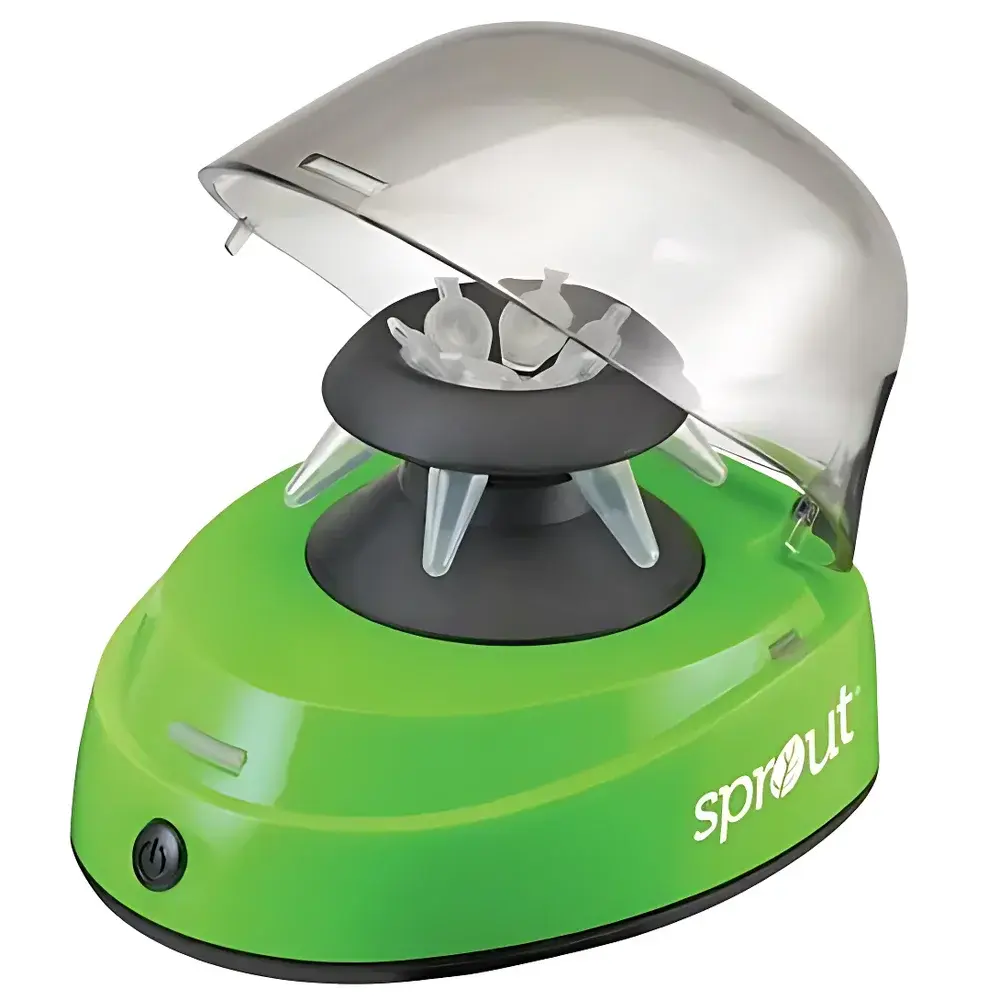
Heathrow Scientific Sprout Mini Centrifuge
| Brand | Heathrow Scientific |
|---|---|
| Origin | USA |
| Model | Sprout |
| Type | Palm-Sized Centrifuge |
| Max Speed | 6000 rpm |
| Max RCF | 2000 × g |
| Max Capacity | 6 × 1.5 mL |
| Dimensions | 153 × 108 × 124 mm |
| Rotor Types | Fixed-angle rotor (6-position, 1.5 mL), with included adapters for 0.2 mL and 0.5 mL tubes, plus 16-position 0.2 mL strip-tube rotor |
| Safety Certifications | CE, cETL, ETL |
| Motor | Brushless DC motor |
| Operating Modes | Push-button start & lid-actuated start |
| Lid Interlock | Automatic rotor stop upon lid opening |
| Noise Level | <45 dB(A) |
| Compliance | Designed for GLP-compliant laboratories |
Overview
The Heathrow Scientific Sprout Mini Centrifuge is a compact, brushless DC-powered palm centrifuge engineered for rapid, reproducible microcentrifugation in resource-constrained or high-throughput laboratory environments. Utilizing fixed-angle rotor geometry and precise rotational control, it delivers consistent sedimentation forces up to 2000 × g at 6000 rpm—sufficient for pelleting cellular debris, precipitating nucleic acids, concentrating proteins, and clarifying small-volume biological samples (e.g., PCR products, enzyme reactions, cell lysates). Its footprint—smaller than an A5 sheet—enables seamless integration on crowded benchtops, biosafety cabinets, or mobile lab carts without compromising mechanical stability or thermal management. Unlike brushed-motor centrifuges, the Sprout’s maintenance-free motor eliminates carbon dust contamination risks and ensures long-term torque consistency across repeated start-stop cycles—a critical factor in applications requiring frequent, short-duration spins.
Key Features
- Brushless DC motor with thermal overload protection and dynamic braking—ensures stable speed delivery and extends service life beyond 10,000 operating hours.
- Intelligent lid interlock system: rotor halts within <0.5 seconds upon lid opening, meeting IEC 61010-1 safety requirements for Class II equipment.
- Dual activation modes: push-button initiation for timed runs (0–99 seconds, default 30 s), and automatic start/stop triggered by lid closure—optimized for single-hand operation during multi-step protocols.
- Optically transparent polycarbonate lid with UV-stabilized acrylic coating provides real-time visual monitoring while blocking >99% of ambient UV radiation that could degrade light-sensitive samples.
- Acoustically damped housing reduces operational noise to ≤45 dB(A) at 1 m distance—suitable for open-plan labs and quiet environments such as core facilities and teaching laboratories.
- Pre-calibrated rotor assembly with traceable certification; no user calibration required—complies with ISO 15197:2013 verification principles for routine instrument performance checks.
Sample Compatibility & Compliance
The Sprout accommodates standard microcentrifuge tube formats including 0.2 mL PCR strips (16-position rotor), 0.5 mL and 1.5 mL conical tubes (via included dual-fit adapters), and 2.0 mL tubes (with optional adapter kit). All rotors are balanced to ISO 21501-4 specifications and rated for continuous operation at maximum speed. The device meets electromagnetic compatibility (EMC) and low-voltage directive standards per EN 61326-1 and EN 61000-6-3, and carries CE, cETLus, and ETL marks—validating conformity with North American and European regulatory frameworks. While not classified as a medical device, its construction materials (FDA-compliant polypropylene rotor, USP Class VI-certified housing polymers) support use in clinical research settings adhering to CLIA and CAP guidelines.
Software & Data Management
The Sprout operates as a standalone instrument with no embedded firmware or digital interface—intentionally designed to eliminate cybersecurity vulnerabilities, reduce validation burden, and ensure uninterrupted function during power fluctuations or network outages. For laboratories implementing electronic lab notebooks (ELNs) or LIMS, manual entry of run parameters (speed, duration, rotor ID) satisfies 21 CFR Part 11 requirements when paired with procedural documentation and operator sign-off. Optional barcode-labeled rotor kits enable traceability in GMP-aligned workflows where rotor usage history must be retained for ≥2 years.
Applications
- Routine clarification of bacterial and mammalian cell lysates prior to SDS-PAGE or Western blotting.
- Spin-down of enzymatic reaction mixtures (e.g., restriction digests, ligations, phosphorylations) to minimize carryover contamination.
- Concentration of dilute DNA/RNA samples from column eluates or phenol-chloroform extractions.
- Pre-centrifugation of capillary tubes in hematocrit assays or microfluidic sample prep.
- Field-deployable centrifugation in point-of-care diagnostics, veterinary clinics, and environmental sampling stations.
- Student training in molecular biology techniques—robust design withstands repeated classroom handling without calibration drift.
FAQ
Is the Sprout suitable for centrifuging blood samples?
Yes—when used with certified 1.5 mL microtubes, it effectively separates serum or plasma from whole blood at 2000 × g for 30 seconds. However, it is not intended for high-speed separation of packed cell volume (PCV) or platelet-rich plasma (PRP), which require refrigerated centrifuges with higher RCF and temperature control.
Can I use the Sprout in a cold room or incubator?
It is rated for operation between 10–40 °C and 20–80% non-condensing humidity. Prolonged use below 15 °C may affect rotor polymer elasticity; avoid condensation ingress by allowing thermal equilibration before startup.
Does the device include rotor balancing verification tools?
No balance weights or calibration discs are supplied, as the fixed-angle rotor is factory-balanced and tolerance-tested to ±0.5 g imbalance at full load—within ISO 15197:2013 acceptance limits for microcentrifuges.
What maintenance is required?
None beyond periodic wiping of the rotor chamber with 70% ethanol and inspection of lid seal integrity. The brushless motor requires no lubrication or brush replacement over its operational lifetime.
Is rotor interchangeability supported across Heathrow Scientific models?
No—Sprout rotors are mechanically and dimensionally unique to this model. Cross-model compatibility is intentionally excluded to prevent unsafe overspeed conditions or imbalance-induced vibration.



