
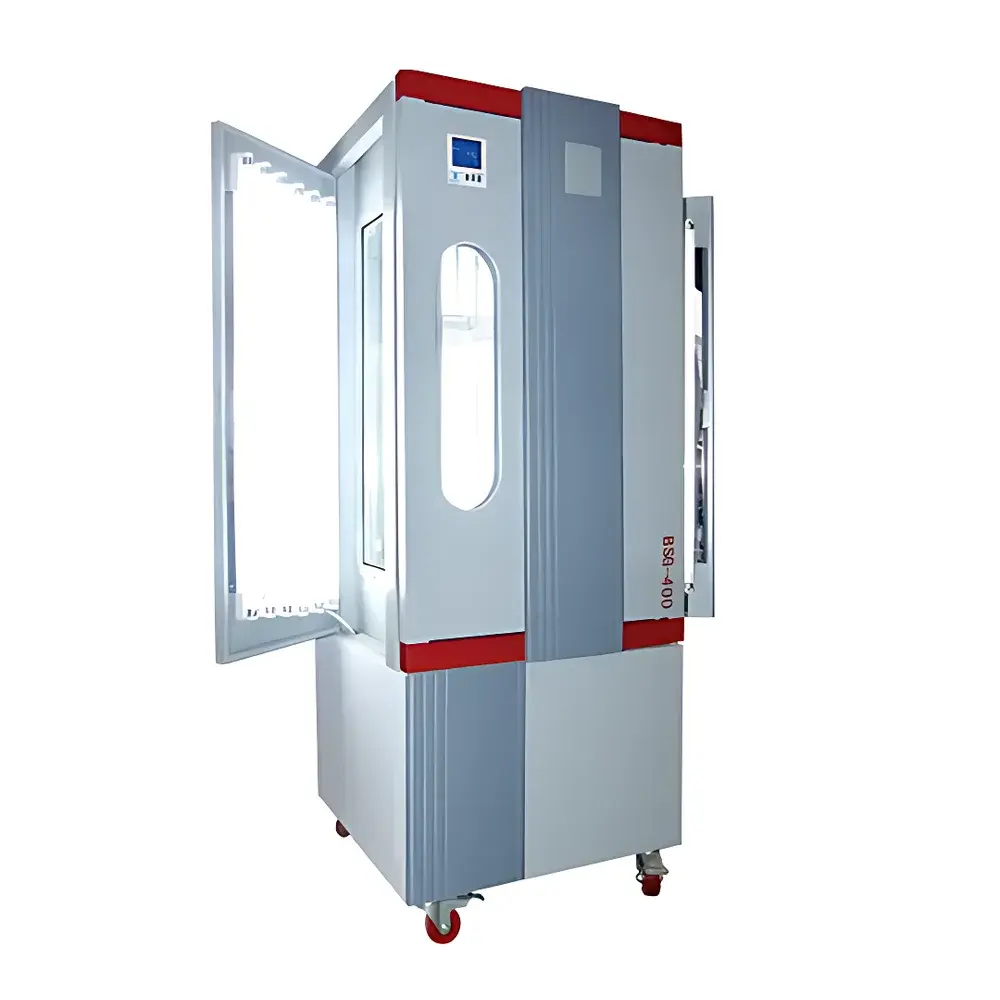
Hebei HOPU BSG-250 Photostability Chamber for Pharmaceutical Forced Degradation Testing
| Brand | Hebei HOPU |
|---|---|
| Origin | Shandong, China |
| Model | BSG-250 |
| Temperature Range (dark) | 0–60 °C |
| Temperature Range (light-on) | 10–60 °C |
| Temperature Resolution | 0.1 °C |
| Temperature Uniformity | ±1 °C |
| Temperature Fluctuation | ±0.5 °C |
| Illuminance Range | 0–15,000 lx (6 adjustable levels) |
| Input Power | 1300 W |
| Timer Range | 0–9999 min |
| Inner Dimensions (W×D×H) | 480×480×1100 mm |
| Outer Dimensions (W×D×H) | 710×775×1770 mm |
| Shelf Capacity | 4 adjustable stainless-steel shelves |
| Refrigerant | Eco-friendly non-CFC |
| Communication Interface | RS-485 |
Overview
The Hebei HOPU BSG-250 Photostability Chamber is an ICH Q1B-compliant environmental test system engineered for pharmaceutical forced degradation studies under controlled light exposure. It implements a dual-mode thermal management architecture—combining high-efficiency refrigeration with precision resistive heating—to maintain stable temperature conditions across the full operational range (0–60 °C in dark mode; 10–60 °C under illumination). The chamber integrates a calibrated, six-level adjustable LED or fluorescent light array delivering uniform irradiance up to 15,000 lx across the entire working volume, conforming to ICH Q1B Option 1 (UV/visible light source) and Option 2 (cool white fluorescent lamp) requirements. Its sealed, corrosion-resistant stainless-steel interior and laminar airflow design ensure minimal thermal gradient deviation (±1 °C uniformity) and reproducible photostress conditions critical for regulatory submissions to FDA, EMA, and PMDA.
Key Features
- Microprocessor-based PID temperature and illumination control with real-time LCD display of setpoint, actual value, elapsed time, and alarm status
- Integrated refrigeration system using eco-friendly non-CFC refrigerant and patented auto-defrost technology that eliminates thermal interruption during extended stability runs
- Three-dimensional lighting layout with reflective inner surfaces and optimized lamp positioning to achieve ≥90% spatial illuminance uniformity per ICH Q1B Annex 1 guidelines
- Four independently adjustable stainless-steel shelves with reinforced load-bearing capacity; shelf spacing configurable without tools
- RS-485 serial interface supporting Modbus RTU protocol for integration into centralized lab monitoring systems or LIMS
- Power-failure recovery function with non-volatile memory retaining all programmed parameters—including multi-segment cycles (up to 30 segments × 99 cycles)—and real-time clock synchronization
- Over-temperature cut-off protection with audible/visual alarm and automatic compressor shutdown to safeguard sample integrity
Sample Compatibility & Compliance
The BSG-250 accommodates standard pharmaceutical packaging formats including blister packs, amber vials (2–20 mL), HDPE bottles, and aluminum-laminated pouches. Its internal volume (250 L net) supports simultaneous placement of multiple ICH Q5C reference standards (e.g., riboflavin, chlorpromazine hydrochloride) alongside active pharmaceutical ingredients (APIs) and formulated products. The system complies with key regulatory frameworks: ICH Q1B (Photostability Testing of New Drug Substances and Products), USP (Stability Considerations in Dispensing Practice), and ISO 17025-accredited laboratory environmental control requirements. Optional GPRS remote alerting enables 24/7 monitoring of temperature excursions or lamp failure events—critical for GLP-compliant stability programs requiring audit-trail documentation.
Software & Data Management
The chamber operates natively via embedded firmware with no external PC dependency. All operational logs—including temperature, illuminance level, cycle phase, and alarm timestamps—are stored internally with 30-day rolling buffer capacity. When connected via RS-485 to a host computer running compliant data acquisition software (e.g., LabVIEW, WinCC, or custom SCADA), users can export CSV-formatted datasets with ISO 8601 timestamps and generate 21 CFR Part 11–compliant electronic records when paired with validated user authentication and audit trail modules. Optional thermal printer support enables on-demand hardcopy output of trend curves, confirming adherence to ALCOA+ principles (Attributable, Legible, Contemporaneous, Original, Accurate).
Applications
- ICH Q1B photostability screening of drug substances and products under UV and visible light stress
- Accelerated stability testing per ICH Q1A(R3) at elevated temperatures with concurrent light exposure
- Plant physiology research requiring precise photoperiodic control (e.g., seed germination kinetics, photomorphogenesis assays)
- Microbial culture maintenance under defined light–temperature regimes for phototrophic organisms
- Long-term storage validation of light-sensitive reagents, antibodies, and diagnostic kits
- Environmental simulation for material compatibility testing of primary packaging components
FAQ
Does the BSG-250 meet ICH Q1B Option 2 requirements for cool white fluorescent lamps?
Yes—the integrated lamp configuration and spectral output profile comply with ICH Q1B Annex 1 specifications for Option 2, including minimum irradiance (≥1.2 million lux·hr) and spectral distribution verification.
Can the chamber operate continuously for 30 days without manual intervention?
Yes—its robust compressor architecture, large-capacity water reservoir for humidity maintenance (when equipped), and non-interruptive auto-defrost system enable unattended operation across extended stability protocols.
Is calibration traceable to NIST or equivalent national metrology institutes?
Temperature and illuminance sensors are factory-calibrated using traceable reference standards; users receive a Certificate of Conformance with uncertainty values. Field recalibration services are available through authorized HOPU service centers.
What is the maximum allowable ambient room temperature for reliable operation?
For rated performance, ambient conditions should not exceed 30 °C and 60% RH. Operation above these limits may reduce cooling capacity and extend stabilization time.
How is humidity controlled, and is it required for photostability testing?
Humidity is maintained via PTC-heated finned evaporator tubes and a 5-L external reservoir. While ICH Q1B does not mandate humidity control for photostability, it is essential for combined light–temperature–humidity stress studies per ICH Q5C.




